Signed instruction · Elena Riverav
Trigger · Ovidrel 250 micrograms subcutaneous, once
PDT · Oct 30
Signed by Dr. Mira Lee · 17:10 PDT
v2 · 20:30 PDT · retrieval 07:30 PSTSuperseded · kept for history
Product preview · Fictional patient data
Stage 4 of 9
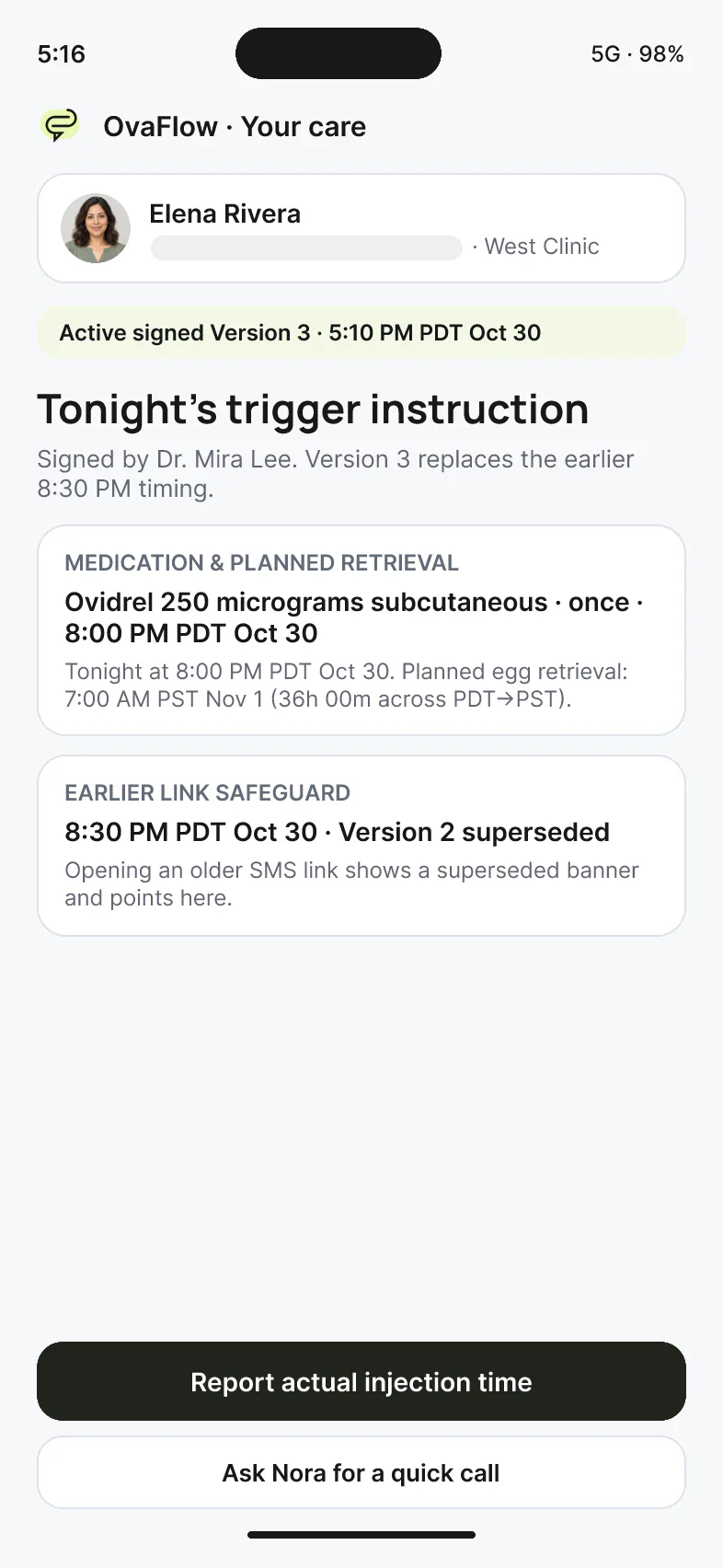
When leading follicles reach maturity, the trigger injection prompts final egg maturation so retrieval can take place about 35 to 36 hours later. In the fictional daily-care story, the signed instruction is Ovidrel 250 micrograms, subcutaneous, once at 20:00 PDT on Oct 30, with retrieval on Nov 1 at 07:00 PST: 36 hours apart across the daylight-saving change.
[ Signed change ]
At 17:10 PDT Dr. Mira Lee signs version 3 of Elena's trigger instruction. The old time stays visible but retired, and every commitment that depends on it is flagged for the person who owns it.
Trigger · Ovidrel 250 micrograms subcutaneous, once
PDT · Oct 30
Signed by Dr. Mira Lee · 17:10 PDT
v2 · 20:30 PDT · retrieval 07:30 PSTSuperseded · kept for history
Trigger to retrieval36h 00m
From 20:00 PDT October 30 to 07:00 PST November 1. Counted across the clock change at 02:00 on Nov 1. Every clinical decision stays with the care team.
From the daily-care walkthrough.Fictional patient data
Both sides
For the clinic team
OvaFlow tracks the signed trigger instruction across changes and the daylight-saving clock change, the right chart, the publication outcome, the patient's reported time, and who owns the evening callback.
For you and your family
A timed injection finishes egg maturation, so the retrieval about 36 hours later lines up.
Questions about your own treatment go to your care team. OvaFlow never gives medical advice. In an emergency, call 911.
Read the plain-language guide to IVFSee it
Recorded from an interactive design prototype. Every patient, clinician and clinic is fictional, and EMR screens are modeled reconstructions.
A late estradiol result, a newly signed trigger time, the wrong chart caught before publishing, and a lost confirmation checked rather than blindly resent.
Elena says she injected at 8:20, not 8:00. Her words are kept as she said them, the signed instruction stays as signed, and the evening callback changes hands only when Alex accepts it.
Beside a modeled Artisan view, the companion compares Dr. Priya Shah's approval with the unchanged Artisan fields, stops on Maya's open chart, and won't assume an update it didn't see.
Saving a trigger doesn't tell the patient or the lab. Portal distribution, the lab change order and a message that was read but not accepted are each tracked separately.
An old text link can't send Elena to a superseded injection time. Reporting a late dose is simple and honest, and urgent help is one tap away.
On the on-call phone, seeing a handoff isn't accepting it, declining leaves the original nurse responsible, and the physician's decision stays with the physician.
One signed change reaches instructions, the OR, anesthesia and the lab. Later an outside emergency visit for OHSS turns a planned fresh transfer into freeze-all.
The patient's phone and the clinic's workspace side by side, so each reassuring screen shows the safeguard behind it.
Handoffs and safeguards
These are the moments the design is built around. Each safeguard stops or holds work; the decision stays with the clinician or the lab.
Where it slips today
What holds in OvaFlow
Workflows here
Each row opens the capability. Point at, focus or scroll to a row to see it in a recording from this stage.
Stories
Fictional people, told end to end.
Step-by-step timing & questions
The trigger injection restarts meiosis for final oocyte maturation; its clock time locks in the operating room, anesthesia and embryology schedule 35 to 36 hours later—including across daylight-saving transitions.
Your clinic finalizes your trigger time: 8:00 PM on Oct 30, timed for retrieval at 7:00 AM on Nov 1 (36 hours across the clock change).
Dr. Mira Lee signs version 3 (20:00 PDT Oct 30 → 07:00 PST Nov 1 = 36h 00m); OR, anesthesia and lab commitments update together.
On your phone, version 3 appears first; tapping an older text link for 8:30 PM is blocked and redirected to 8:00 PM.
Wrong-chart stop blocks placement into Jordan Patel's open chart; after a network drop on Elena's chart, Nora checks the portal log before resending.
At 5:24 PM you ask a syringe question (kept as a question, not a dose); at 8:22 PM you honestly report injecting at 8:20 PM on Oct 30.
Patient-reported time (20:20 PDT, 35h 40m interval) is kept alongside the signed 20:00 PDT order without overwriting it.
You know who is calling you back tonight while your physician reviews the 20-minute timing difference.
Nora offers the callback at 20:26; on-call nurse Alex Kim, RN accepts at 20:28 while Dr. Mira Lee retains the clinical interval review.
What the patient sees
Elena sees '8:00 PM, Oct 30' on her companion screen, asks a pre-dose syringe question at 5:24 PM without marking the shot taken, and reports '8:20 tonight' at 8:22 PM.
What the clinic team sees
Clinician surfaces show 24-hour times: signed 20:00 PDT vs. reported 20:20 PDT (received 20:22 PDT), a 35h 40m interval to the 07:00 PST Nov 1 retrieval across the 02:00 fallback hour. Alex Kim accepts the nursing callback at 20:28 PDT.
Why it holds: Six safeguards work in sequence: wrong-chart stop, unknown-outcome hold, superseded-link block, report-kept-as-said, read-is-not-accept, and decline-keeps-owner.
What OvaFlow coordinates
What stays with clinicians & the EMR
Common questions at this stage
As SART and ESHRE guidelines explain, the trigger injection mimics or induces the luteinizing hormone surge that resumes oocyte meiosis and loosens the egg-cumulus complex from the follicle wall. Retrieving too early risks finding immature eggs that do not release from the follicle; waiting too long past 36–37 hours risks spontaneous ovulation before the procedure begins.
Sources: [5] ESHRE Guideline Group (2026) · [6] SART Patient Guide (2026)
When clocks fall back from Daylight Time (PDT) to Standard Time (PST) at 02:00 on Sunday morning, an extra elapsed hour occurs between Saturday evening and Sunday morning. If a schedule calculates '36 hours' by wall-clock arithmetic without timezone-offset awareness, retrieval can be booked at 37 elapsed hours. OvaFlow displays both wall-clock times with timezone labels and the true elapsed duration (36h 00m).
Sources: [6] SART Patient Guide (2026) · [18] ONC SAFER Guides (2025)
Clinicians need both facts: what was prescribed and signed by the physician (20:00 PDT) and what the patient actually experienced and reported (20:20 PDT, received 20:22 PDT). Keeping both timestamps side by side lets the physician see the exact 35h 40m interval and decide whether the 07:00 PST retrieval slot still holds.
Sources: [6] SART Patient Guide (2026) · [18] ONC SAFER Guides (2025)
Reading a notification never transfers ownership. Until the receiving on-call nurse taps Accept—or if they tap Decline—responsibility remains visibly with the sending nurse so the patient's evening callback never falls between shifts.
Sources: [18] ONC SAFER Guides (2025)
Along the spine
Plans can change at almost any point. See how a change of plan is handled.
See it with your team
We'll go through the prototype walkthroughs for this stage and the questions your team would ask first.