Daily care: a changed trigger, the wrong chart and an unknown outcome
A late estradiol result, a newly signed trigger time, the wrong chart caught before publishing, and a lost confirmation checked rather than blindly resent.
Product preview · Fictional patient data
Platform
OvaFlow is a coordination companion designed to work beside the EMR a clinic already runs. Each piece of IVF work stays tied to its signed source, one responsible person and the next action, and nothing counts as done until the clinic's EMR shows it. Staff make every clinical decision.
One evening · Elena Rivera
From a signed change to an accepted owner
Four modes
Each mode has its own label and its own controls, so nobody has to guess whether OvaFlow changed the record. Most work stops at preparing and checking.
OvaFlow shows what the EMR record says, beside the chart. Nothing in the EMR changes.
In the first pilotA draft is prepared from the current signed source and waits for a person to review it.
In the first pilotAn authorized person finishes the step in the clinic's own system. OvaFlow then checks the outcome and labels who did it.
In the first pilotOnly for a specific operation a clinic has tested, and every write is read back before it counts.
Tested in your clinic firstCapabilities
Every capability uses the same source, owner and next-step model. Scroll, hover or tab through the list to watch each one in a prototype walkthrough.
Surfaces
Desktop, phone, watch and widgets show the same statuses in the same words. The patient companion shows only what the care team has signed.
Why this matters in clinic
An ovarian stimulation or embryo transfer episode spans dozens of time-critical handoffs across physicians, monitoring nurses, procedure nurses, anesthesia, embryology, financial clearance and the patient at home. Published patient-safety studies show that outpatient test results lack timely documented follow-up in 6.8% to 62% of laboratory panels [1], while unstructured shift handoffs leave action items unowned until structured closed-loop programs (such as I-PASS) reduce medical errors by 23% and preventable adverse events by 30% [2].
Even when electronic alerts are delivered and opened, read receipts frequently fail to produce clinical follow-through—and broadcasting the same alert to two clinicians at once can reduce action because each assumes the other handled it [3]. OvaFlow sits beside your existing EMR as a dedicated coordination layer: it keeps every instruction tethered to its signed EMR revision, assigns exactly one current owner per scope, and requires readback verification before marking any send complete [4].
Patient portal instruction
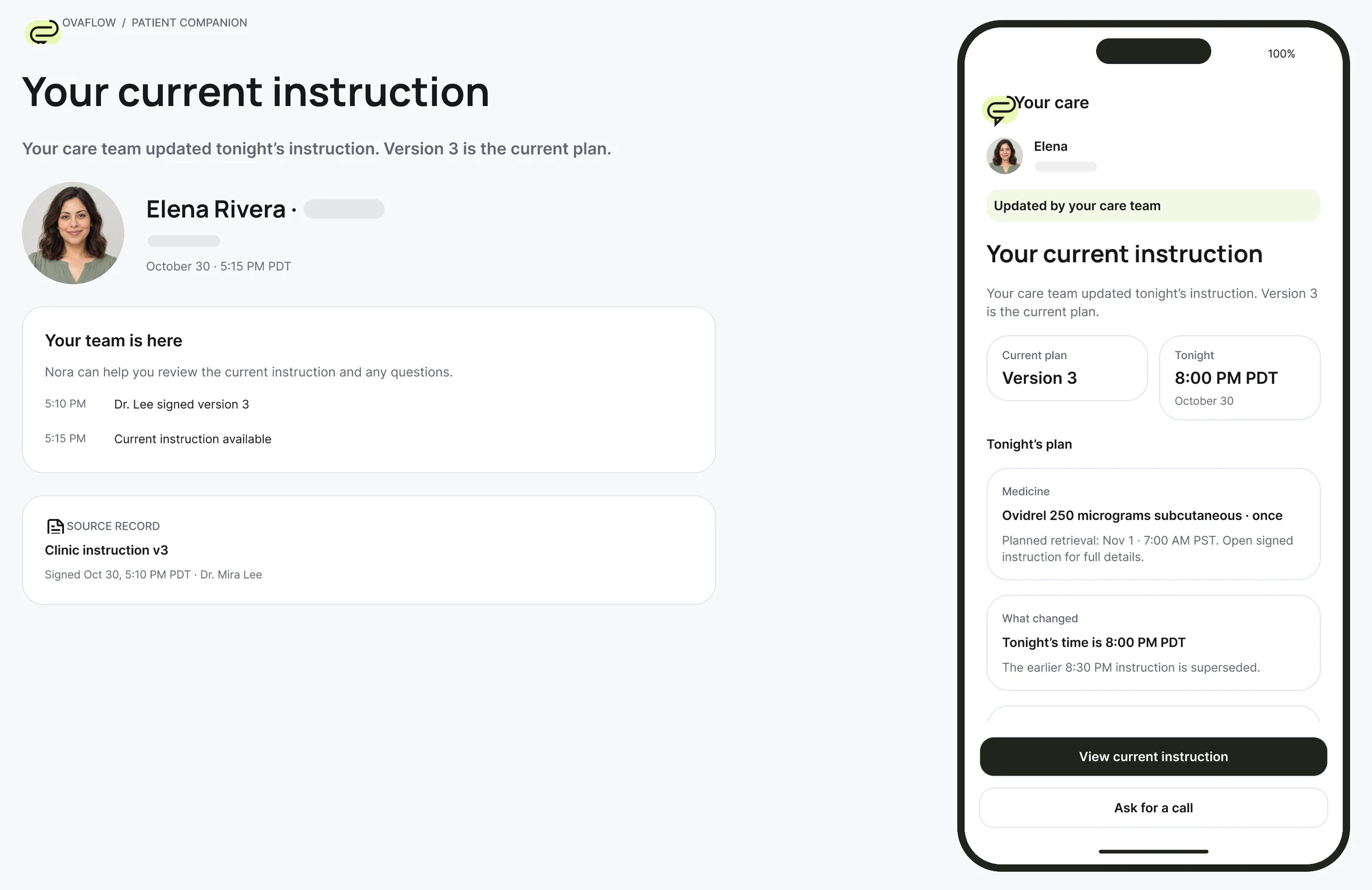
Nora Ruiz, RN publishes version 3 (8:00 PM, Oct 30) in the portal. Older version 2 text links redirect to version 3.
One matching publication verifiedOperating room & anesthesia slot
Tracks explicit re-commitment from procedure scheduling and anesthesia for the 07:00 PST retrieval slot.
Whole-team commitment trackedDish prep & lab readiness
Updates lab preparation timing for Elena’s retrieval while keeping specimen witnessing inside the lab’s own system.
Aligned to version 3 source8:20 PM dose report & handoff
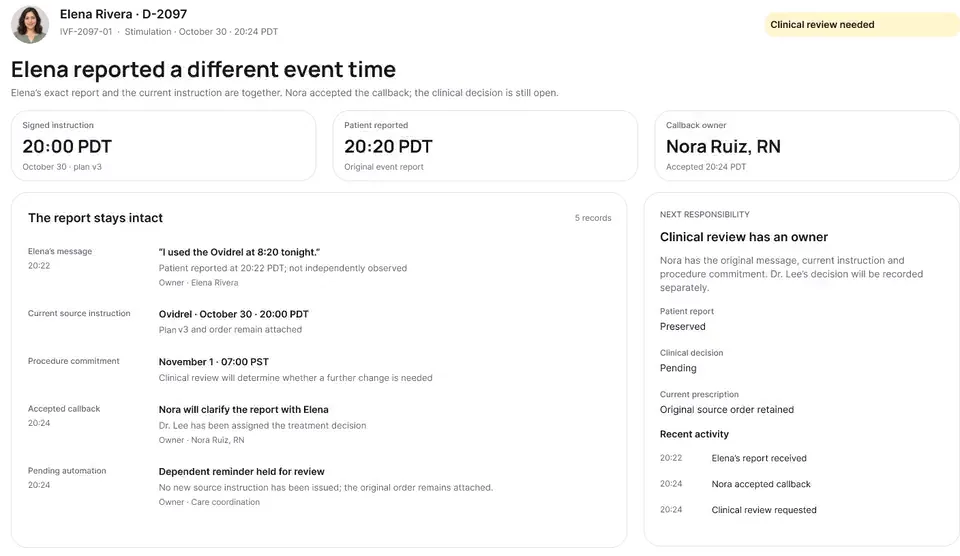
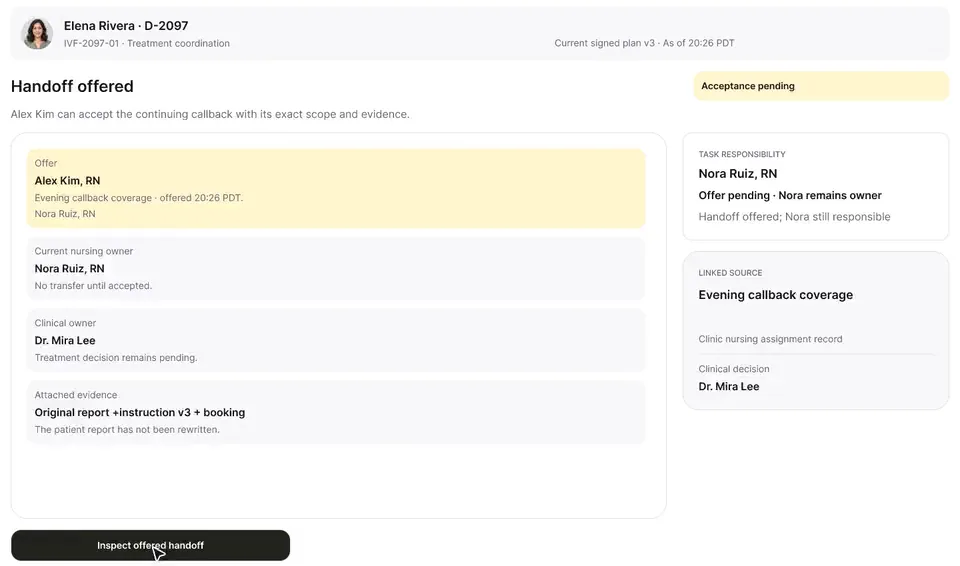
Elena reports injecting at 20:20 PDT (received 20:22 PDT). Alex Kim, RN accepts the callback at 20:28 PDT; Dr. Mira Lee reviews the 20-minute difference.
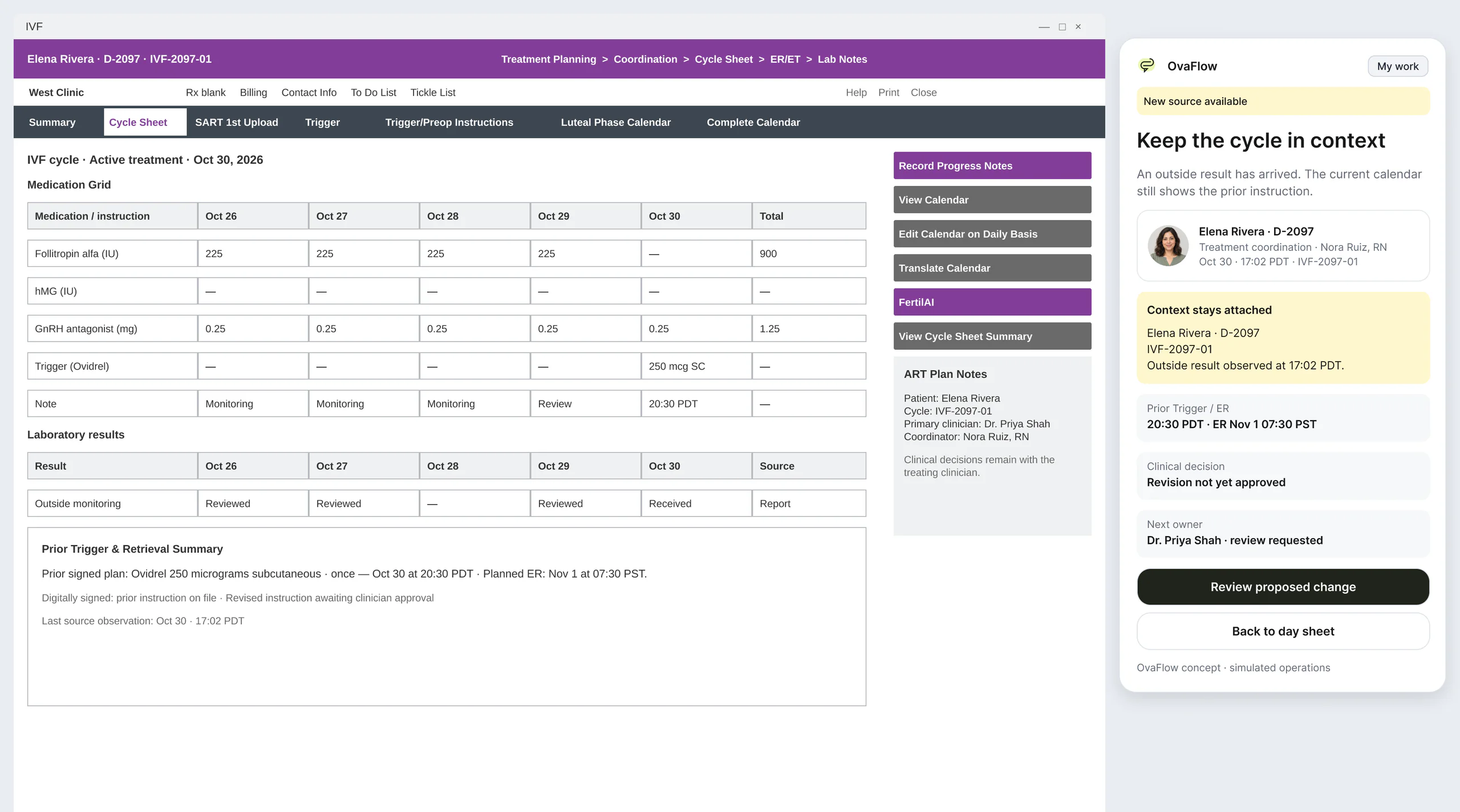
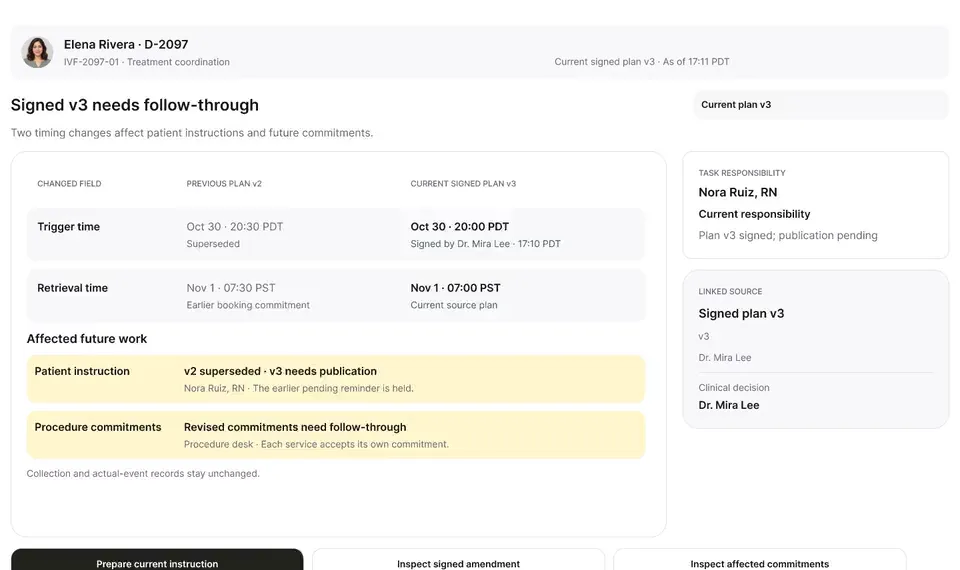
Clinical review pending (Dr. Mira Lee)After reviewing Elena Rivera’s Cycle Day 11 estradiol (2,840 pg/mL) and ultrasound, Dr. Mira Lee signs version 3 moving the trigger shot from 20:30 PDT to 20:00 PDT on Oct 30 for a Nov 1, 07:00 PST retrieval (36 hours across the PDT-to-PST clock change). OvaFlow retires version 2 and opens four linked tasks: patient instruction, procedure slot, anesthesia hold, and lab prep.
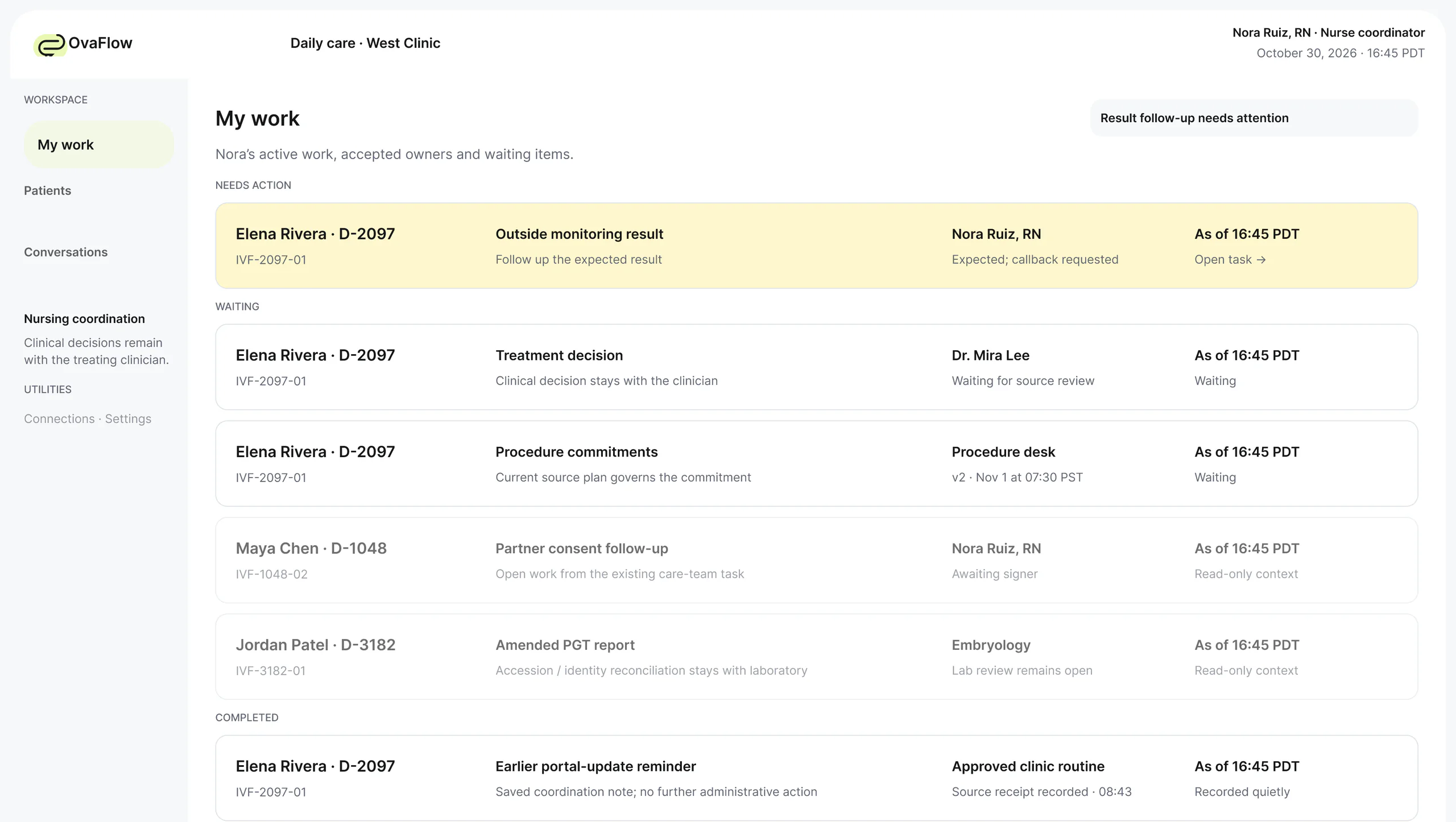
Nora Ruiz, RN reviews the prepared version 3 instruction beside Elena’s chart, publishes it in the clinic portal, and waits for OvaFlow to read back the matching published record. Closing the portal publication leaves the procedure, anesthesia, lab, and evening callback obligations open.
Elena taps an older version 2 text notification on her phone; OvaFlow blocks the outdated 8:30 PM view and opens the current signed 8:00 PM, Oct 30 instruction. Elena reports that she injected at 8:20 PM, Oct 30 (20:20 PDT), and the clinic receives her report at 20:22 PDT—preserved in her exact words alongside the 20:00 PDT signed order.
Nora Ruiz, RN offers evening nursing follow-up to Alex Kim, RN at 20:26 PDT. Reading the card at 20:27 PDT changes nothing; Alex explicitly accepts at 20:28 PDT. Meanwhile, the 20-minute interval check (35h 40m to the Nov 1, 07:00 PST retrieval) stays under “Clinical review pending” with Dr. Mira Lee.
System boundaries
Clear operational boundaries keep clinical authority, prescribing, and laboratory witnessing inside your clinic’s own systems. See AI & clinical boundaries for full governance rules.
Questions & primary sources
No. Clinical orders, flowsheet values, and signatures happen in your EMR. OvaFlow observes the signed EMR state, stages drafts for human continuation, and reads back the saved EMR record so coordination tasks update without double entry.
Every workflow on this site runs against deterministic, fictional IVF episodes modeled beside representative fertility EMR screens (Artisan, nAble IVF, and eIVF patterns). We walk your leadership and nursing leads through your own shift handoff and trigger-change bottlenecks using synthetic records first.
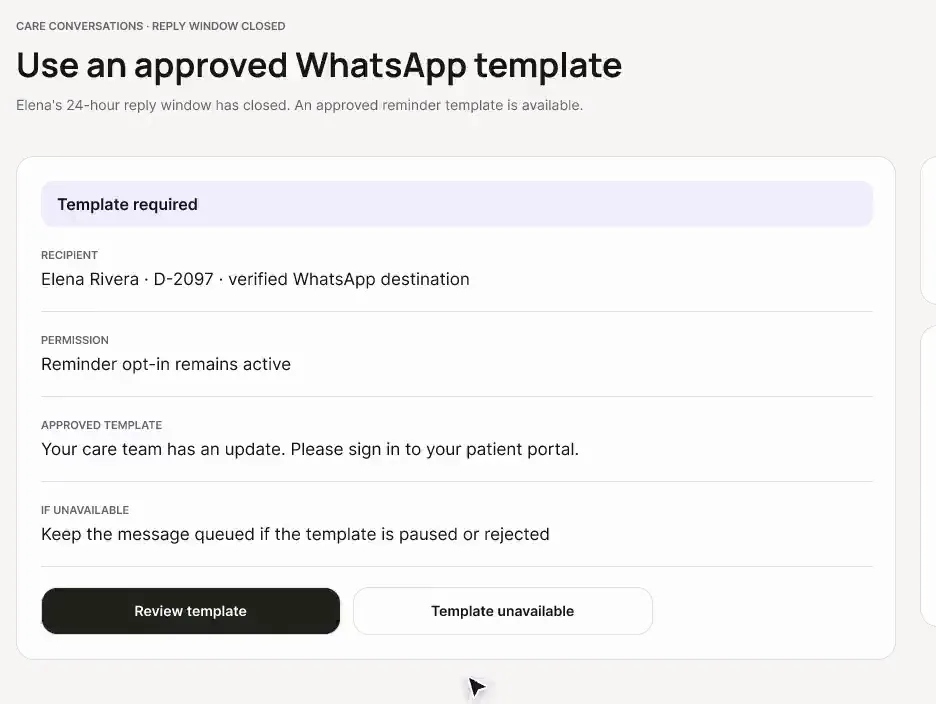
OvaFlow retires the superseded link so tapping an older message opens your current signed instruction instead, and any dose time you report is shown directly to your nursing team and physician.
Walkthroughs
Prototype recordings with fictional patient data, beside modeled EMR screens.
A late estradiol result, a newly signed trigger time, the wrong chart caught before publishing, and a lost confirmation checked rather than blindly resent.
Elena says she injected at 8:20, not 8:00. Her words are kept as she said them, the signed instruction stays as signed, and the evening callback changes hands only when Alex accepts it.
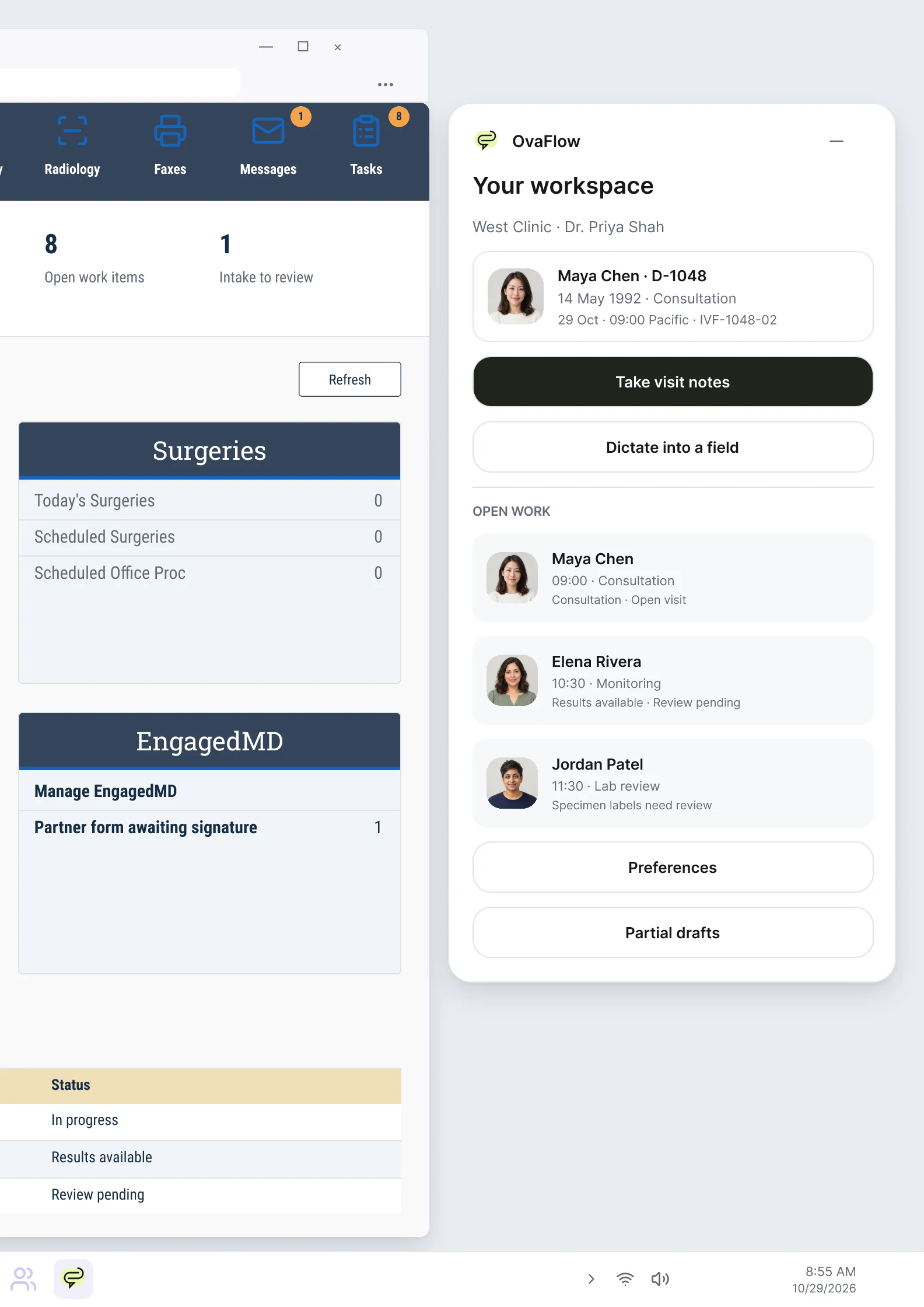
Beside a modeled Artisan view, the companion compares Dr. Priya Shah's approval with the unchanged Artisan fields, stops on Maya's open chart, and won't assume an update it didn't see.
Next step
We'll follow a signed change from the source to the person who owns it and the check in the EMR, in the prototype. Fictional records only; please don't send patient data.