Product preview · Fictional patient data

OvaFlow

Stage 9 of 9

Cryo & long‑term

Frozen eggs, sperm and embryos can remain in liquid-nitrogen cryostorage for many years across clinic moves, family growth and changing life plans. Managing long-term custody means keeping shipping authorization separate from clinical-use clearance, reconciling dry-shipper manifests cane by cane on arrival, logging every outreach and fee payment before any unclaimed-tissue review, freezing action when two signatories disagree on disposition, and routing late-onset donor medical updates across clinics.

4 prototype walkthroughs
Cryo custody, donor updates, outages and model governance. Prototype walkthrough preview with fictional patient data.
  1. Permission to ship cryopreserved material is kept separate from clearance for clinical use.
  2. The receiving facility confirms tank space and accepts custody.
  3. On arrival, one of four canes doesn't match the manifest.
  4. All four items are reconciled, and clinical use stays restricted until the required infectious-disease and eligibility review is complete.
  5. In long-term storage, one bounced email doesn't mean the embryos are abandoned.
  6. Two people submit conflicting instructions, so nothing is carried out.
  7. A separate, verified legal resolution and the lab's own record are both required.
  8. A late donor health update reaches linked recipient clinics without exposing unrelated identities.
  9. Both receiving clinics acknowledge the update.
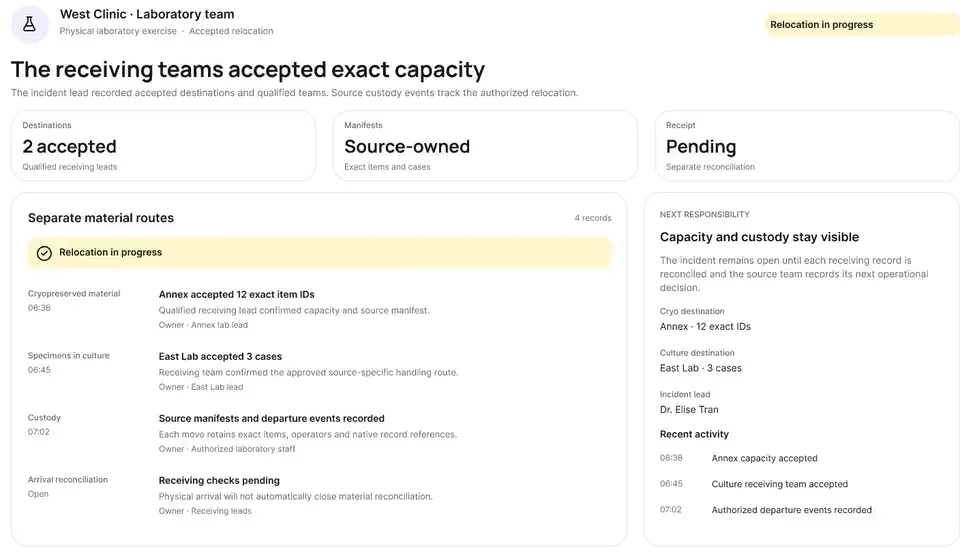
  10. A cryo facility emergency opens a relocation matched to available capacity.
  11. The receiving labs accept the exact canister capacity.
  12. The relocated inventory is reconciled before the emergency is closed.
  13. Paper records from a clinic system outage are reconciled.
  14. The live queue is aligned with the care actually given during downtime.
  15. A departing nurse or clinician's open tasks are reassigned.
  16. A named successor explicitly accepts every open episode.
  17. Two official clinic protocol documents disagree.
  18. A single authoritative reference revision is approved.
  19. A model update is held for local clinical governance review.
  20. The model release is limited to approved operational scope, not clinical decision support.
A late donor health update reaches each linked recipient clinic, and each one acknowledges it.Prototype walkthroughFictional patient dataOpen the walkthrough

Long-term custody

Every linked clinic hears, and every move is accepted

Storage can last years and involve several clinics. Updates reach the people who need them, and a move waits for the receiving lab.

  1. 01Donor updateA late donor health update reaches linked recipient clinics, without exposing unrelated identities.
  2. 02AcknowledgedBoth receiving clinics acknowledge the update.
  3. 03EmergencyA cryo facility emergency opens a relocation matched to available capacity.
  4. 04Capacity acceptedThe receiving labs accept the exact canister capacity before anything moves.

From the cryo custody walkthrough. Fictional patient data.

Handoffs and safeguards

Where work slips, and what holds instead

These are the moments the design is built around. Each safeguard stops or holds work; the decision stays with the clinician or the lab.

Where it slips today

  1. Permission to transport a dry shipper between facilities is mistaken for clinical-use clearance to thaw and transfer.
  2. One cane or straw label in a received shipment doesn't match the paper manifest on arrival.
  3. A bounced billing email is treated as specimen abandonment even though storage fees are still being paid or outreach across channels is incomplete.
  4. Two intended parents submit conflicting disposition instructions and one is carried out before the dispute is resolved.

What holds in OvaFlow

  • Right next stepShipping isn't clinical clearancePermission to ship and eligibility for clinical use are tracked separately.
  • Right next stepContact history before any abandonment decisionOne bounced email never classifies stored embryos as abandoned.
  • Right ownerConflicting instructions holdWhen two people give conflicting storage instructions, nothing is carried out until it is resolved.
All safeguards

Both sides

One stage, seen from both sides

For the clinic team

What the team coordinates

OvaFlow tracks shipment versus clinical-use clearance, arrival reconciliation, contact history, conflicting disposition instructions, donor health updates and emergency relocation.

  • Shipping release and clinical-use clearance kept as separate, independently verified authorizations
  • Receiving lab arrival reconciliation checked item by item against the shipping manifest
  • Multi-channel contact history and payment activity verified before any unclaimed-embryo review
  • Conflicting-instruction hold that freezes thawing, transfer, shipment or discard until resolved
  • Late-onset donor health updates routed to linked clinics and recipient families without exposing confidential identities
  • Emergency tank relocation with receiving-facility capacity accepted before transfer
Operational checks at this stage (3)
  • Keep dry-shipper transport authorization distinct from clinical-use clearance (such as 21 CFR 1271 donor eligibility, quarantine release, and local transfer consents).
  • Reconcile every arriving dry shipper cane by cane and straw by straw against the shipping manifest before placing specimens into long-term tanks.
  • Record storage fee payments and portal logins as active patient contact per ASRM ethics guidance, and place an immediate freeze hold whenever signatories submit conflicting disposition elections.

For you and your family

What you experience

Frozen eggs or embryos can stay in storage for years, and the clinic keeps in touch with you about your choices.

Questions you may ask here (3)
  • “If we authorize shipping our frozen embryos to a new clinic, does that automatically clear them to be thawed and transferred?”
  • “Could a missed email or outdated street address ever cause our embryos to be treated as abandoned while we are still paying storage fees?”
  • “What happens if two intended parents separate and give different instructions about stored embryos?”
Words you may hear (4)
Cryopreservation
Freezing eggs, sperm or embryos for long-term storage.
Disposition
A decision about what happens to stored embryos or eggs. It needs the right people's agreement before anything is done.
Chain of custody
The record of who held stored material and when, including when it moves between facilities.
Donor
A person who provides eggs, sperm or embryos for someone else's treatment. Later health updates may need to reach every clinic holding related material.

Questions about your own treatment go to your care team. OvaFlow never gives medical advice. In an emergency, call 911.

Read the plain-language guide to IVF

See it

Walkthroughs from this stage

Recorded from an interactive design prototype. Every patient, clinician and clinic is fictional, and EMR screens are modeled reconstructions.

Prototype walkthrough · Fictional patient data

Step-by-step timing & questions

How Cryo & long‑term unfolds day by day

Vitrified oocytes, sperm and embryos remain in monitored liquid-nitrogen tanks for years, requiring strict separation between shipping release and clinical-use eligibility, cane-by-cane arrival checks, verified contact history, and conflict holds.

Months to 10+ years · Annual custody & contact

Long-term cryostorage custody, inter-clinic transport & disposition

  1. 01Storage entry

    Tank coordinate & PGT link

    Patient & family

    You receive a clear summary of how many eggs, vials or embryos are stored and your current disposition elections.

    What holdsVerified tank coordinate & status
    Clinic, EMR & lab

    Each straw or vial is logged by tank, canister, cane and goblet coordinate alongside its witnessed PGT and infectious-disease status.

  2. 02Inter-clinic ship

    Shipping vs. clinical use

    Patient & family

    If you move or transfer specimens between clinics, you authorize transport and verify arrival before any cycle is booked.

    What holdsShipping is separate from clinical use
    Clinic, EMR & lab

    Shipping release allows dry-shipper transport only; the receiving lab checks every cane on arrival and verifies clinical-use clearance separately.

  3. 03Multi-year custody

    Contact history & conflict holds

    Patient & family

    Over the years you can update your contact details or disposition choices; if two intended parents disagree, nothing is thawed or discarded.

    What holdsFee payment counts as contact · Conflict hold
    Clinic, EMR & lab

    Storage fee payments count as active contact; any conflicting instruction between signatories triggers an immediate disposition hold.

  4. 04Longitudinal safety

    Donor updates & tank relocation

    Patient & family

    If a gamete bank shares a relevant late-onset medical update, your clinic can reach you while respecting donor anonymity rules.

    What holdsDonor updates routed · Lab capacity accepted
    Clinic, EMR & lab

    Donor medical updates route across linked clinics without exposing restricted identities; emergency relocation requires receiving-lab capacity acceptance.

Four custody rules protect stored reproductive tissue over years: shipping is not clinical use, arrival manifests are reconciled cane by cane, fee payment counts as active contact, and conflicting disposition instructions freeze action.
Worked example: Dry-shipper manifest discrepancy, shipment-vs-use boundary & disposition conflict hold
Worked example · West ClinicFictional patient data

Dry-shipper manifest discrepancy, shipment-vs-use boundary & disposition conflict hold

What the patient sees

Jordan Patel's embryo storage coordinate and PGT status stay reconciled against the lab record. For multi-party storage, if two signatories submit conflicting disposition forms, both see that all tank actions are paused pending resolution.

What the clinic team sees

In the cryostorage walkthrough, a received shipment with a manifest mismatch is held at intake reconciliation; shipping permission never unlocks warming; and a bounced billing email cannot trigger an abandonment workflow while payment or alternate outreach channels exist.

Why it holds: Irreversible cryostorage actions—thawing, transfer, inter-facility release or discard—never proceed on ambiguous authority or a single bounced notice.

Where OvaFlow fits

How OvaFlow works beside the clinic's own EMR and lab

Coordination companion

What OvaFlow coordinates

  • Separate status tracking for physical shipping authorization versus clinical-use release and item-by-item arrival reconciliation
  • Unified contact ledger (including billing fee payments and multi-channel outreach) and automatic holds on conflicting disposition instructions
  • De-identified routing of late-onset donor health updates and receiving-facility capacity acceptance during emergency relocation
System of record

What stays with clinicians & the EMR

  • Physical liquid-nitrogen tank monitoring, alarm response, vapour dry-shipper preparation and bench witnessing
  • Determining 21 CFR 1271 donor eligibility, quarantine release and accompanied-shipping labeling
  • Legal resolution of disputed embryo disposition agreements and clinic storage policy governance
OvaFlow never prescribes medications, never triages symptoms, and never replaces the clinic's own EMR or electronic witnessing hardware.

Common questions at this stage

Questions from patients, families and clinic teams

View all 4 stage questions & answers
Why is permission to ship frozen embryos or gametes separate from permission to use them clinically?

Under 21 CFR Part 1271 Subpart C and ASRM donation guidance, reproductive tissue may be physically transported between facilities under quarantine or accompanied-records rules before all infectious-disease testing, donor eligibility determinations, or receiving-clinic consents are complete. Treating 'cleared to ship' as 'cleared to thaw and transfer' risks using unverified tissue. OvaFlow tracks transport release and clinical-use clearance as two separate gates.

Sources: [15] 21 CFR Part 1271 & ASRM (2024–2026) · [9] ASRM Practice Committee (2022)

When can stored embryos be considered 'unclaimed' or abandoned?

ASRM's Ethics Committee opinion on unclaimed embryos states that embryos must never be treated as abandoned simply because a billing email bounced or a letter was returned—especially if storage fees are still being paid, since fee payment itself constitutes contact. Diligent outreach across multiple contact channels over years and verification of written disposition directives are required before any unclaimed-tissue review.

Sources: [16] ASRM Ethics & Practice Committees (2020–2021)

What happens if two partners or intended parents submit conflicting instructions for stored embryos?

When two people with joint dispositional authority submit conflicting instructions—for example, one requests transfer or continued storage while the other requests discard or revokes consent—any irreversible action must stop. OvaFlow places an immediate conflict hold on the storage record until joint written agreement or legal resolution is documented.

Sources: [16] ASRM Ethics & Practice Committees (2020–2021) · [12] ASRM Practice Committee (2022)

Why shouldn't staff pull canes out of liquid-nitrogen tanks for routine administrative audits?

ASRM's cryostorage committee opinion cautions against removing vitrified oocytes and embryos from liquid nitrogen for routine physical inventory counts without specific cause, because repeated thermal excursions near the tank neck can compromise specimen viability. Accurate electronic custody records and targeted witnessing at actual movement events protect stored tissue.

Sources: [16] ASRM Ethics & Practice Committees (2020–2021) · [9] ASRM Practice Committee (2022)

Clinical & operational sources for Cryo & long‑term (4 primary guidelines)
  1. [15]
    21 CFR Part 1271 & ASRM (2024–2026) — eCFR Title 21 Part 1271 Subpart C (Donor Eligibility) & ASRM Guidance Regarding Gamete and Embryo DonationSeparation of physical transport release from clinical-use eligibility and longitudinal routing of donor medical updates.
  2. [16]
    ASRM Ethics & Practice Committees (2020–2021) — Disposition of unclaimed embryos (2021) & Cryostorage of reproductive tissues in the IVF laboratory (2020)Storage fee payment as active contact, multi-channel outreach before any unclaimed status, and holds on conflicting disposition instructions.
  3. [9]
    ASRM Practice Committee (2022) — Comprehensive guidance for human embryology, andrology, and endocrinology laboratories: management and operationsContinuous specimen witnessing, chain of custody, culture-media lot traceability, warming authorization and cryostorage records.
  4. [18]
    ONC SAFER Guides (2025) — Test Results Reporting and Follow-Up & Contingency PlanningClosed-loop tracking of expected diagnostic results from order to clinician review and downtime reconciliation.

See it with your team

Bring the storage questions that last for years.

We'll go through the prototype walkthroughs for this stage and the questions your team would ask first.