Embryology: PGT-M readiness, a media recall and warming authorization
A missing family sample, a culture-media recall and an embryo that doesn't survive warming, each traced to the exact embryo, case and decision.
Product preview · Fictional patient data
Stage 6 of 9
From Day 0 conventional insemination or intracytoplasmic sperm injection (ICSI, injecting a single sperm into an egg) through Day 1 fertilization checks and Day 5 to 7 blastocyst culture, embryologists track every dish and embryo individually. When families use preimplantation genetic testing (PGT), trophectoderm biopsy samples go to a reference genetics lab while embryos are frozen—and every specimen label, biopsy tube and amended report must stay tied to the exact embryo.
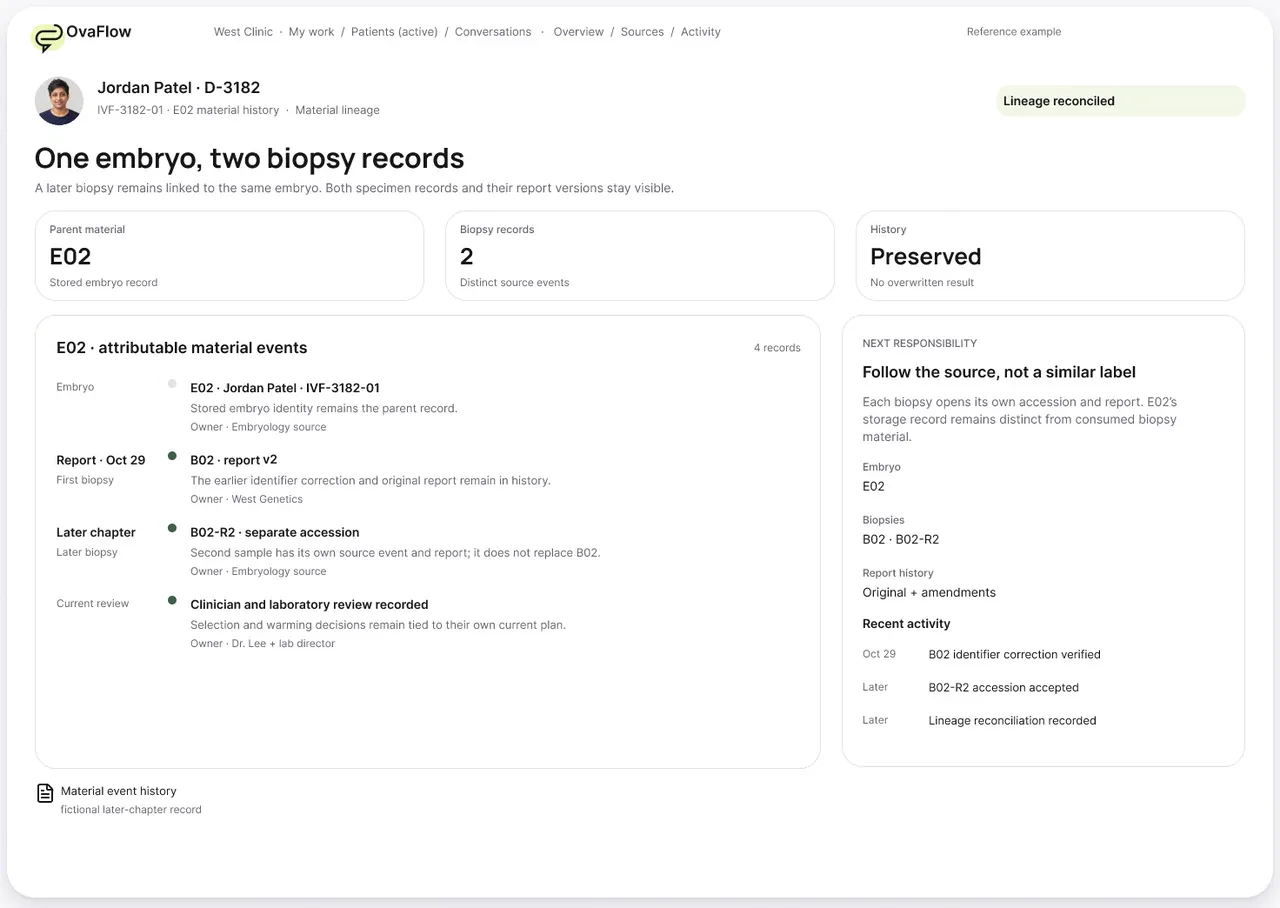
Lineage
When one embryo has two biopsy records, each keeps its own accession, report and history. A similar label is never treated as the same sample.
Results never cross
From the embryology walkthrough. Fictional patient data.
Handoffs and safeguards
These are the moments the design is built around. Each safeguard stops or holds work; the decision stays with the clinician or the lab.
Where it slips today
What holds in OvaFlow
See it
Recorded from an interactive design prototype. Every patient, clinician and clinic is fictional, and EMR screens are modeled reconstructions.
A missing family sample, a culture-media recall and an embryo that doesn't survive warming, each traced to the exact embryo, case and decision.
Accession holds, amended PGT reports, cryo tank signals and pharmacy change requests land in one queue, each with a named owner.
From duplicate barcodes to cold-chain delivery and the patient's own “received”, every handoff to the clinic's own system has an owner and a confirmation.
A note isn't done until it's saved, a cycle doesn't start with prior authorization unresolved, dose changes go to eIVF's own e-prescribing, and a PGT label mismatch stops the review.
A patient-reported penicillin rash is surfaced against the chart, a monitoring note is confirmed saved rather than assumed, and a specimen label mismatch stops review.
Both sides
For the clinic team
OvaFlow tracks PGT-M readiness, lineage across biopsies, development endpoints, amended PGT reports, label and barcode stops, and culture-media lot recalls.
People involved
For you and your family
In the lab, eggs are fertilized and embryos develop; some families also choose genetic testing.
Questions about your own treatment go to your care team. OvaFlow never gives medical advice. In an emergency, call 911.
Read the plain-language guide to IVFWorkflows here
Each row opens the capability. Point at, focus or scroll to a row to see it in a recording from this stage.
Stories
Fictional people, told end to end.
Step-by-step timing & questions
Inside the embryology lab, mature oocytes are fertilized on Day 0, checked for two pronuclei on Day 1, and cultured to Day 5–7 blastocysts for transfer, vitrification or trophectoderm biopsy.
After retrieval, the embryology team prepares the sperm sample and pairs it with your mature eggs.
Two-identifier electronic or dual witnessing verifies egg and sperm dishes before conventional insemination or intracytoplasmic sperm injection (ICSI, injecting a single sperm into an egg).
Your nurse or embryologist calls with your Day 1 update: how many mature eggs fertilized normally.
Embryologist records 2-pronuclei (2PN) fertilization counts and links culture-media and oil lot numbers to the cohort.
Embryos that reach the blastocyst stage are graded; if you chose PGT, a few outer cells are biopsied before each embryo is frozen.
Each blastocyst gets a unique ID, straw/cane coordinate and biopsy tube barcode; second biopsies link to the same parent embryo.
Your physician reviews your genetic testing results with you and confirms which embryos are eligible for transfer.
Incoming PGT reports—and any subsequent amended report or accession hold—require documented physician sign-off before warming.
What the patient sees
Jordan's embryos undergo trophectoderm biopsy for genetic testing. Every embryo's biopsy history and storage location stay matched before any transfer date is confirmed.
What the clinic team sees
In Jordan's walkthrough, a specimen label mismatch halts clinical review; an outside reference-lab accession hold is resolved with confirmation; an amended PGT report requires physician review before transfer planning; and Embryo #3's two biopsy tubes stay tied to one embryo record.
Why it holds: Lab identity, biopsy lineage, report versions and consumable lot numbers are tracked explicitly rather than stitched together from PDFs and spreadsheets.
What OvaFlow coordinates
What stays with clinicians & the EMR
Common questions at this stage
On Day 0 (retrieval day), mature metaphase-II oocytes are fertilized by conventional insemination or intracytoplasmic sperm injection (ICSI, injecting a single sperm into an egg). On Day 1 (16–18 hours later), embryologists check for normal fertilization (two pronuclei). Over Days 2 to 4 the embryo divides into a cleavage-stage embryo and then a compacting morula. By Days 5, 6 or 7, embryos that form a fluid-filled cavity with an inner cell mass and outer trophectoderm reach the blastocyst stage, where they can be transferred, vitrified or biopsied.
Sources: [6] SART Patient Guide (2026) · [7] HFEA Patient Guide (2026) · [10] ASRM Practice Committee (2026)
Preimplantation genetic testing (PGT) analyzes a small trophectoderm biopsy (typically 5–10 outer cells) from a blastocyst. PGT-A screens for chromosome number changes (aneuploidy); PGT-M tests for a specific single-gene (monogenic) condition known in the family; and PGT-SR checks for structural chromosome rearrangements such as translocations. Biopsied blastocysts are vitrified while the reference genetics lab runs the analysis.
Sources: [4] ASRM Practice Committee (2023) · [7] HFEA Patient Guide (2026)
Occasionally a first trophectoderm biopsy returns a 'no-result' or amplification failure from the genetics lab. If the patient and physician decide to warm and re-biopsy that blastocyst, the second biopsy tube must remain linked as a child event of the same parent embryo so the clinic never mistakes two biopsy reports for two separate embryos.
Sources: [4] ASRM Practice Committee (2023) · [9] ASRM Practice Committee (2022)
ASRM embryology laboratory guidelines require recording the lot number and expiration Window of every medium, oil and consumable that contacts gametes or embryos. If a manufacturer issues a recall notice, OvaFlow lists every affected episode and assigns a named clinical reviewer to each case rather than relying on manual binder searches.
Sources: [9] ASRM Practice Committee (2022)
Along the spine
Plans can change at almost any point. See how a change of plan is handled.
See it with your team
We'll go through the prototype walkthroughs for this stage and the questions your team would ask first.