Elena's episode: one change, four commitments, recovery and freeze-all
One signed change reaches instructions, the OR, anesthesia and the lab. Later an outside emergency visit for OHSS turns a planned fresh transfer into freeze-all.
Product preview · Fictional patient data
Stage 5 of 9
Egg retrieval is an ultrasound-guided procedure under sedation that usually takes 15 to 30 minutes, followed by recovery in the clinic and structured check-ins at home. Afterward, the team watches for ovarian hyperstimulation syndrome (OHSS): an over-response to stimulation medicines that can cause rapid fluid shifts, bloating or abdominal pain in the days after retrieval. Symptom questions always go to the clinic's care team, and emergencies to 911.
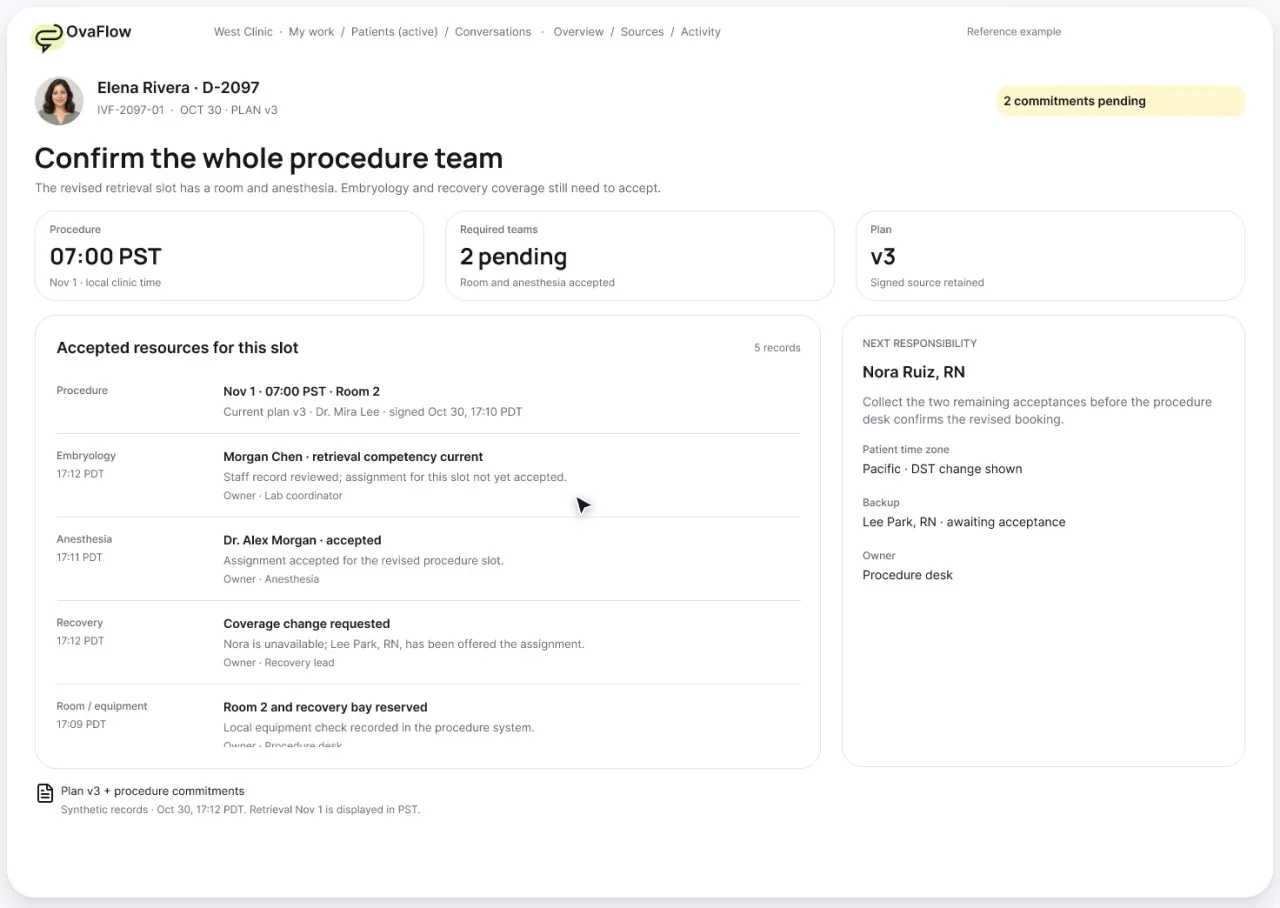
The whole procedure team
Elena's retrieval moved with version 3 of her plan. Each team commits to the revised slot on its own, and the slot stays unconfirmed until all of them have.
2 commitments pending. Not confirmed yet.
From the multi-party walkthrough. Team names are roles. Fictional patient data.
See it
Recorded from an interactive design prototype. Every patient, clinician and clinic is fictional, and EMR screens are modeled reconstructions.
One signed change reaches instructions, the OR, anesthesia and the lab. Later an outside emergency visit for OHSS turns a planned fresh transfer into freeze-all.
Every member of the procedure team commits to the slot, a mid-cycle insurance change rebuilds the estimate, consent lands on the right person's chart, and the interpreter is booked for every visit.
An old text link can't send Elena to a superseded injection time. Reporting a late dose is simple and honest, and urgent help is one tap away.
The patient's phone and the clinic's workspace side by side, so each reassuring screen shows the safeguard behind it.
Both sides
For the clinic team
OvaFlow tracks the whole procedure team's commitment, anesthesia questions, a named discharge owner, post-retrieval symptoms, outside emergency visits and a change to freeze-all.
For you and your family
Eggs are collected in a short procedure, and the care team checks in on your recovery afterward.
Questions about your own treatment go to your care team. OvaFlow never gives medical advice. In an emergency, call 911.
Read the plain-language guide to IVFHandoffs and safeguards
These are the moments the design is built around. Each safeguard stops or holds work; the decision stays with the clinician or the lab.
Where it slips today
What holds in OvaFlow
Workflows here
Each row opens the capability. Point at, focus or scroll to a row to see it in a recording from this stage.
Stories
Fictional people, told end to end.
Step-by-step timing & questions
Egg retrieval brings together the physician, anesthesiologist, operating room and embryology bench on a timed morning slot, followed by post-anesthesia recovery and structured surveillance for ovarian hyperstimulation syndrome (OHSS).
You arrive fasting (nothing by mouth as instructed) with a responsible adult to accompany you home.
OR, REI physician, anesthesiologist and embryology bench are all confirmed on the slot; open airway or medication questions must be resolved.
Under intravenous sedation, the physician aspirates follicular fluid through a thin ultrasound-guided needle while you sleep comfortably.
Follicular aspirates pass immediately through the warmed pass-through window to the embryologist with two-identifier witnessing.
You rest in recovery, learn how many eggs were collected, and receive written discharge guidance with 24/7 clinic and 911 numbers.
Before discharge closes, a specific nurse is named to own the Day 1 recovery and fertilization call.
You log bloating, weight change, urine output or pain; any symptom prompt displays your clinic's 24/7 line and 911.
If moderate/severe OHSS symptoms or an outside emergency visit occur, the physician converts a planned fresh transfer to freeze-all.
What the patient sees
After her Nov 1 retrieval, Elena reports abdominal bloating and rapid weight gain on her companion check-in. The screen immediately shows West Clinic's 24/7 on-call line and 911 rather than automated reassurance.
What the clinic team sees
Nora Ruiz, RN receives the symptom report, reconciles Elena's outside emergency department visit into the episode timeline, and Dr. Mira Lee converts the planned Day 5 fresh transfer to a freeze-all cycle.
Why it holds: OvaFlow never scores or triages symptoms on its own, and an outside emergency visit immediately halts a planned fresh transfer when the clinician converts the plan.
What OvaFlow coordinates
What stays with clinicians & the EMR
Common questions at this stage
According to SART and HFEA patient guides, transvaginal ultrasound-guided oocyte retrieval typically takes 15 to 30 minutes under intravenous sedation. Patients usually rest in the clinic recovery area for 1 to 2 hours until alert and comfortable, then go home with an accompanying adult and a named nurse scheduled to call the next day.
Sources: [6] SART Patient Guide (2026) · [7] HFEA Patient Guide (2026)
OHSS is an exaggerated response to ovarian stimulation and trigger hormones in which fluid shifts from blood vessels into the abdomen and third spaces. Early symptoms—abdominal distension, nausea, rapid weight gain, decreased urination or shortness of breath—typically appear within 3 to 7 days after trigger and retrieval (or later if pregnancy occurs). Any concerning symptom must be evaluated promptly by the clinical team, and severe symptoms such as difficulty breathing or chest pain require calling 911.
Sources: [8] ASRM Practice Committee (2024) · [5] ESHRE Guideline Group (2026)
If a patient has high estradiol levels, a large cohort of retrieved oocytes, or post-retrieval OHSS symptoms, pregnancy hormone (hCG) from a fresh transfer can significantly worsen and prolong OHSS. ASRM guidelines recommend vitrifying all suitable blastocysts ('freeze-all') so the ovaries and hormone levels return to baseline before a frozen embryo transfer (FET) in a subsequent cycle.
Sources: [8] ASRM Practice Committee (2024) · [6] SART Patient Guide (2026)
Unlike an office visit, an egg retrieval requires four synchronized clinical functions: the REI physician, the anesthesia provider, the procedure room nurse, and an embryologist at a warmed workstation ready to receive follicular aspirates at a precise hour after trigger. OvaFlow keeps a slot provisional until all four teams commit.
Sources: [9] ASRM Practice Committee (2022) · [6] SART Patient Guide (2026)
Along the spine
Plans can change at almost any point. See how a change of plan is handled.
See it with your team
We'll go through the prototype walkthroughs for this stage and the questions your team would ask first.