Product preview · Fictional patient data

OvaFlow

Flagship story · Daily care

One afternoon, one evening, every next step in view

From 16:45 to 20:28 PDT on Oct 30, follow the trigger instruction for Elena Rivera through a nurse's afternoon and evening at West Clinic. Across eight moments—from a pending satellite estradiol lab to an on-call callback—see where routine coordination usually breaks and what holds instead.

Oct 30, 16:45 → 20:28 PDT8 chapters
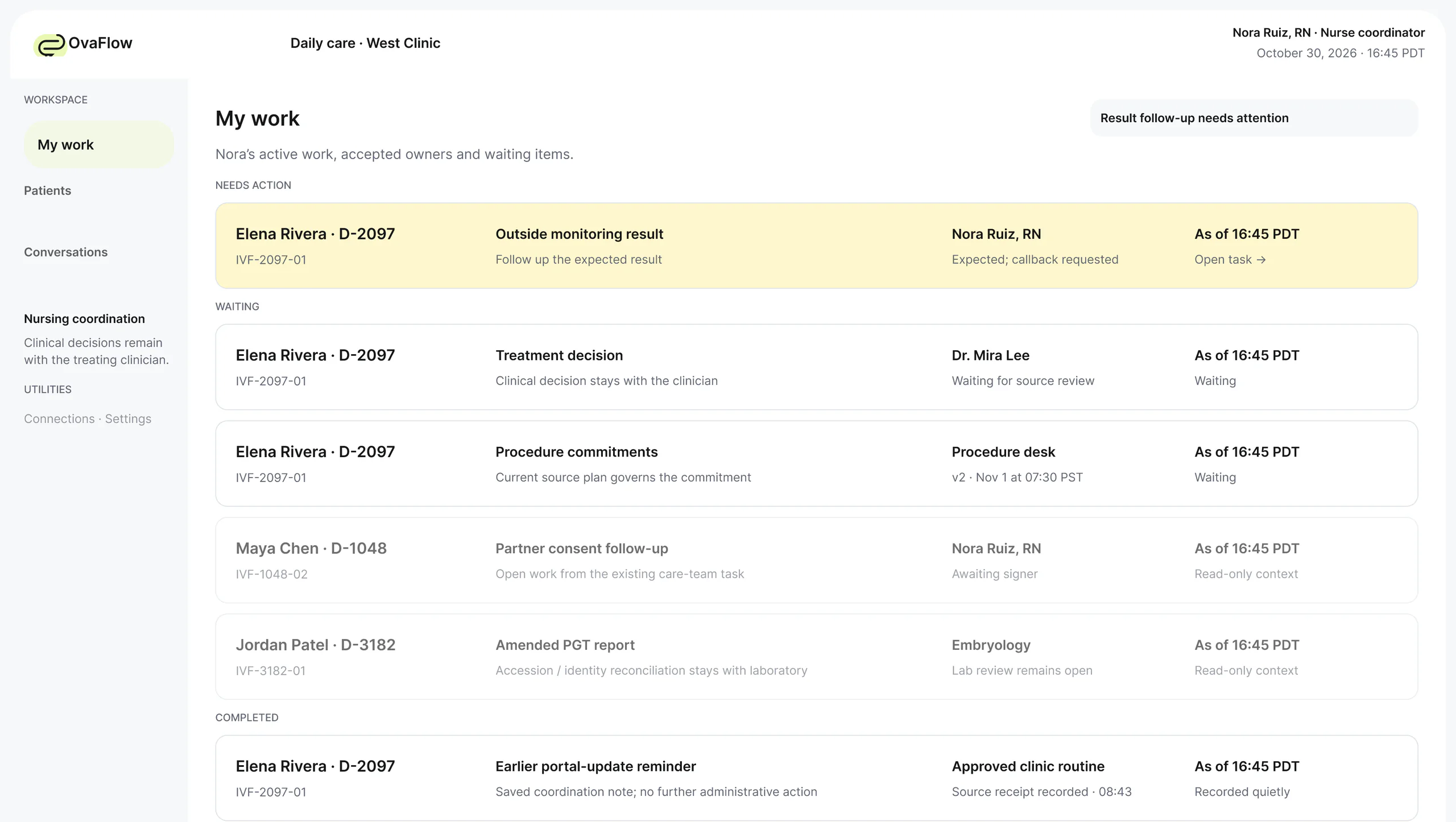
Expanded workspace My work queue (prototype walkthrough) at two points in the same day: before and after an explicit handoff acceptance. Fictional patient data.
Elena RiveraPatient going through stimulation, trigger and retrieval
Prototype walkthroughFictional patient data
  1. 16:45 PDT. Nora's queue: what needs action, what is waiting, and who owns each item.
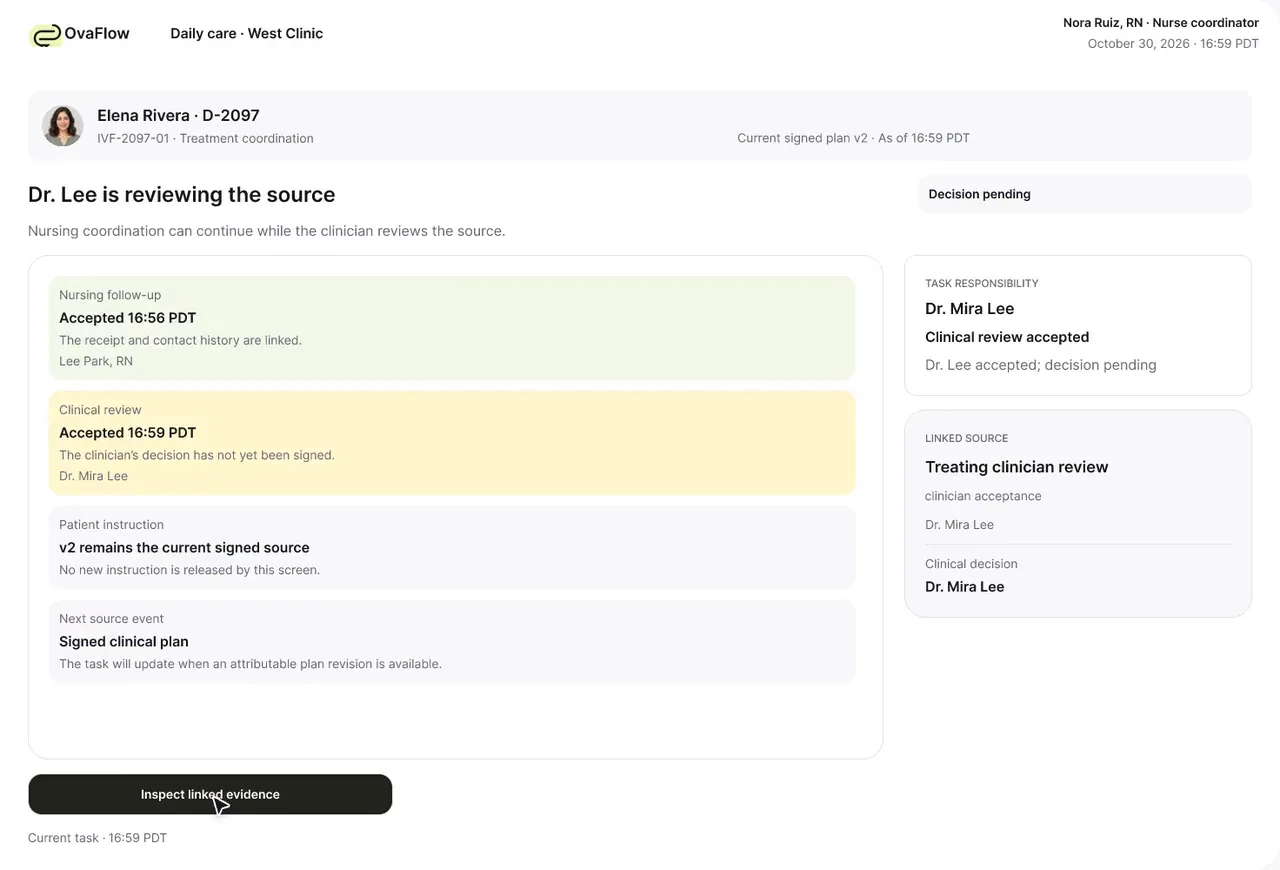
  2. 20:28 PDT. Alex Kim, RN accepted the evening callback. The clinical decision stays with Dr. Lee.

People

Who's in this story

View all 5 people in this story
  • Elena RiveraPatient going through stimulation, trigger and retrieval
  • Nora Ruiz, RNIVF nurse coordinator
  • Lee Park, RNCoverage nurse
  • Dr. Mira LeeREI physician
  • Alex Kim, RNEvening on-call nurse

Fictional patient dataEvery patient, family member, clinician and clinic in these stories is fictional. Names, times and screens come from prototype walkthroughs, not from real care.

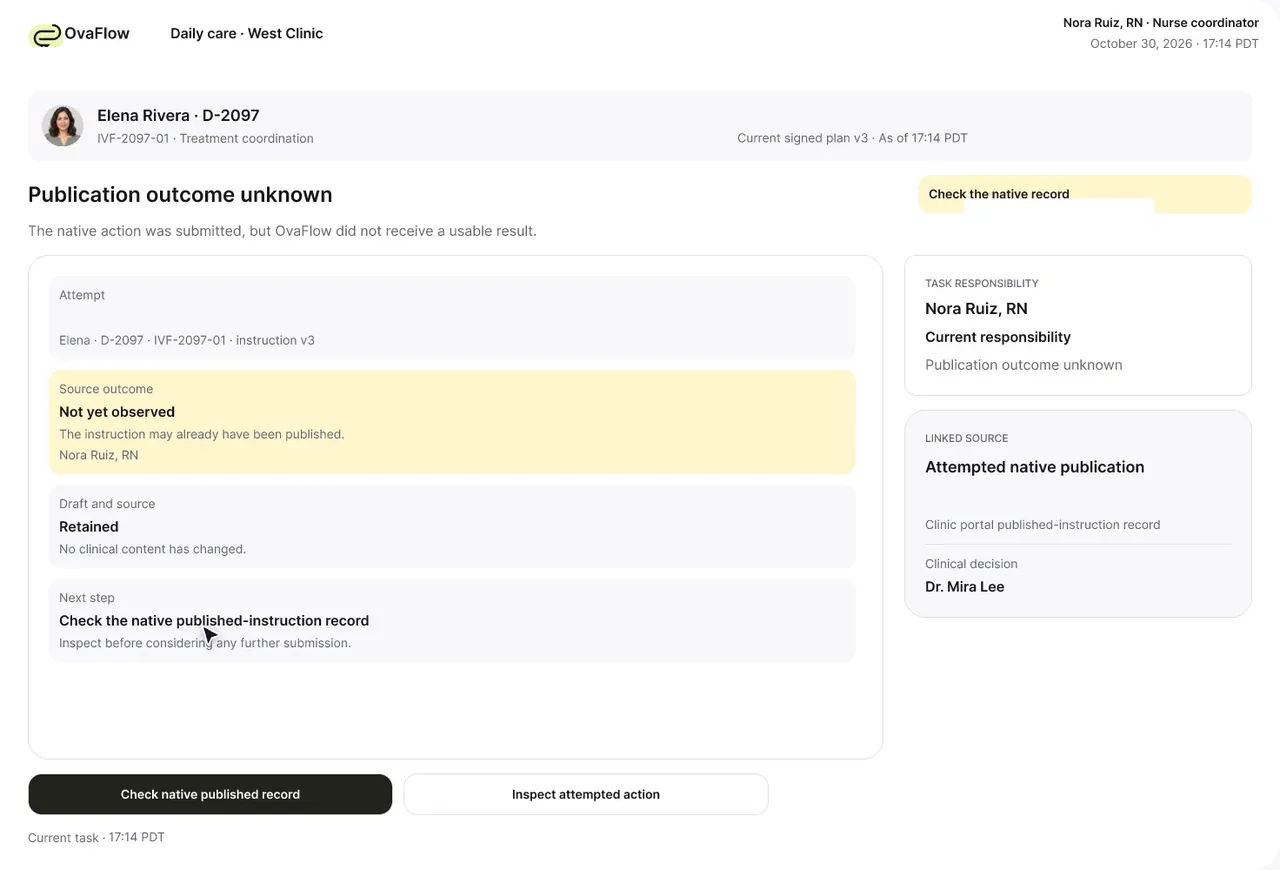
Daily care: a changed trigger, the wrong chart and an unknown outcome: the moment in each chapter, from the prototype walkthrough. Fictional patient data.
Walkthrough page

Prototype walkthrough · Fictional patient data · Desktop

  1. Chapter 0116:45 PDTStimulation & monitoring

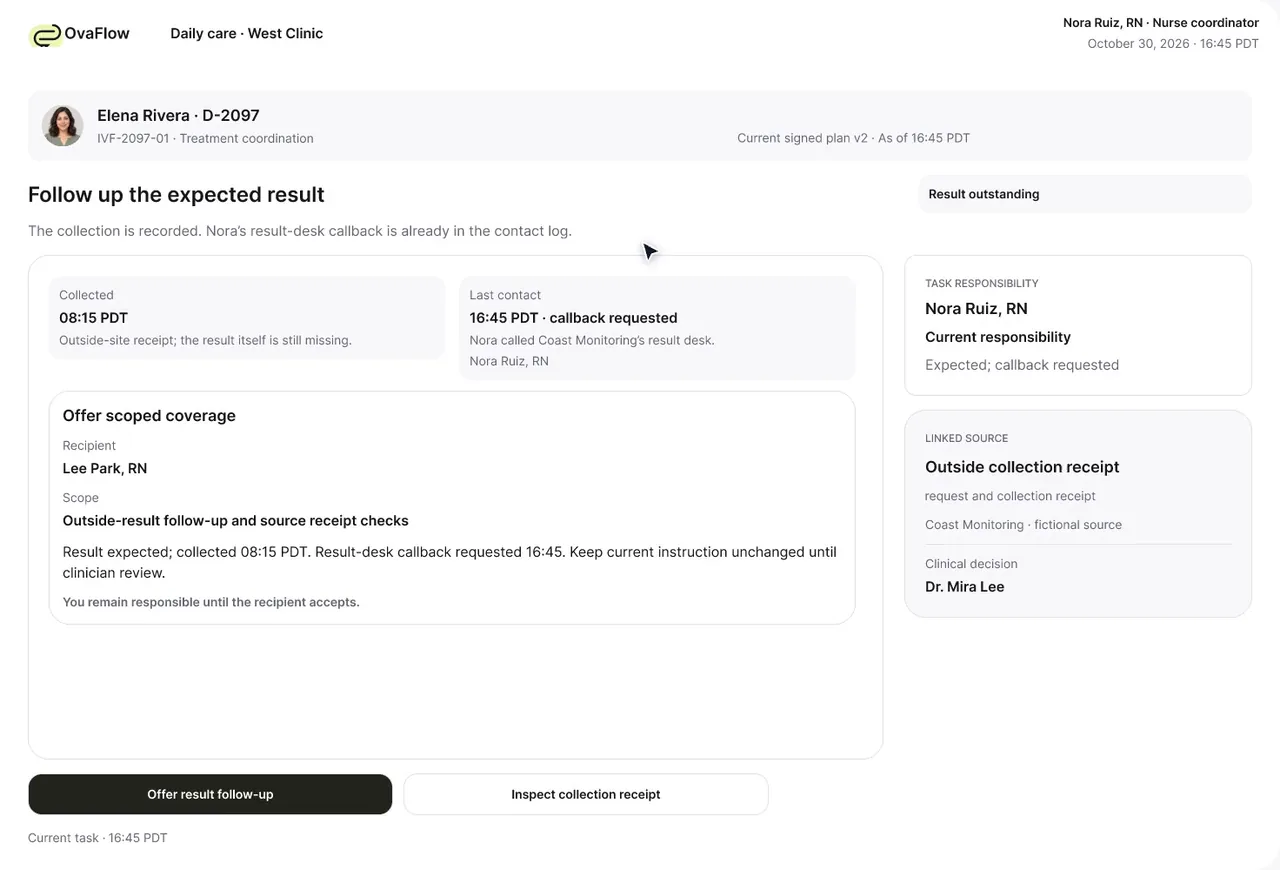
    A result that hasn't arrived

    Elena's morning estradiol result from an outside draw is tracked as expected, not forgotten in a quiet inbox. Nora Ruiz, RN offers the follow-up to Lee Park, RN; until Lee Park explicitly accepts, Nora still owns the follow-up.

    On screen at 0:01Elena's estradiol result is expected but hasn't arrived, and its follow-up opens.

  2. Chapter 0217:10 PDTTrigger

    Dr. Mira Lee signs version 3

    When the late estradiol result arrives, it routes to Dr. Mira Lee, who signs a revised trigger instruction: Ovidrel 250 micrograms, subcutaneous, once at 20:00 PDT on Oct 30 (retrieval Nov 1 at 07:00 PST, 36 hours across the daylight-saving change). OvaFlow shows what changed; the clinical decision is hers.

    On screen at 0:10The late result goes to Dr. Mira Lee for clinical review.

  3. Chapter 03Trigger

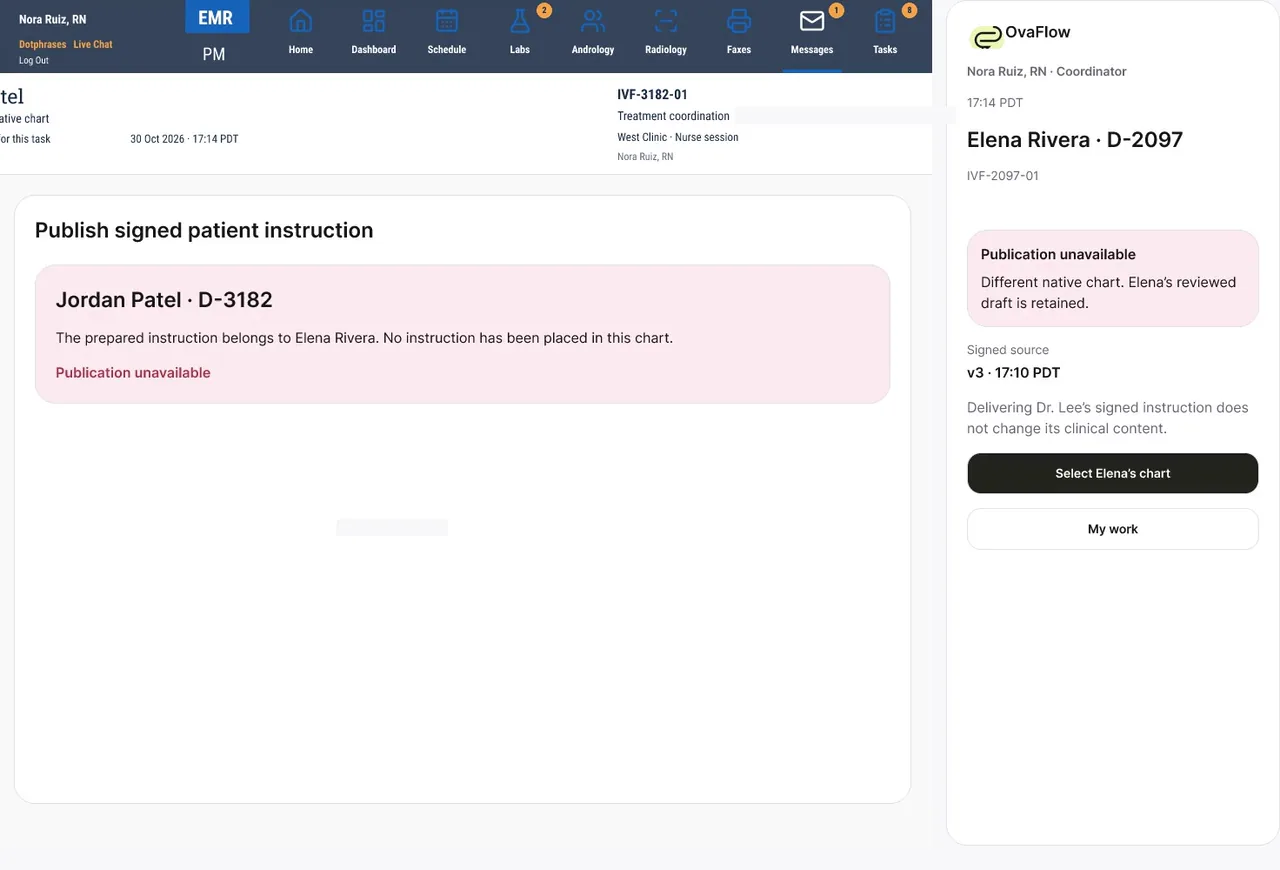
    The wrong chart is open

    Nora prepares to place the updated trigger instruction into the EMR, but the chart open on her desktop is Jordan Patel's. Placement stops before anything is written, and the draft waits intact for Elena's chart.

    On screen at 0:19The open chart switches to Jordan Patel. The instruction belongs to Elena, so placement stops.

  4. Chapter 04Trigger

    Unknown is not done

    The portal publish goes out on Elena's chart, but a connection drop prevents confirmation from returning. Instead of resending blindly, Nora checks the portal's own activity record and reconciles against the single matching entry.

    On screen at 0:23The portal publish is submitted, but no confirmation comes back. The status reads “Publication outcome unknown”, and resending is held.

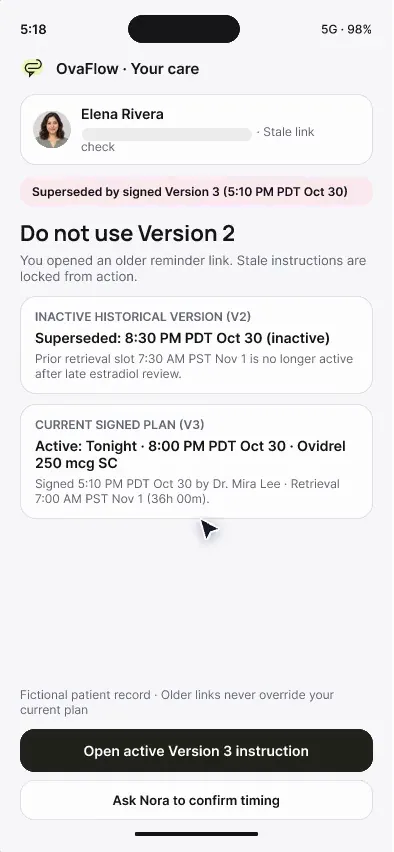
Elena's iPhone: the current instruction, an old link, an honest report: the moment in each chapter, from the prototype walkthrough. Fictional patient data.
Walkthrough page

Prototype walkthrough · iPhone

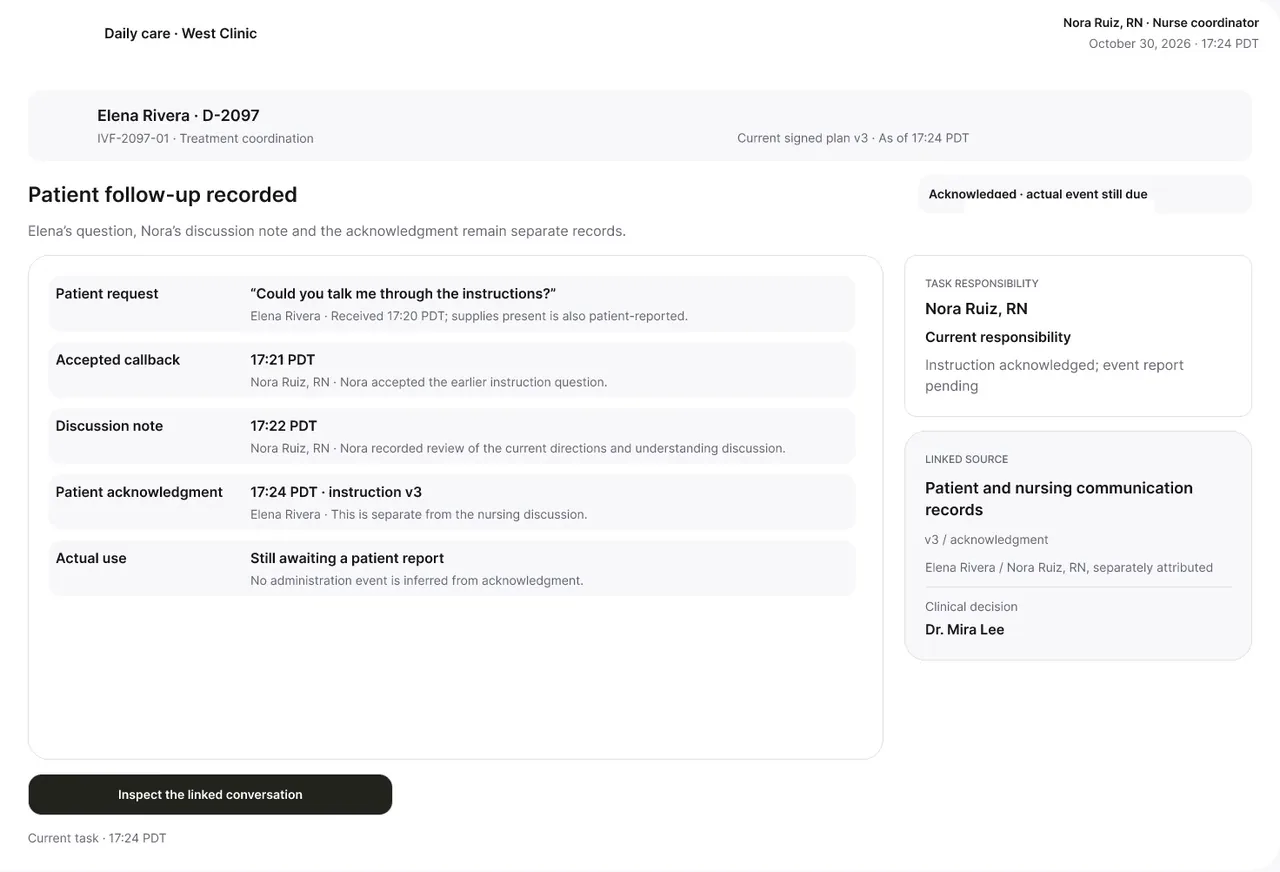
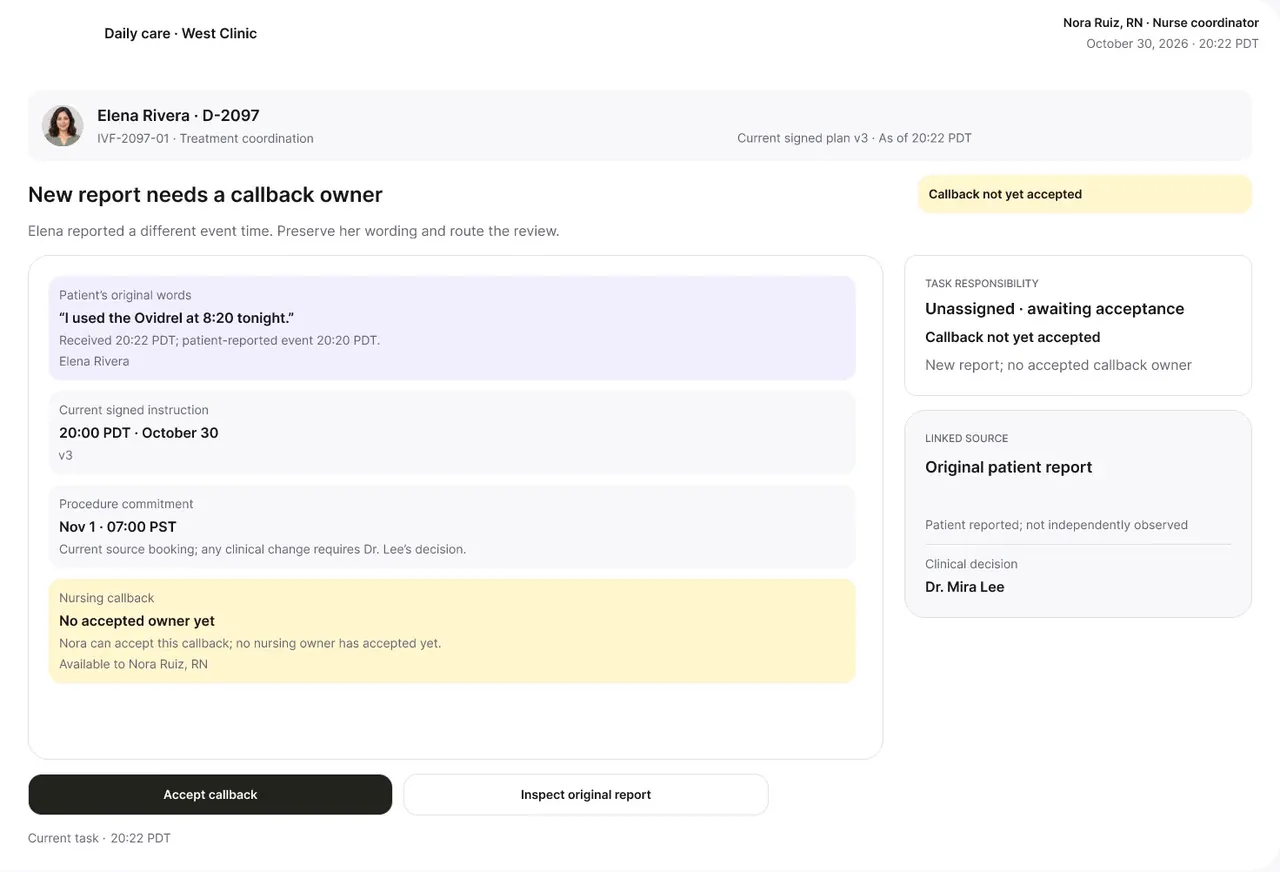
Daily care: the 8:20 PM report and the evening handoff: the moment in each chapter, from the prototype walkthrough. Fictional patient data.
Walkthrough page

Prototype walkthrough · Desktop

  1. Chapter 0617:24 PDTTrigger

    A question isn't a dose

    Elena's pre-dose question at 17:24 is logged on the nursing queue as an open clinical question. Nothing about her trigger medication is marked administered or complete.

    On screen at 0:01At 17:24 PDT Elena asks a question before her dose. It is logged without marking the medication as taken.

  2. Chapter 0720:22 PDTTrigger

    “8:20 tonight”

    Elena reports she injected at 20:20 PDT (8:20 PM, Oct 30), and the clinic receives the report at 20:22 PDT. Her words are kept as she said them: 35h 40m before the Nov 1 07:00 PST retrieval, against 36h 00m planned. The signed 20:00 order stays as signed, and Dr. Mira Lee reviews the 20-minute difference.

    On screen at 0:03At 20:22 PDT Elena reports “8:20 tonight”. Her report is kept as she said it: 35h 40m before retrieval, against 36h 00m planned.

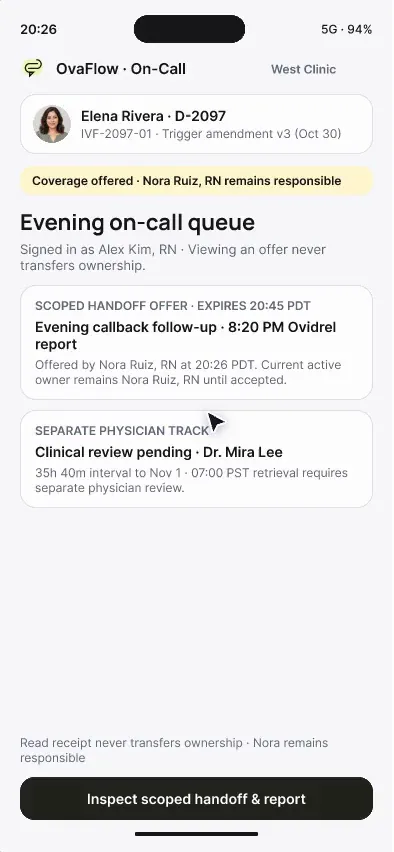
On-call nurse iPhone: seeing isn't accepting, declining leaves no gap: the moment in each chapter, from the prototype walkthrough. Fictional patient data.
Walkthrough page

Prototype walkthrough · iPhone

  1. Chapter 0820:26 → 20:28 PDTTrigger

    The evening handoff

    Nora offers the evening callback to on-call nurse Alex Kim, RN at 20:26 PDT. On the on-call phone, viewing the card does not transfer ownership. At 20:28 PDT Alex explicitly accepts the nursing callback; Dr. Mira Lee's clinical review of the timing interval stays with her.

    On screen at 0:00Alex Kim, RN opens the evening on-call queue. Nora is still the owner.

For the team

What changed for the team

Each of these is a moment where work usually goes quiet. In the walkthrough it stays visible, with one owner and a next step.

  1. The late result

    Without it: An expected result that hasn't arrived looks the same as no result at all.

    In this walkthrough: It is tracked as expected, and Nora owns it until Lee Park, RN explicitly accepts.

  2. The signed change

    Without it: Version 2 and version 3 sit side by side in different places.

    In this walkthrough: Dr. Mira Lee signs version 3. Version 2 stays visible as history and stops being usable.

  3. The wrong chart

    Without it: An instruction can land in whichever chart happens to be open.

    In this walkthrough: Placement stops on Jordan's chart, and Elena's draft waits intact.

  4. The silent send

    Without it: No confirmation invites a second send, and a duplicate message.

    In this walkthrough: Publication outcome unknown, resending held, then one matching record found.

  5. Elena's report

    Without it: “8:20 tonight” gets rounded into the plan, or overwrites it.

    In this walkthrough: Her words, 20:20 reported and 20:22 received, sit beside the signed 20:00 instruction for Dr. Mira Lee to review.

  6. The evening handoff

    Without it: A read message is taken to mean someone has it.

    In this walkthrough: Alex Kim accepts the nursing callback at 20:28. Dr. Mira Lee's clinical review stays with her.

Every decision in this story is made by a clinician, a nurse or the lab. OvaFlow keeps the work, its owner and its source in view.

Afternoon & evening timeline

Six handoff checkpoints across 3 hours and 43 minutes

Between 16:45 and 20:28 PDT on Oct 30, Elena Rivera's trigger instruction crosses four staff members, two patient charts, a network drop, a mobile notification link, and an on-call shift change.

6 handoff checkpoints

Handoff sequence across patient, clinical team, and EMR & lab

  1. 0116:45 PDTClinical team

    Expected estradiol tracked

    Nora Ruiz, RN offers follow-up to Lee Park, RN; Nora retains ownership until accepted.

    What holds: Expected lab tracked

  2. 0217:10 PDTClinical team

    Dr. Mira Lee signs v3

    Ovidrel 250 mcg at 20:00 PDT Oct 30 for 07:00 PST Nov 1 retrieval (36h across DST).

    What holds: Signed order & DST check

  3. 0317:14 PDTEMR & lab check

    Wrong-chart stop & publish check

    Blocks placement into Jordan Patel's open chart; checks portal log after network drop.

    What holds: Chart match & log check

  4. 045:24 PM / 17:24Patient & family

    Old link blocked & question logged

    Elena's old 8:30 PM link opens 8:00 PM v3; her syringe question stays a question, not a dose.

    What holds: Question is not a dose

  5. 058:20 PM / 20:22Patient & family

    Reported 20:20 PDT vs signed 20:00

    Elena reports injecting at 8:20 PM; 35h 40m interval preserved alongside signed 20:00 order.

    What holds: Reported time kept intact

  6. 0620:26 → 20:28Clinical team

    Explicit on-call acceptance

    Alex Kim, RN accepts the nursing callback at 20:28 PDT; Dr. Lee keeps clinical interval review.

    What holds: Viewing is not accepting

Timeline of Oct 30 (16:45 → 20:28 PDT) across Elena's phone (12-hour AM/PM), nursing and physician coordination (24-hour), and the clinic's EMR and portal.
Clinical context & EMR scope boundaries

Why this sequence matters

Clinical and operational context

In the clinic: Trigger timing locks in the 35-to-36-hour biological window before oocyte retrieval. When a late afternoon estradiol result shifts the trigger time on the weekend of a daylight-saving clock change, both the patient and the procedure teams need the exact revised minute and true elapsed interval.

Across handoffs: Afternoon nursing runs are high-interruption environments: multiple charts are open, satellite labs trickle in, and evening callbacks cross from daytime coordinators to on-call staff. Each safeguard in this walkthrough holds a specific failure mode without taking clinical judgment away from the nurse or physician.

Where OvaFlow fits

What OvaFlow coordinates vs. what stays with the clinic

OvaFlow coordinates

  • Expected-result tracking from morning order to afternoon physician review
  • Wrong-chart stop when Jordan Patel's chart is open during Elena's trigger publish
  • Side-by-side retention of signed 20:00 PDT order and patient-reported 20:20 PDT injection
  • Explicit acceptance before transferring the evening callback to on-call nursing

Clinicians, EMR & lab own

  • Dr. Mira Lee's decision to sign trigger version 3 and evaluate the 20-minute interval difference
  • Authoritative order history and documentation inside West Clinic's own EMR
  • Direct clinical advice during the evening nursing callback

Questions about this walkthrough

Common questions from patients and clinic teams

View all 3 story questions & answers
Why does Elena's phone show '8:00 PM, Oct 30' while the nursing board shows '20:00 PDT'?

Patients at home read 12-hour times with AM/PM and an explicit calendar date most reliably, whereas clinical, operating-room and embryology teams coordinate on 24-hour clock time with timezone labels (PDT/PST) so elapsed hours across midnight and daylight-saving changes are unmistakable.

Sources: [6] SART Patient Guide (2026) · [18] ONC SAFER Guides (2025)

Why doesn't tapping 'Send' a second time happen when the portal confirmation drops?

If a network interruption occurs right after pressing Publish, the message may have already landed in the patient portal. Checking the portal's own activity log first prevents sending duplicate or out-of-order trigger notifications on a high-stakes evening.

Sources: [18] ONC SAFER Guides (2025)

Why are the nursing callback and the physician's interval review tracked separately at 20:28 PDT?

When Elena reports injecting 20 minutes after the signed 20:00 PDT time, two distinct clinical actions arise: an immediate nursing callback to reassure and check on Elena, and a physician decision by Dr. Mira Lee on whether a 35h 40m interval affects the 07:00 PST retrieval schedule. Accepting the nursing call never closes the physician's clinical review.

Sources: [6] SART Patient Guide (2026) · [5] ESHRE Guideline Group (2026)

Clinical & operational guidelines referenced in this story (3 sources)
  1. [5]
    ESHRE Guideline Group (2026) — Guideline on Ovarian Stimulation for IVF/ICSI (v2.3 update)Individualized gonadotropin stimulation, ultrasound and estradiol monitoring cadence, trigger criteria and luteal phase support.
  2. [6]
    SART Patient Guide (2026) — ART Step-by-Step Guide: Oocyte Retrieval and Embryo Transfer8–12 day stimulation window, 35–36 hour trigger-to-retrieval interval, 15–30 minute sedated retrieval, Day 5–6 blastocyst culture and progesterone support.
  3. [18]
    ONC SAFER Guides (2025) — Test Results Reporting and Follow-Up & Contingency PlanningClosed-loop tracking of expected diagnostic results from order to clinician review and downtime reconciliation.

See it with your team

Walk this story through with your team

We'll replay the walkthroughs behind each chapter and look at where the same moments happen in your clinic.