Product preview · Fictional patient data

OvaFlow

Walkthrough 1 of 29 · Desktop

Daily care: a changed trigger, the wrong chart and an unknown outcome

A late estradiol result, a newly signed trigger time, the wrong chart caught before publishing, and a lost confirmation checked rather than blindly resent.

Length
0:27
Chapters
10
Shown on
Desktop workspace beside an illustrative clinic portal
  • In the first pilot
  • Prototype walkthrough · Fictional patient data

Daily care: a changed trigger, the wrong chart and an unknown outcome, muted recording of the design prototype. Fictional patient data.

Chapter 1 of 10: My work, with Elena's task on top

Recorded from an interactive design prototype. Every patient, clinician and clinic is fictional, EMR screens are modeled reconstructions, and nothing shown is a live connection to any clinic or vendor system.

Clinical & operational context

The situation on screen, why it matters, and where OvaFlow stops.

Follow Nora Ruiz, RN through one afternoon. A result arrives late, Dr. Mira Lee signs a revised trigger instruction, and the instruction is prepared for the portal. When the wrong chart is open, placement stops; when the confirmation never comes back, the EMR is checked before anything is sent again.

What clinical situation this depicts

Late afternoon on trigger-decision day is one of the highest-pressure windows in an IVF stimulation cycle. Morning ultrasound and serum estradiol results arrive from in-house and outside laboratories while the afternoon nursing team is simultaneously closing callbacks, preparing evening medication instructions, and handing unfinished items to coverage. When a late estradiol value changes the timing of the final maturation injection, four downstream commitments — the patient's trigger clock, the operating room retrieval slot, the anesthesia arrival time, and the embryology bench schedule — must move in lockstep.

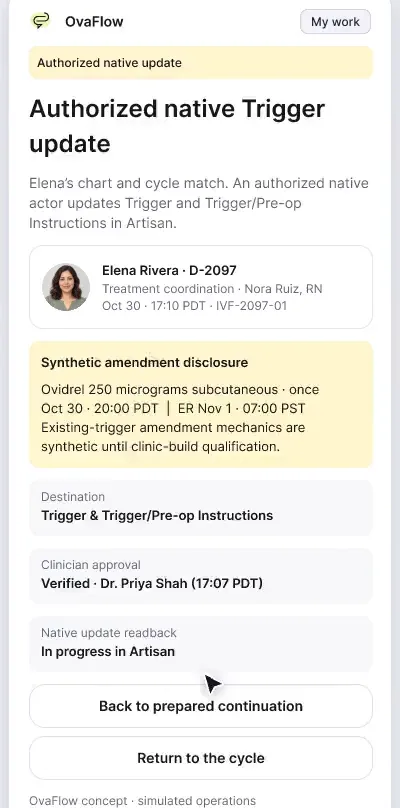
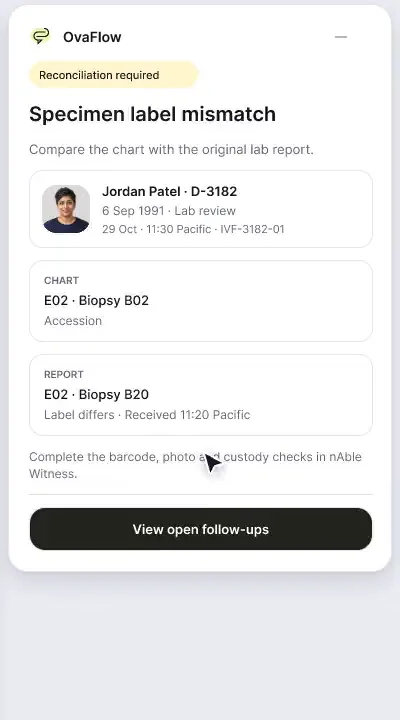
In this walkthrough, Nora Ruiz, RN is managing Elena Rivera's Day 10 antagonist cycle when an outside estradiol result arrives late at 16:45 PDT. Coverage is offered to Lee Park, RN, who accepts the lab follow-up at 17:04 PDT and routes the result to Dr. Mira Lee. At 17:10 PDT, Dr. Mira Lee signs trigger amendment version 3 in the EMR, moving Elena's trigger from 20:30 PDT to 20:00 PDT. When Nora prepares to publish the updated instruction to the clinic portal, OvaFlow detects that Jordan Patel's chart is open in the background window and stops before any text is placed, then tracks an interrupted portal response until exactly one matching version-3 publication is verified.

Step-by-step workflow

Signed trigger amendment to verified single publication

Step 1Desktop workspace

Lee Park, RN

Accepts late estradiol follow-up at 17:04 PDT

Coverage accepted
Step 2Clinic EMR

Dr. Mira Lee

Signs trigger v3 (20:00 PDT) at 17:10 PDT

Signed source
Step 3Portal window

Nora Ruiz, RN

Attempts publish while Jordan Patel's chart is open

Wrong-chart stop
Step 4Elena's chart

Nora Ruiz, RN

Checks portal history before closing task

1 publication verified

How Elena Rivera's 17:10 PDT trigger revision moves from outside estradiol receipt to a verified portal publication without touching the wrong chart.

Guardrail: Active chart identity is checked before placing text, and an interrupted portal response stays 'Publication outcome unknown' until verified.

What OvaFlow coordinates in this recording

  • Keeps Nora Ruiz, RN named as owner until Lee Park, RN explicitly accepts coverage at 17:04 PDT.
  • Pairs Dr. Mira Lee's signed 17:10 PDT version-3 trigger order with a strike-through of version 2.
  • Blocks portal placement when Jordan Patel's chart is open and holds an interrupted send as 'Publication outcome unknown' until checked.

What stays with clinicians & the clinic's own systems

  • Never recommends an estradiol threshold, gonadotropin dose, or trigger clock time.
  • Never auto-publishes a medication change to the patient portal without staff review.
  • Never blindly re-sends an instruction after a portal timeout when a message may have already landed.

What to watch for

What could go wrong, and what you'll see instead.

Follow Nora Ruiz, RN through one afternoon. A result arrives late, Dr. Mira Lee signs a revised trigger instruction, and the instruction is prepared for the portal. When the wrong chart is open, placement stops; when the confirmation never comes back, the EMR is checked before anything is sent again.

The problems it is designed around

  1. Offered coverage mistaken for accepted responsibility during a late-result follow-up.
  2. A revised trigger instruction published into another patient's open chart.
  3. A blind resend when the portal confirmation drops.

What you'll see in the recording

  1. My work, with Needs action, Waiting and Completed
  2. Coverage offered, then explicitly accepted
  3. Dr. Mira Lee signing version 3 at 17:10 PDT
  4. A wrong-chart stop that keeps the draft
  5. “Publication outcome unknown” resolved by checking the EMR
Chapter-by-chapter guide

Every chapter in this 0:27 walkthrough (10 chapters)

Follow the exact timestamps, UI status changes, and coordination safeguards as the recording plays.

  1. Chapter 10:00 – 0:02

    My work, with Elena's task on top

    What to watch for: Watch the My Work queue prioritize Elena Rivera's overdue outside estradiol result above routine follow-ups.

    Boundary rule: OvaFlow ranks coordination urgency from clinic rules; it never interprets hormone values.

    On-screen narration: My work opens with Elena Rivera's task at the top.

Show chapters 2–10 (9 more chapters with timestamps & boundary notes)
  1. Chapter 20:02 – 0:04

    An expected result that hasn't arrived

    What to watch for: Notice the overdue timer and explicit source-lab tag on the expected estradiol row.

    Boundary rule: A missing lab stays visibly open rather than disappearing into an unmonitored inbox.

    On-screen narration: Elena's estradiol result is expected but hasn't arrived, and its follow-up opens.

  2. Chapter 30:04 – 0:09

    Coverage offered, Nora still responsible

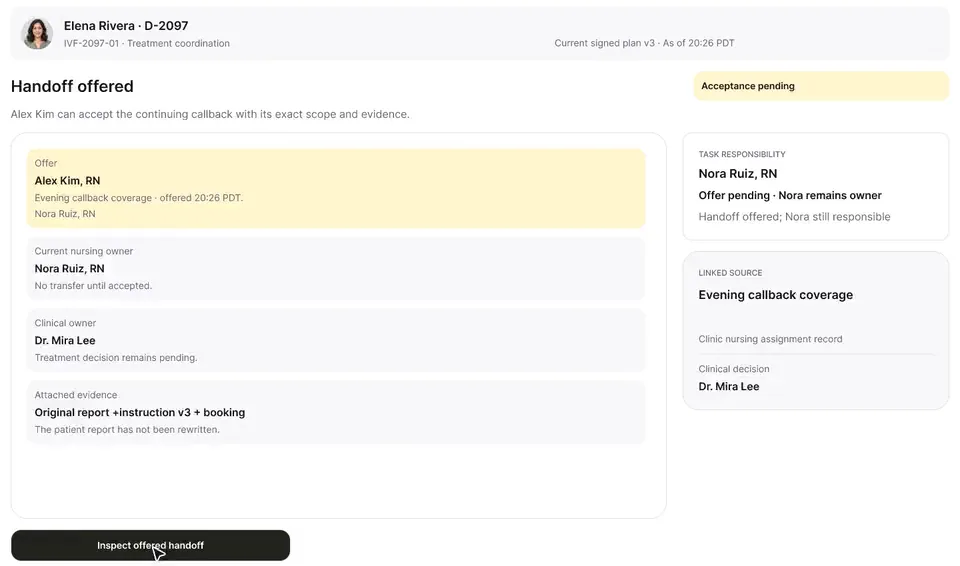
    What to watch for: Nora offers the lab follow-up to Lee Park, RN; the badge reads 'Coverage offered — Nora still responsible'.

    Boundary rule: Offering a task never transfers accountability until the receiving nurse accepts.

    On-screen narration: Nora Ruiz, RN offers the result follow-up to Lee Park, RN. Until Lee Park accepts, Nora remains responsible. The handoff summary shows the offer is still waiting for acceptance. The handoff summary closes.

  3. Chapter 40:09 – 0:11

    The result arrives and Lee Park, RN accepts

    What to watch for: The estradiol result lands and Lee Park, RN clicks Accept at 17:04 PDT, shifting the named owner badge.

    Boundary rule: Both timestamps (offered and accepted) remain visible in the handoff trail.

    On-screen narration: The late estradiol result arrives, and Lee Park, RN explicitly accepts the follow-up.

  4. Chapter 50:11 – 0:13

    Sent to Dr. Mira Lee for clinical review

    What to watch for: Lee routes the result to Dr. Mira Lee for clinical decision-making.

    Boundary rule: Clinical dosing and trigger timing remain exclusively with the reproductive endocrinologist in the EMR.

    On-screen narration: The late result goes to Dr. Mira Lee for clinical review.

  5. Chapter 60:13 – 0:18

    Dr. Mira Lee signs version 3 at 17:10 PDT

    What to watch for: Dr. Mira Lee signs trigger version 3 (20:00 PDT) at 17:10 PDT; version 2 (20:30 PDT) is marked superseded.

    Boundary rule: OvaFlow displays the signed EMR version and visibly retires the older instruction.

    On-screen narration: Dr. Mira Lee signs trigger instruction version 3 at 17:10 PDT. My work shows one copy of each task, sorted into Needs action, Waiting and Completed. Back to the version 3 follow-through task.

  6. Chapter 70:18 – 0:20

    Preparing the current instruction

    What to watch for: Nora opens the prepared patient instruction card showing the 20:00 PDT trigger time and version-3 diff.

    Boundary rule: Staff review the prepared wording before any action occurs in the clinic portal.

    On-screen narration: Nora prepares the patient portal instruction from the signed version 3.

  7. Chapter 80:20 – 0:24

    The wrong chart is open, so it stops

    What to watch for: Because Jordan Patel's chart is open in the target browser tab, a hard stop banner blocks placement.

    Boundary rule: OvaFlow never places patient text when the visible chart header does not match the active task.

    On-screen narration: The open chart switches to Jordan Patel. The instruction belongs to Elena, so placement stops. With Elena's chart open again, the kept draft returns intact: Ovidrel 250 micrograms, subcutaneous.

  8. Chapter 90:24 – 0:26

    Publication outcome unknown

    What to watch for: After switching to Elena's chart, the portal drops its response; the status turns 'Publication outcome unknown'.

    Boundary rule: An interrupted network response is never marked sent and never blindly re-sent.

    On-screen narration: The portal publish is submitted, but no confirmation comes back. The status reads “Publication outcome unknown”, and resending is held.

  9. Chapter 100:26 – 0:27

    One matching publication verified

    What to watch for: Nora inspects the portal's sent history, confirms one matching v3 message, and closes the task.

    Boundary rule: Only verified evidence in the clinic's own portal resolves an unknown publication state.

    On-screen narration: Checking the portal's own record finds one matching publication. Only then is it verified.

OvaFlow never makes the clinical call in these recordings. Physicians sign, the person taking a handoff accepts it, and the lab keeps its own holds. The companion tracks, checks and stops; staff decide.

In this walkthrough

The people on screen

Every patient, family member, clinician and clinic in these stories is fictional. Names, times and screens come from prototype walkthroughs, not from real care.

  • Nora Ruiz, RNIVF nurse coordinator
  • Lee Park, RNCoverage nurse
  • Dr. Mira LeeREI physician
  • Elena RiveraPatient
  • Jordan PatelPatient
Fictional patient data

Questions & answers

Common questions about this walkthrough

What clinicians, coordinators, practice leaders, and patients ask when reviewing Walkthrough 1.

Why doesn't OvaFlow automatically re-send the portal message when the connection drops?

On trigger night, an automatic retry can deliver two medication messages minutes apart, leaving the patient unsure whether a second change occurred. Holding the row as 'Publication outcome unknown' prompts the nurse to check the portal's sent history first.

Who remains responsible while coverage is offered to Lee Park, RN?

Nora Ruiz, RN remains the named owner on the task until Lee Park, RN explicitly clicks Accept at 17:04 PDT.

Show 1 more walkthrough questions
Does OvaFlow calculate the 20:00 PDT trigger time from the estradiol result?

No. Dr. Mira Lee evaluates the ultrasound and estradiol result and signs the 20:00 PDT trigger order in the clinic's EMR at 17:10 PDT.

Next step

Walk through it with your own team.

We'll replay this flow against your roles and handoffs, using fictional records. Please don't send patient data.