No automated clinical advice for patients
Patient-facing screens never give automated clinical advice. Symptom questions go to the clinic's care team, and emergencies to 911.
Product preview · Fictional patient data
AI boundaries
AI in OvaFlow is designed to help with reading and drafting, always grounded in a source and always reviewed by a person. “Uncertain” is an acceptable answer.
Grounded, or empty
Every AI result can come back empty or uncertain, with a reason. A missing field is shown as missing.
Signed source · trigger instruction, version 3
Ovidrel 250 micrograms subcutaneous, once, at 20:00 PDT on Oct 30. Signed by Dr. Mira Lee at 17:10 PDT.
Scope
Design prototype · Fictional patient data
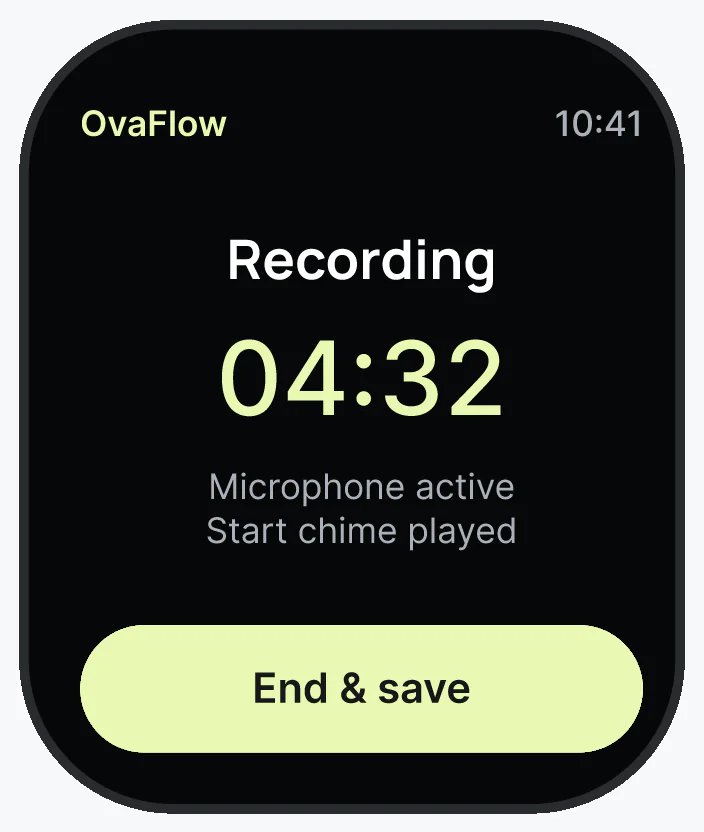
Capture with consent
Capture follows the clinic's policy, starts only after consent, is always visible and can be paused at any moment. A draft from speech is reviewed by a clinician before it goes anywhere.
Patient-facing screens never give automated clinical advice. Symptom questions go to the clinic's care team, and emergencies to 911.
A model update waits for the clinic's medical director and stays within approved operational scope. It is not clinical decision support.
How AI output is checked
OvaFlow's AI boundaries are designed around NIST AI RMF 1.0, WHO AI for Health guidance, US federal clinical decision support transparency principles, and ASRM laboratory guidance [1, 2, 3, 4].
Hard exclusions at every step: No diagnosis · No dosing · No symptom triage · No embryo ranking · No outcome prediction
Standard: Define explicit context-of-use boundaries, measure failure modes, and keep human governance over model updates [1].
OvaFlow design: Restricts context to reading/drafting beside the chart, logs abstentions, and gates model changes behind clinic medical-director approval.
Never deploys autonomous background model changes into clinical workflows.
Standard: Protect human autonomy, ensure transparency and explainability, and preserve clinician accountability [2].
OvaFlow design: Every extracted value highlights its exact source span; visit capture is strictly opt-in with visible consent status.
Patient-facing screens never deliver automated clinical advice or symptom triage.
Standard: Software supporting clinicians should enable independent review of the underlying basis so clinicians do not rely blindly on opaque outputs [3].
OvaFlow design: Displays the signed source document side-by-side with any extracted field or version comparison.
Never generates ungrounded recommendations or hidden risk scores.
Standard: Highlights validation, generalizability and oversight requirements for embryo evaluation and laboratory AI [4].
OvaFlow design: Deliberately excludes embryo morphology ranking, ploidy prediction and live-birth probability calculators.
Embryology grading and selection stay 100% with embryologists and lab systems.
See it
Recordings of the interactive design prototype, with fictional patients and staff.
Shipping clearance isn't clinical clearance, a bounced email isn't abandonment, and a model update waits for the medical director.
Consult notes captured with consent, paused for private moments, reviewed, then checked as saved rather than assumed.
When someone new joins the thread just before a clinical update, the send pauses. Duplicate reminders are caught, and dose questions go to a nurse instead of an automated reply.
AI boundaries
We will show every place AI appears in the prototype, and where it is deliberately absent.