Product preview · Fictional patient data

OvaFlow

Stage 7 of 9

Transfer

Whether a transfer is fresh or uses a frozen embryo (FET) on a natural-ovulation or programmed hormone schedule, the calendar date stays provisional until lining checks, progesterone timing and physician sign-off align. Warming is authorized for one specific embryo by its unique identifier, and if that embryo does not survive warming, any next step requires a fresh clinical decision and consent rather than an automatic backup thaw.

3 prototype walkthroughs
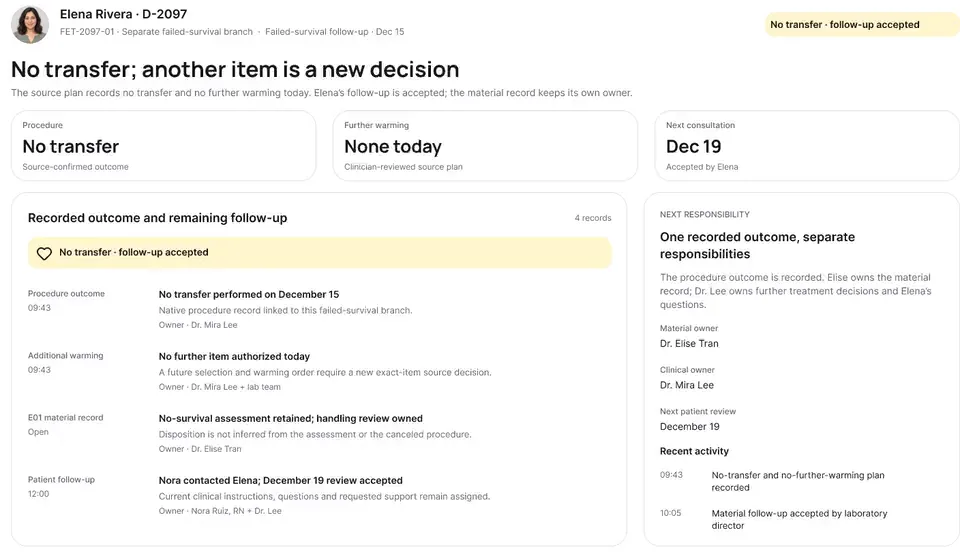
Embryology: PGT-M readiness, a media recall and warming authorization. Prototype walkthrough preview with fictional patient data.
  1. The exact embryo and its warming authorization are confirmed before warming.
  2. The completed transfer is reconciled against the lab's own record.
  3. The recipient's medical deferral on the day of transfer opens a different path.
  4. A refreeze or disposition owner and clinical follow-up are assigned.
  5. Stepping back to the safeguard for an embryo that doesn't survive warming.
  6. Back to the warming authorization.
  7. The warmed embryo's non-survival is recorded in the lab's own record.
  8. Warming any backup embryo requires a new, explicit authorization.
When a warmed embryo doesn't survive, warming a backup embryo needs a new, explicit authorization.Prototype walkthroughFictional patient dataOpen the walkthrough

Both sides

One stage, seen from both sides

For the clinic team

What the team coordinates

OvaFlow tracks provisional versus signed transfer dates, exact-embryo warming authorization, day-of deferral, failed-survival decisions and attempt-specific clearance.

  • Provisional target window kept distinct from the clinician-signed transfer schedule
  • Exact-embryo warming authorization tied to a single embryo identifier and witnessed PGT result
  • Day-of deferral or non-survival branch held for a new physician and patient decision
  • Medical, legal and gestational-carrier clearance tied to one specific transfer attempt
Operational checks at this stage (3)
  • Keep target transfer dates visibly provisional on both clinic and patient views until lining, hormone and clearance checks are signed by the physician.
  • Tie warming authorization to one specific embryo identifier, its storage location and its verified PGT status.
  • Enforce a hard stop if a warmed embryo does not survive—requiring a new documented clinical and patient decision before touching another straw—and require fresh clearance for each transfer attempt.

For you and your family

What you experience

An embryo is placed in the uterus, fresh or after freezing, on a date your clinician confirms.

Questions you may ask here (3)
  • “What is the difference between a natural-ovulation frozen embryo transfer (FET) and a programmed (medicated) FET cycle?”
  • “Why does my calendar say 'Provisional transfer window' until a few days before the procedure?”
  • “What happens if the frozen embryo we chose does not survive warming on the morning of transfer?”
Words you may hear (3)
FET
Placing a warmed, previously frozen embryo in the uterus, in a later cycle.
Warming
Bringing vitrified (flash-frozen) embryos or eggs out of storage so they can be used. Which ones are warmed is a specific, authorized decision.
Gestational carrier
A person who carries a pregnancy for intended parents, with their own role, chart and consent.

Questions about your own treatment go to your care team. OvaFlow never gives medical advice. In an emergency, call 911.

Read the plain-language guide to IVF

One attempt at a time

Clearance belongs to one attempt

Clearance recorded for a first transfer attempt can't be reused for the second. The second attempt gets its own, recorded separately.

Attempt 1Transfer cycle 1Clearance · attempt 1
Attempt 2Transfer cycle 2Clearance · attempt 2

Attempt 1 clearance can't be reused

From the multi-party walkthrough. Fictional patient data.

See it

Walkthroughs from this stage

Recorded from an interactive design prototype. Every patient, clinician and clinic is fictional, and EMR screens are modeled reconstructions.

Prototype walkthrough · Fictional patient data

Handoffs and safeguards

Where work slips, and what holds instead

These are the moments the design is built around. Each safeguard stops or holds work; the decision stays with the clinician or the lab.

Where it slips today

  1. A provisional target window on the patient calendar is treated by staff or family as a signed transfer schedule.
  2. A second embryo is warmed automatically on procedure morning after the first embryo does not survive warming.
  3. Medical or legal clearance recorded for an earlier transfer attempt is reused without re-verification for a new attempt.
  4. Progesterone start timing drifts from the embryology warming schedule.

What holds in OvaFlow

  • Right patientExact-embryo authorizationWarming goes ahead only for the embryo named in the authorization.
  • Right next stepA new decision if an embryo doesn't survive warmingIf a warmed embryo doesn't survive, another one is not warmed without a new authorization.
  • Right patientClearance per attemptClearance recorded for one transfer attempt isn't reused for the next one.
All safeguards

Step-by-step timing & questions

How Transfer unfolds day by day

Embryo transfer places a selected fresh or warmed frozen blastocyst into the uterus under ultrasound guidance after endometrial readiness, progesterone timing, exact-embryo warming authorization and attempt-specific clearances align.

2–3 wks lining prep · Exact progesterone window · 15m transfer

From provisional transfer window to exact-embryo warming & placement

  1. 01Weeks 1–2

    Lining prep & attempt clearance

    Patient & family

    Whether on a natural-ovulation cycle or programmed estrogen support, scans check uterine lining thickness and pattern.

    What holdsProvisional label + per-attempt clearance
    Clinic, EMR & lab

    Target transfer window stays labeled 'Provisional'; attempt-specific medical and gestational-carrier legal clearances are verified.

  2. 025–6 days pre-FET

    Ovulation / progesterone anchor

    Patient & family

    Once ovulation is confirmed or progesterone support starts, your clinician signs your confirmed transfer date and time.

    What holdsSigned date + exact embryo ID authorized
    Clinic, EMR & lab

    Physician signs the transfer schedule and exact-embryo warming authorization tied to one specific embryo ID and PGT report.

  3. 03Transfer morning

    Embryo warming & backup rule

    Patient & family

    On transfer morning the embryologist warms your authorized embryo and checks re-expansion before you head to the procedure room.

    What holdsNew decision if warming fails
    Clinic, EMR & lab

    If the authorized embryo does not survive warming, lab workflow stops—no second embryo is thawed without a new physician and patient decision.

  4. 04Procedure + luteal

    Ultrasound-guided transfer

    Patient & family

    With a comfortably full bladder, you watch on ultrasound as the catheter places the embryo; you continue luteal progesterone until your blood test.

    What holdsWitnessed placement + luteal plan
    Clinic, EMR & lab

    Two-identifier witnessing confirms patient and embryo dish; luteal medication schedule and beta-hCG date are published.

Natural-ovulation and programmed frozen embryo transfer (FET) pathways anchor on different biological clocks; warming is authorized for one specific embryo ID, with a mandatory pause for a new decision if warming survival fails.
Worked example: Single-embryo warming stop and attempt-scoped clearance for Avery & Sam
Worked example · West ClinicFictional patient data

Single-embryo warming stop and attempt-scoped clearance for Avery & Sam

What the patient sees

Avery & Sam see their target transfer window clearly marked as provisional until lining and progesterone timing are signed. When preparing for a second attempt, prior clearance does not silently carry over.

What the clinic team sees

In the embryology warming walkthrough, warming is authorized for one specific embryo ID. If survival fails on transfer morning, OvaFlow blocks automatic warming of a second embryo and opens a clinician-patient decision step.

Why it holds: Provisional dates are never mistaken for confirmed procedures, backup embryos are never warmed without consent, and earlier-attempt clearances are never reused.

Where OvaFlow fits

How OvaFlow works beside the clinic's own EMR and lab

Coordination companion

What OvaFlow coordinates

  • Clear visual distinction between a provisional target window and a physician-signed transfer schedule
  • Single-embryo warming authorization linked to embryo ID, tank coordinate and verified PGT report
  • Mandatory decision hold on warming non-survival and attempt-specific medical/legal clearance tracking
System of record

What stays with clinicians & the EMR

  • Selecting natural-ovulation versus programmed FET protocol, endometrial lining criteria and luteal progesterone regimen
  • Embryo warming, survival assessment, assisted hatching and catheter loading in the embryology lab
  • Ultrasound-guided transcervical embryo transfer and clinical counseling on single embryo transfer
OvaFlow never prescribes medications, never triages symptoms, and never replaces the clinic's own EMR or electronic witnessing hardware.

Common questions at this stage

Questions from patients, families and clinic teams

View all 4 stage questions & answers
How do natural-ovulation and programmed frozen embryo transfer (FET) protocols differ?

In a natural or modified-natural FET cycle (for ovulatory patients), the clinic tracks the body's own dominant follicle and luteinizing hormone surge to time embryo warming after ovulation, where a corpus luteum forms naturally. In a programmed FET cycle, estrogen builds the uterine lining and exogenous progesterone starts on a set day to open the implantation window. A 2026 multicentre randomised trial of 4,376 ovulatory patients in The BMJ (Wei et al.) found comparable healthy live-birth rates between natural and programmed regimens, with different trade-offs in monitoring flexibility, cycle cancellation and obstetric hypertensive risk that clinicians tailor to each patient.

Sources: [11] Wei et al. (The BMJ) (2026) · [6] SART Patient Guide (2026)

Why is warming authorized for one specific embryo rather than a general 'thaw next available' instruction?

Each vitrified blastocyst has its own developmental day (Day 5, 6 or 7), morphological grade, biopsy history and genetic testing result. Authorizing warming by exact embryo identifier and storage coordinate ensures the embryo warmed on procedure morning is the exact one the patient and physician consented to transfer.

Sources: [9] ASRM Practice Committee (2022) · [7] HFEA Patient Guide (2026)

What happens if an embryo does not survive warming on the morning of transfer?

Although modern vitrification survival rates are high, non-survival can still occur. When an embryo does not survive warming, another embryo may have a different genetic result, sex chromosome status, mosaicism finding or grading profile. OvaFlow holds the workflow so the physician and patient make a fresh, documented decision—whether to warm a specific second embryo or defer the transfer—rather than allowing an automatic backup thaw.

Sources: [9] ASRM Practice Committee (2022) · [6] SART Patient Guide (2026)

Why can't legal or medical clearance from Attempt #1 be reused for Attempt #2?

In third-party reproduction and gestational-carrier care, ASRM guidelines emphasize that legal agreements and medical clearances often specify attempt limits, expiration dates or updated infectious-disease windows. Tying clearance to a single transfer attempt prevents a subsequent transfer from proceeding on expired or single-attempt paperwork.

Sources: [12] ASRM Practice Committee (2022)

Clinical & operational sources for Transfer (5 primary guidelines)
  1. [11]
    Wei et al. (The BMJ) (2026) — Natural ovulation versus programmed regimen before frozen embryo transfer in ovulatory women: multicentre randomised clinical trialComparison of natural-ovulation and programmed frozen embryo transfer (FET) scheduling anchors, monitoring cadence and cancellation trade-offs.
  2. [9]
    ASRM Practice Committee (2022) — Comprehensive guidance for human embryology, andrology, and endocrinology laboratories: management and operationsContinuous specimen witnessing, chain of custody, culture-media lot traceability, warming authorization and cryostorage records.
  3. [12]
    ASRM Practice Committee (2022) — Recommendations for practices using gestational carriers: a committee opinionIndependent legal clearance, separate medical charts and attempt-specific clearance before embryo transfer.
  4. [6]
    SART Patient Guide (2026) — ART Step-by-Step Guide: Oocyte Retrieval and Embryo Transfer8–12 day stimulation window, 35–36 hour trigger-to-retrieval interval, 15–30 minute sedated retrieval, Day 5–6 blastocyst culture and progesterone support.
  5. [7]
    HFEA Patient Guide (2026) — In vitro fertilisation (IVF) and Pre-implantation Genetic Testing (PGT-M / PGT-SR)Plain-language overview of IVF stages, embryo grading, single embryo transfer and genetic testing options.

See it with your team

Walk one transfer attempt through with us.

We'll go through the prototype walkthroughs for this stage and the questions your team would ask first.