Elena's iPhone: the current instruction, an old link, an honest report
An old text link can't send Elena to a superseded injection time. Reporting a late dose is simple and honest, and urgent help is one tap away.
Product preview · Fictional patient data
For patients & families
IVF asks a lot of you: timed injections, late-night questions, waiting. The patient companion is being designed so the current instruction always comes first and a real person is behind every question.
Who this is for
Patients, spouses and support people, and intended parents going through IVF.
Elena's trigger night
Elena is a fictional patient. Her phone shows the current instruction first, takes her report in her own words, and always says who has her callback.
Tapping an older text link and following a time that has changed.
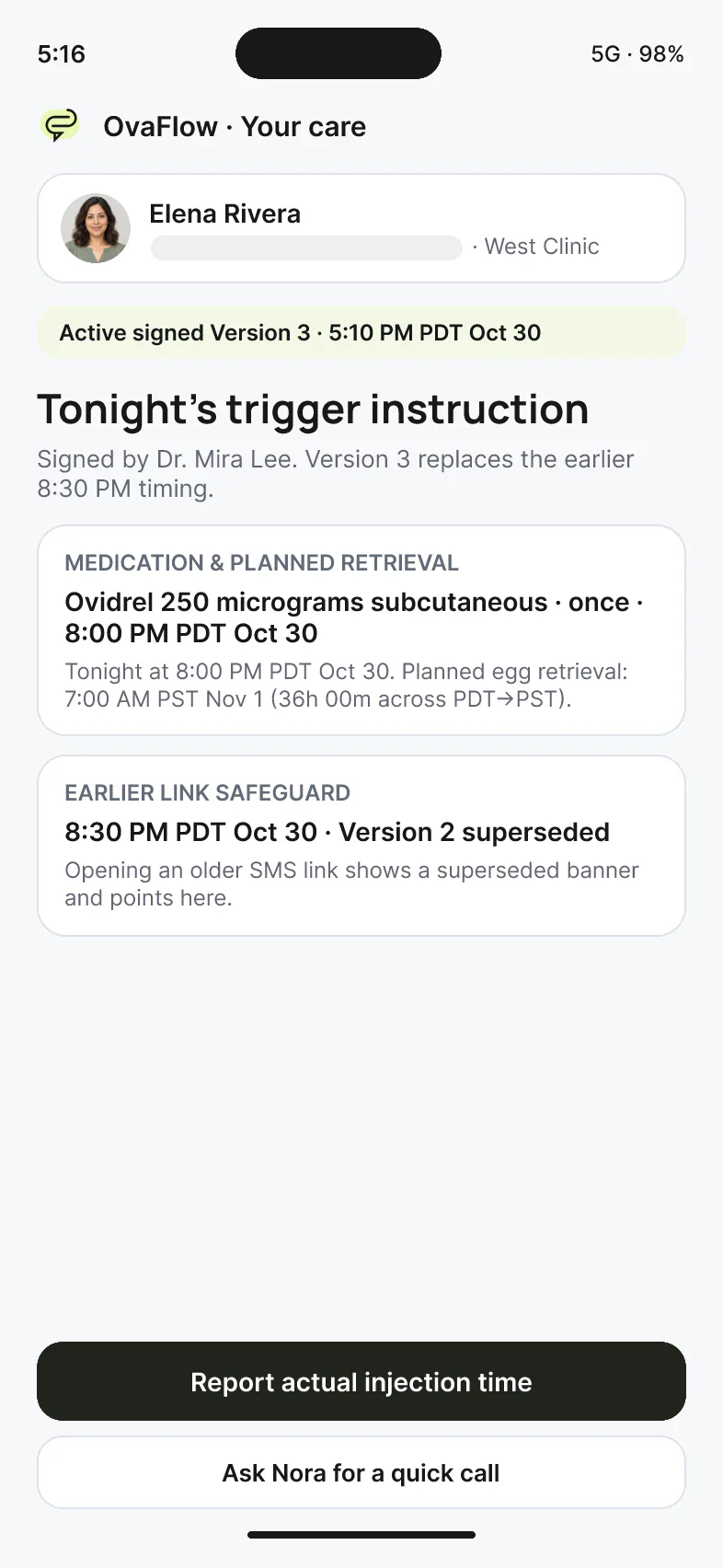
The current signed instruction first; older links open the current one instead.
Feeling afraid to report a late injection.
A simple, honest way to report what actually happened.
Not knowing who will call back this evening.
Care-team status in plain words: who has your callback, and what is still with the doctor.
Being left to judge symptoms alone after retrieval.
Recovery check-ins that point to the clinic's 24/7 line and 911, never automated advice.
A day in the cycle
Drawn from the prototype walkthroughs. Times are from the fictional demonstration day.
Going through IVF means managing refrigerated syringes, exact evening injection times, partner or donor appointments, and emotional waiting periods—all after work hours when clinic phones roll to on-call. ASRM informed consent ethics guidance, ESHRE psychosocial care guidelines, and NICE fertility principles emphasize plain-language clarity, honest two-way communication, and honoring patient-chosen pauses without intrusive automated nudges [1, 2, 3].
Dr. Mira Lee signs Trigger v3 (8:00 PM, Oct 30) and Nora Ruiz, RN publishes it
Tapping an earlier afternoon text notification opens an outdated PDF that still tells you to inject at 8:30 PM.
Shows the current signed 8:00 PM instruction first; tapping any older text link opens the current card instead
Current instruction · Old link redirectedElena wants to double-check her prefilled syringe before the 8:00 PM injection
Replying to a portal reminder to ask a question accidentally checks the box that says you already took the dose.
'Ask for a quick call' requests a nurse callback while leaving the 8:00 PM dose marked Not taken yet
Question sent · Dose stays openElena finishes injecting at 8:20 PM and submits her note at 8:22 PM
Portals only offer a binary 'Taken' button or make you feel afraid to admit the shot happened 20 minutes after 8:00 PM.
Lets you record 8:20 PM in your own words; clinic receives it at 8:22 PM alongside the 8:00 PM signed order
Reported 8:20 PM · Received 8:22 PMAlex Kim, RN accepts the evening callback; Dr. Mira Lee holds the clinical review
After submitting a late-dose note at night, you stare at a spinner wondering if anyone on call saw it.
Plain-language status: 'Alex Kim, RN has your callback · Timing review is with Dr. Mira Lee'
Named nurse & doctor shown plainlyPost-retrieval recovery check-in, or Maya Chen choosing to pause treatment after a hard cycle
Automated symptom bots give generic tips, or automated cycle reminders keep pinging your phone after a loss or pause.
Recovery check-ins go to your nurse with the 24/7 clinic line and 911; a pause stops routine reminders immediately
Human care team · Pause respectedWorked patient stories · Elena Rivera (8:20 PM report) & Maya Chen (Your pause, your pace)
See how the patient companion is designed to protect Elena Rivera on trigger night when her injection time changes from 8:30 PM to 8:00 PM on Oct 30, and how it respects Maya Chen's privacy and pace when she pauses treatment.
Why this moment matters in an IVF clinic
Patients are asked to perform time-sensitive subcutaneous or intramuscular injections at home while navigating intense uncertainty. ESHRE psychosocial guidelines and NICE NG257 principles call for clear, accessible information at every stage, explicit support during early pregnancy waiting periods, and immediate respect for patient-chosen pauses [1, 2, 3, 4].
After Dr. Mira Lee signs a revised 8:00 PM trigger time on Oct 30, Elena taps an older text link from earlier in the afternoon. Instead of displaying the superseded 8:30 PM instruction, OvaFlow opens the current 8:00 PM instruction with a clear banner explaining what changed.[1][3]
Elena asks a quick question at 5:24 PM before dosing—which never marks the shot as taken—and then injects at 8:20 PM. She logs 8:20 PM in her own words; the clinic receives her note at 8:22 PM. At 8:28 PM, her screen shows plainly that Alex Kim, RN has her callback and Dr. Mira Lee is reviewing the 20-minute difference.[1][3]
During post-retrieval recovery and early pregnancy serial beta-hCG / ultrasound follow-up (where NICE NG126 emphasizes careful clinical follow-up for pregnancy of unknown location or ectopic symptoms), every check-in routes to the clinic's human team while prominently displaying the clinic's 24/7 phone line and 911.[4]
When Maya Chen decides to pause treatment, routine medication and appointment prompts stop right away. If she reaches out through a private channel to request counseling or speak with her clinician, asking for support never restarts automated cycle reminders, and her accessibility or interpreter preferences stay attached to future visits.[2][3]
Recovery check-ins go to your clinic team with the 24/7 phone line and 911 visible. Private messages stay out of shared family threads.
The patient companion is planned for after the first pilot. OvaFlow never gives medical advice; urgent symptoms always go to your clinic's 24/7 line or 911.
How Elena Rivera's phone shows her current 8:00 PM instruction and callback owner, and how Maya Chen's pause stops routine reminders.
Prototype walkthroughs
Recorded from the interactive design prototype with fictional patient data. Open one to play it here with chapters and captions.
“Your pause, your pace”: routine reminders stop, and asking for a private call doesn't restart treatment.
The patient's phone and the clinic's workspace side by side, so each reassuring screen shows the safeguard behind it.
Provisional dates stay provisional, a positive test isn't the finish line, a loss stops cheerful reminders, and OB graduation counts only when the OB accepts.
Common questions & sources
How OvaFlow handles edge cases, clinical authority, and source-system boundaries for this role.
OvaFlow checks whether that instruction has been replaced by a newer signed version. If your doctor signed an updated time (for example, moving your shot from 8:30 PM to 8:00 PM on Oct 30), the older link automatically opens the current 8:00 PM instruction and tells you that the earlier time was retired.
You can enter the exact time you took it (such as 8:20 PM) in your own words. OvaFlow sends that report to your care team right away so your physician can review whether your retrieval time needs any adjustment, and shows you which nurse has your callback.
No. OvaFlow never gives medical advice or judges whether a symptom is normal. Questions about doses or symptoms always go to your clinic's human care team, and every recovery screen shows your clinic's 24/7 phone number and 911.[4]
Next step
Share this page with your care team. OvaFlow is a design prototype and never gives medical advice; questions about your care always go to your clinic.