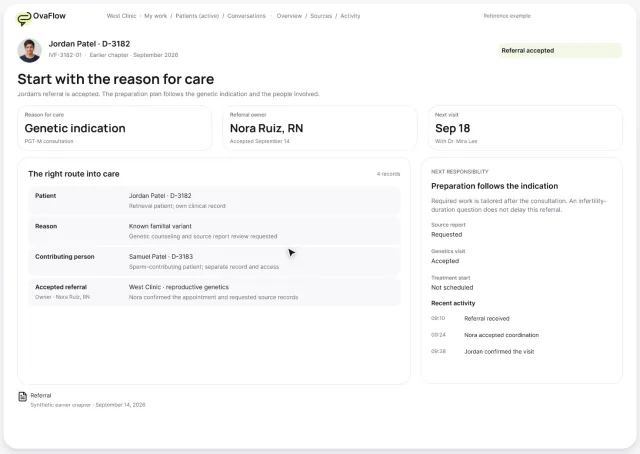
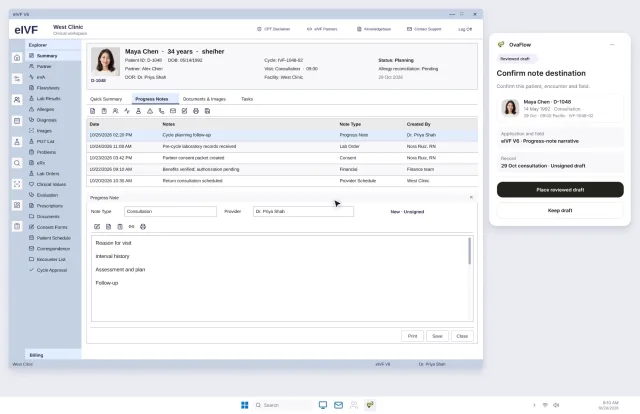
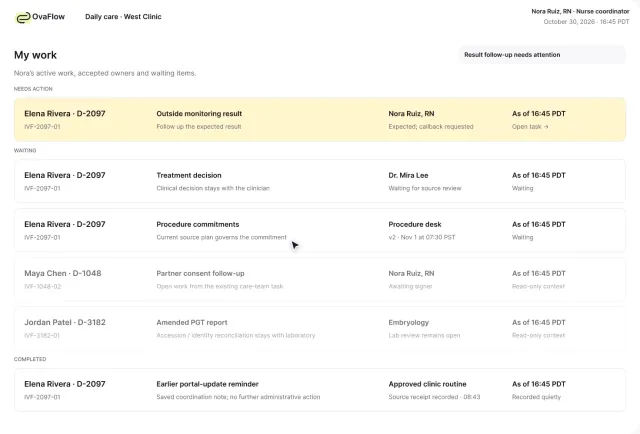
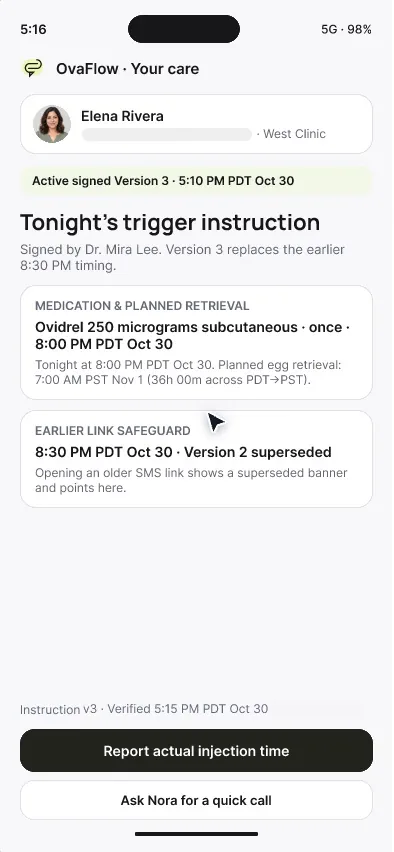
Daily careOct 30, 16:45 → 20:28 PDT
One afternoon, one evening, every next step in view
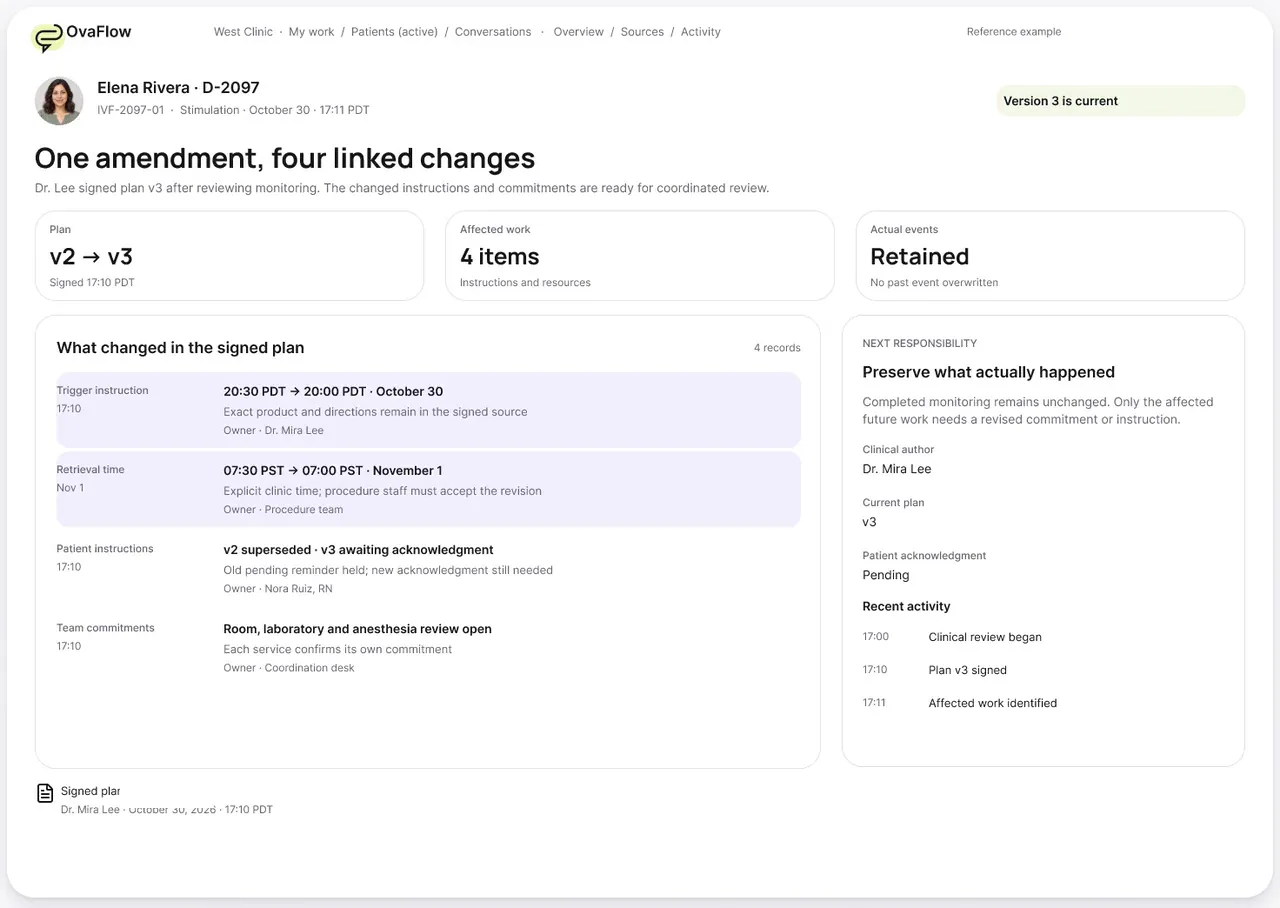
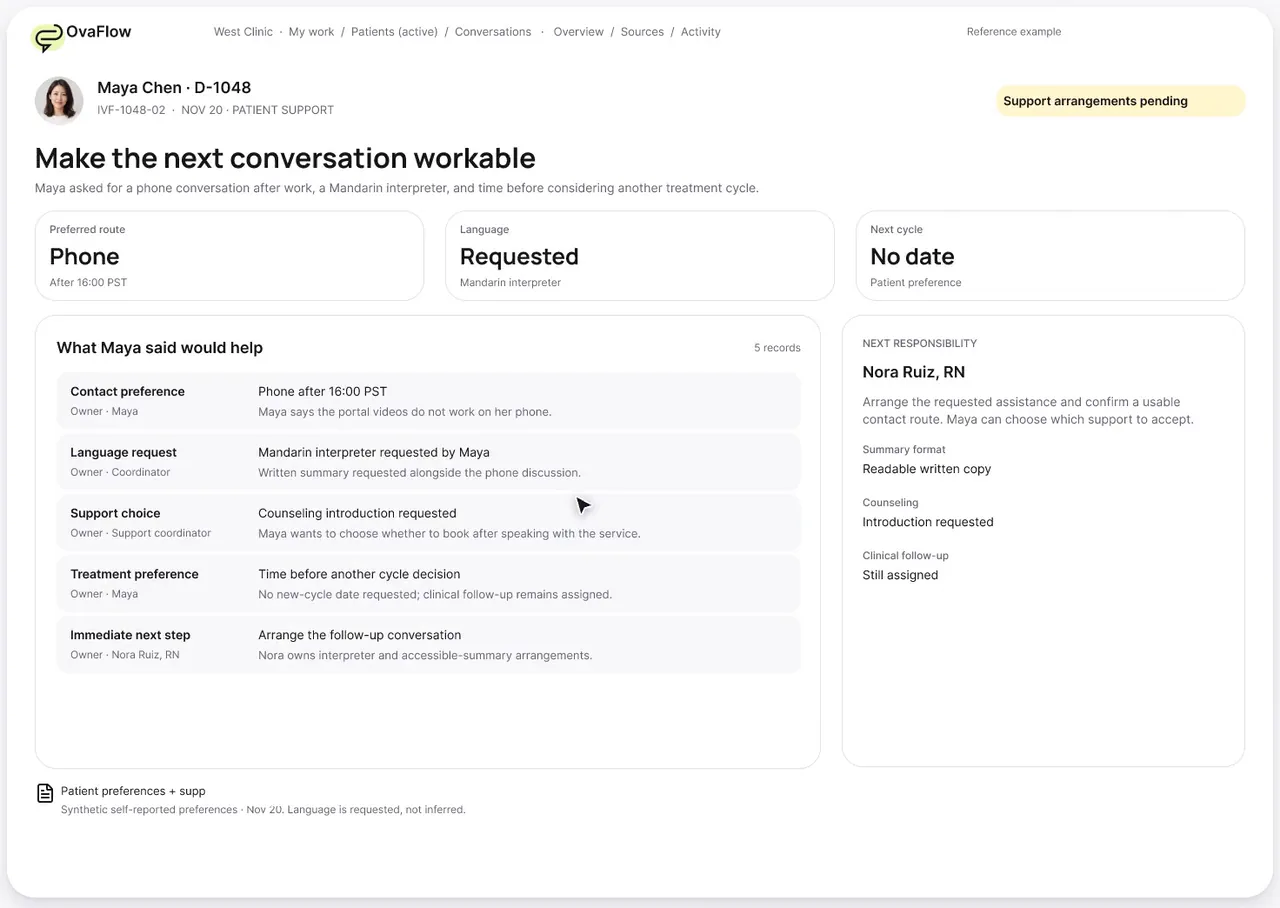
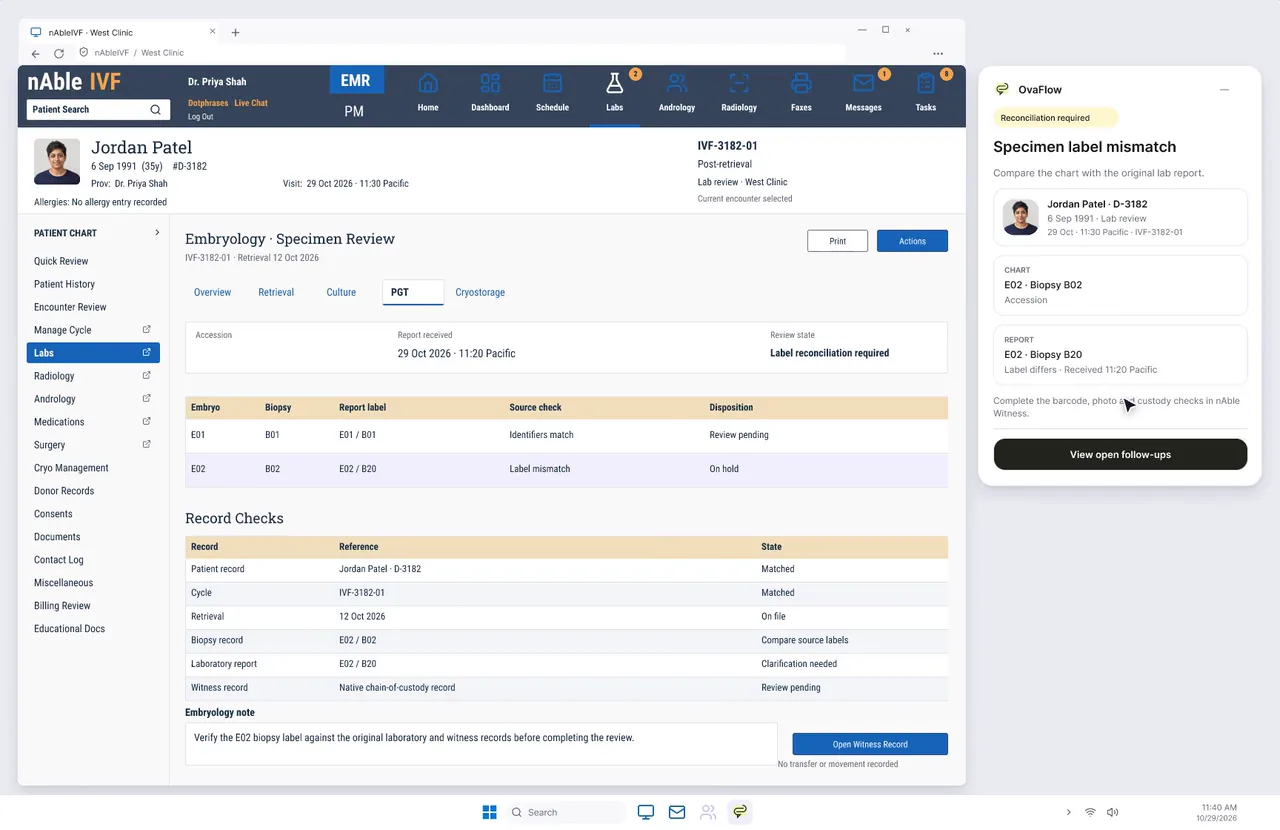
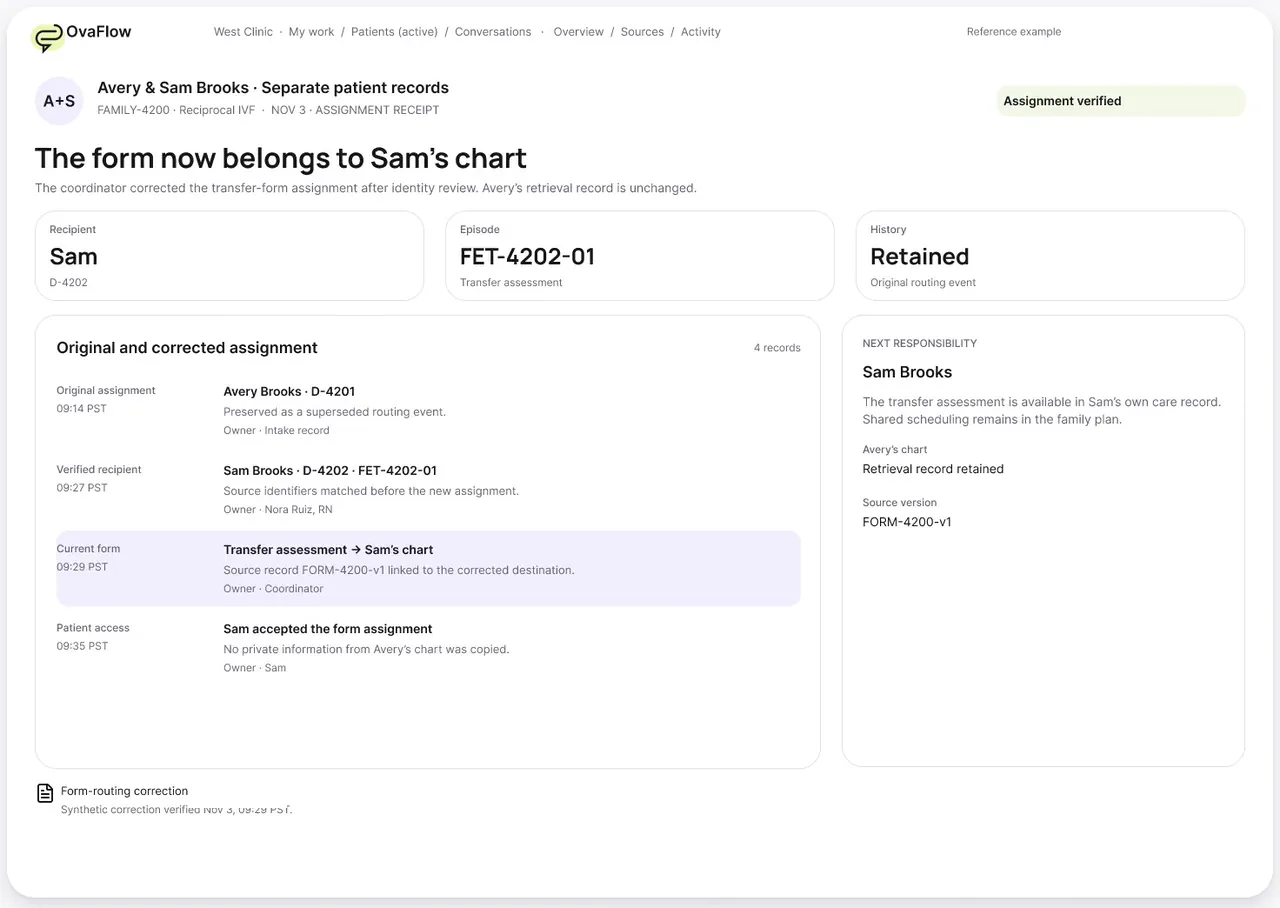
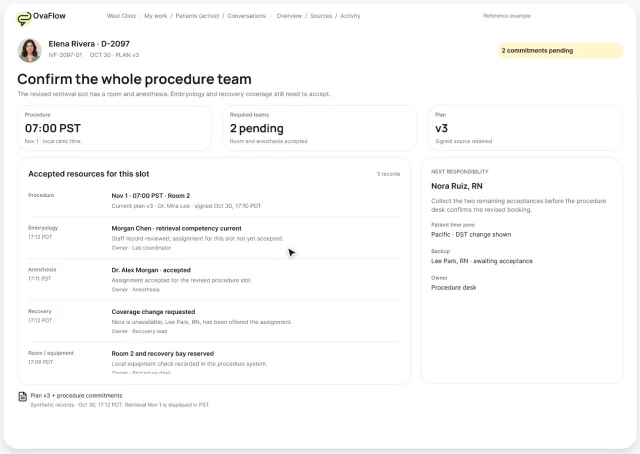
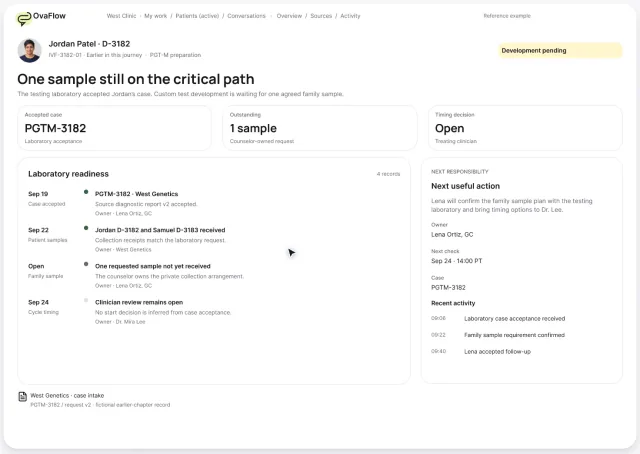
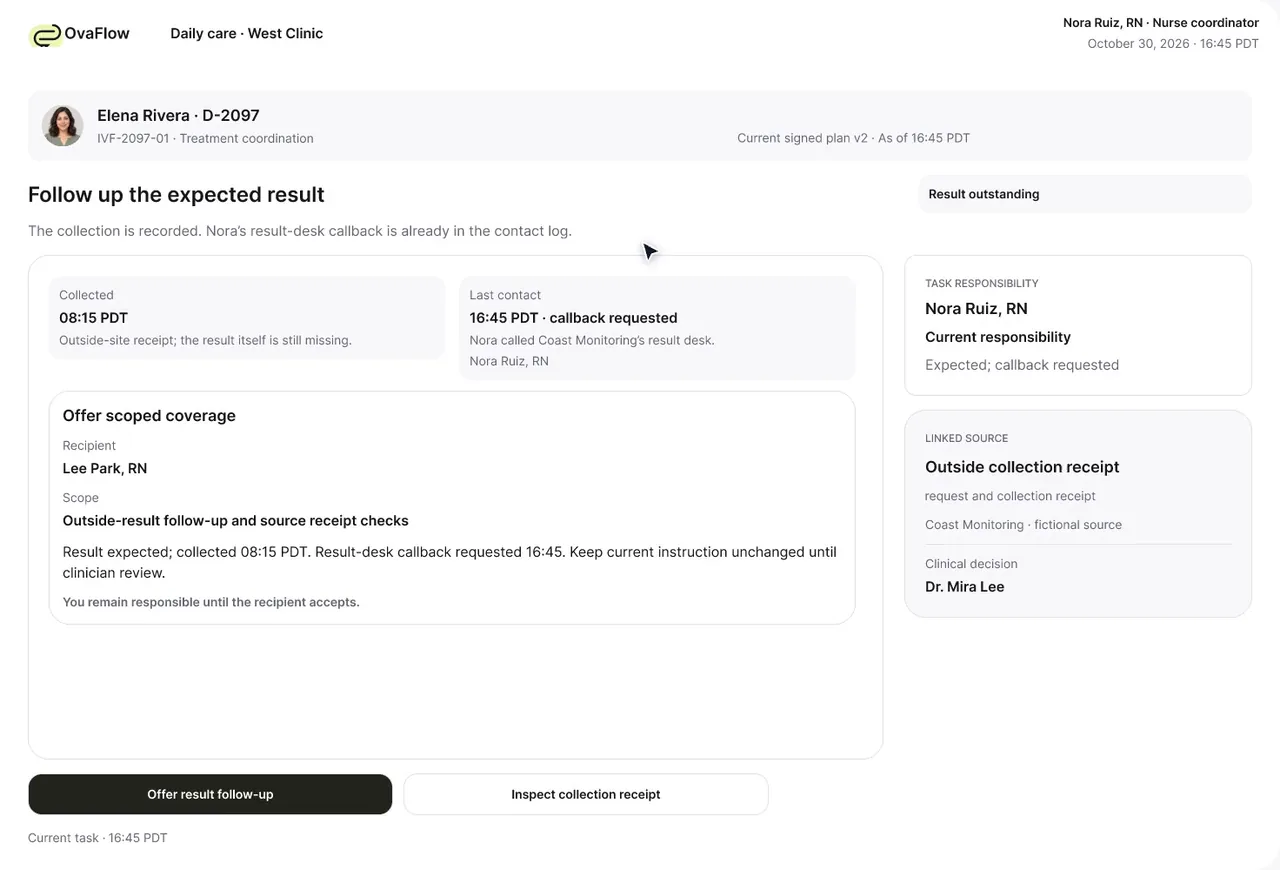
A late result, a signed change, the wrong chart, an unknown outcome and an evening handoff.
Product preview · Fictional patient data
Journey
IVF moves through nine stages, with a branch for when plans change. Follow the path to see what patients go through at each stage, and what OvaFlow helps the clinic team keep track of.
The path
Each stage has a line for patients and families, and a line for clinicians on what OvaFlow tracks there. The dashed branch is part of the journey, not a failure state.
Tip: use the arrow keys to move between stages, Enter to open one.
Stage 01
Stage 02
Stage 03
Stage 04Flagship story
Stage 05
Stage 06
Stage 07
Stage 08
Branch
This branch can open at almost any point. A return happens on the patient's timing, often to planning, a frozen transfer, or long-term storage choices.
Stage 09
Clinical cadence & handoffs
An IVF episode is not a single visit—it is a sequence of timed handoffs between the patient at home, nursing coordination, the clinic's own EMR, the embryology lab, and outside genetics or obstetric care.
12-hour instructions with AM/PM and calendar date, pre-dose questions, self-reported injection times, and Lock Screen privacy.
Patient sees clear next steps before genetics or obstetric transitions.
Expected morning ultrasound and satellite hormone results, afternoon dose callbacks, and explicit shift-to-shift handoffs.
Nursing tracks outside lab requisitions and OB referral acceptance.
Cycle readiness sign-off, flowsheet monitoring notes, versioned trigger orders, and amended genetics report review.
Physicians sign off on amended PGT reports and OB graduation packets.
Gamete pairing, Day 1–7 culture, two-biopsy embryo lineage, single-embryo warming, and cane-by-cane cryo custody.
Lab links biopsy tubes to reference genetics and remaining frozen embryos.
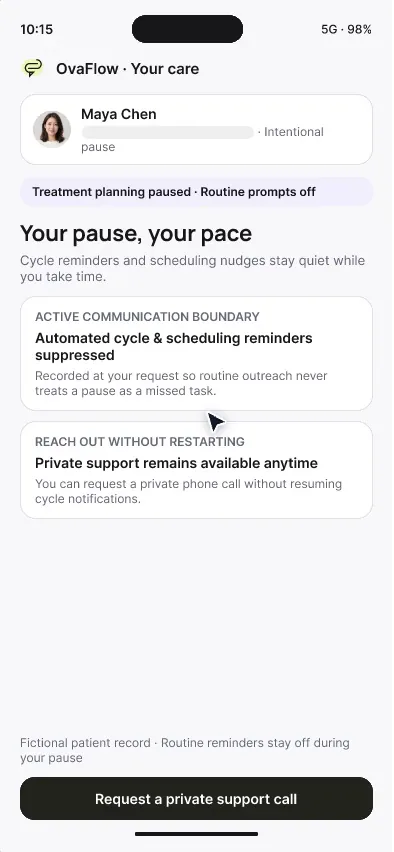
Canceling stimulation, converting to freeze-all, repeating a biopsy, experiencing a loss, or choosing a pause cleans up future bookings and silences routine reminders across all four settings while keeping private support open.
| Stage | Typical window | What patients navigate | What the clinic & lab verify | What holds before the next step |
|---|---|---|---|---|
| 01Referral & intake | 24–72h urgent · 1–3 wks routine | Sharing reason for care, family roles, and any oncology start date | Pathway selection, separate participant charts, oncology–REI window | Accepted retrieval window & role-specific charts |
| 02Workup & readiness | 2–6 wks (4–12 wks w/ PGT-M) | Hormone/infectious labs, uterine scan, consents, medication delivery | Sperm-source check, PGT-M lab acceptance, allergy & PA reconciliation | All-green readiness gate before Day 1 |
| 03Stimulation & monitoring | 8–12 days · Scans q1–3d | Nightly injections, morning scans & blood draws, afternoon dose calls | Expected outside lab tracking, EMR flowsheet save check, e-Rx routing | Verified lab + saved note before dose call |
| 04Trigger | Exact minute · 35–36h pre-retrieval | Taking the maturation shot at the exact signed evening time | DST-aware interval check, wrong-chart stop, reported-time delta, on-call accept | Signed v3 published + explicit evening callback owner |
| 05Retrieval & recovery | 15–30m procedure · 7d recovery | Sedated egg collection, recovery rest, home symptom check-ins | 4-team slot commitment, named Day 1 nurse, OHSS routing & freeze-all sync | 4-team commitment + named discharge owner |
| 06Embryology & PGT | Days 0–7 culture · 1–3 wks PGT | Day 1 fertilization update, Day 5–7 blastocyst & genetic testing results | Witnessed ICSI/insemination, biopsy lineage, amended PGT sign-off, lot trace | Embryo-level biopsy lineage & physician PGT review |
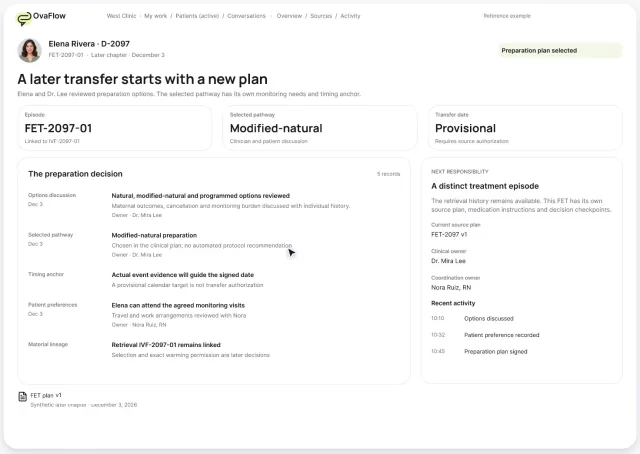
| 07Transfer | 2–3 wks prep · 15m placement | Natural or programmed lining prep, ultrasound-guided embryo placement | Provisional vs signed date, exact-embryo warming ID, per-attempt clearance | Single-embryo warming auth + non-survival hold |
| 08Pregnancy & OB graduation | 9–14d beta · Wks 8–10 OB handoff | Beta-hCG blood tests, early ultrasounds, luteal taper, first OB visit | Active PUL surveillance, luteal stop dates, OB acceptance confirmation | Fertility clinic owns care until OB accepts |
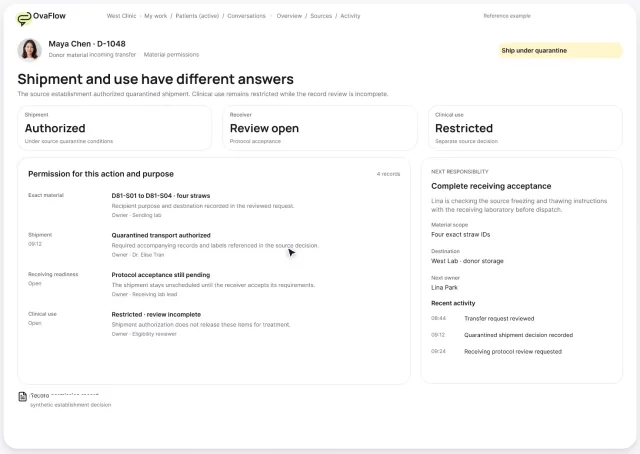
| 09Cryo & long-term | Months to 10+ years | Annual storage choices, inter-clinic shipping, future sibling planning | Shipping vs clinical-use gate, cane manifest check, conflict holds, donor updates | Shipment ≠ use + fee payment = active contact |
| ↺When plans change | Opens anytime · Patient-paced | Stepping back, converting to freeze-all, or grieving a loss without pressure | Order/booking cleanup, prompt suppression, private callback, context return | Prompts silenced + pause kept during support |
Frequently asked questions
While every family's path is individualized, initial diagnostic workup and insurance or genetics preparation typically take 2 to 6 weeks (or 4 to 12 weeks when custom single-gene PGT-M test development is needed). Once ovarian stimulation begins, daily hormone injections and monitoring last about 8 to 12 days, followed by the trigger injection and egg retrieval 35 to 36 hours later. Embryos develop in the lab for 5 to 7 days. A fresh transfer takes place right after culture with a pregnancy blood test (beta-hCG) 9 to 14 days later, whereas a frozen embryo transfer (FET) cycle adds 2 to 4 weeks for PGT results and endometrial preparation.
Sources: [6] SART Patient Guide (2026) · [5] ESHRE Guideline Group (2026) · [7] HFEA Patient Guide (2026)
Modern vitrification (flash-freezing) allows blastocysts to be preserved with high survival rates. Clinicians frequently recommend freezing embryos and transferring in a subsequent cycle when preimplantation genetic testing (PGT) is planned, when ovarian response carries a risk of ovarian hyperstimulation syndrome (OHSS), or when hormone or endometrial factors favor letting the body return to baseline before transfer.
Sources: [8] ASRM Practice Committee (2024) · [11] Wei et al. (The BMJ) (2026) · [6] SART Patient Guide (2026)
OvaFlow is a workflow and coordination layer that works alongside the clinic's own EMR, e-prescribing tool and embryology witnessing system. Physicians still sign orders and prescriptions in the clinic's own systems, and embryologists still witness specimens at the bench; OvaFlow tracks expected results, cross-team commitments, versioned changes, wrong-chart stops and explicit handoffs across those surfaces.
Sources: [18] ONC SAFER Guides (2025) · [9] ASRM Practice Committee (2022)
In real reproductive medicine, converting a fresh transfer to freeze-all, canceling stimulation for abnormal response, repeating a biopsy, or taking a personal pause after an unsuccessful attempt are standard clinical pathways—not software exceptions. Treating plan changes as a connected branch ensures downstream bookings are cleaned up, automated reminders stop immediately, and patients can return on their own timing.
Sources: [17] ASRM & ESHRE (2015–2026) · [13] NICE Guideline 126 (2026)
Stories
Five fictional stories follow patients and the clinic team across these stages.
A late result, a signed change, the wrong chart, an unknown outcome and an evening handoff.
Monitoring, a changed trigger, retrieval, symptoms afterward and a move to freeze-all.
A consult, private support, an attempt that doesn't succeed, a chosen pause and a return.
A label that doesn't match, an accession hold, an amended report and lineage across biopsies.
Separate roles, a consent form moved to the right chart, and clearance for one attempt at a time.
Where to start
Next step
We'll start the walkthrough at that stage and follow the cycle forward from there. Fictional records only; please don't send patient data.