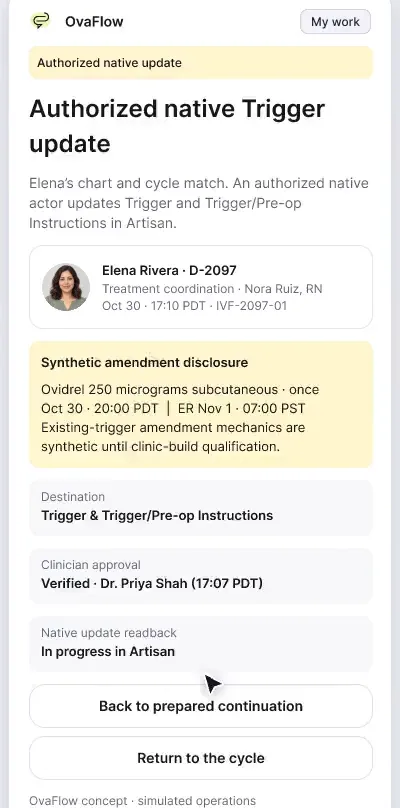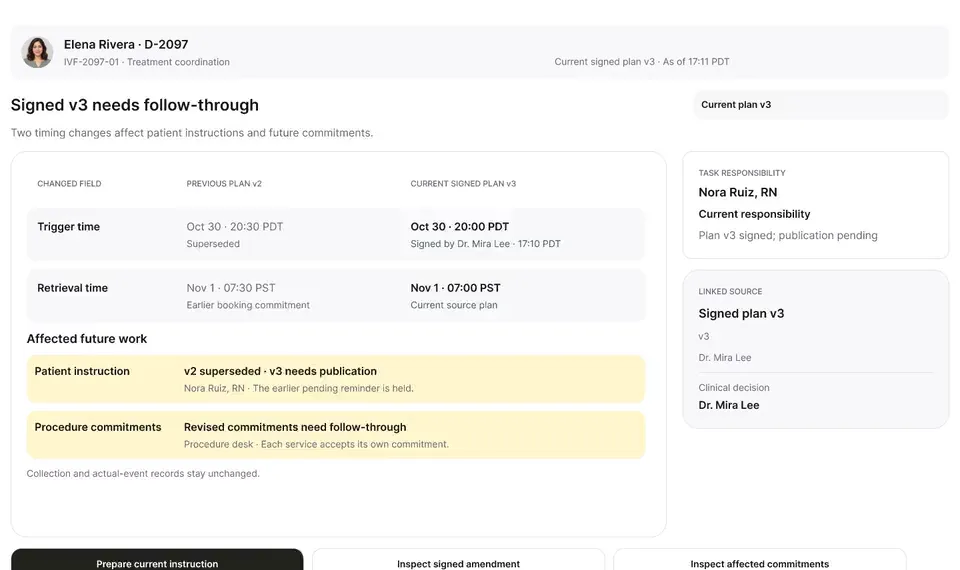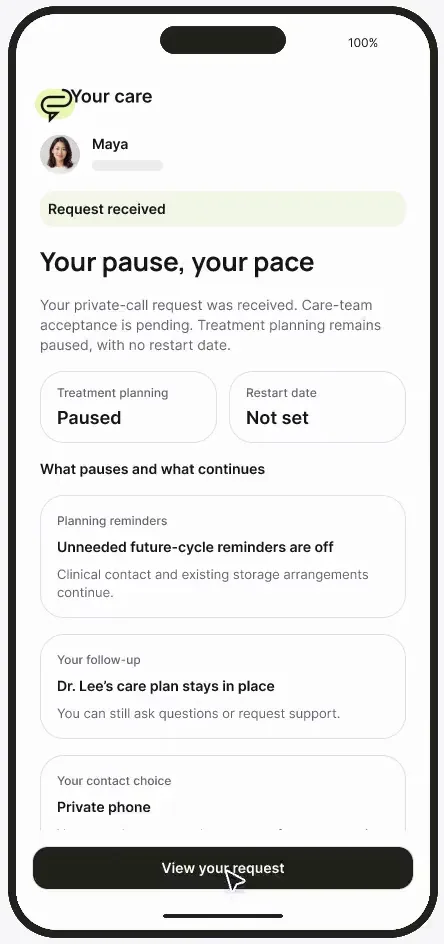
Patient and clinic, side by side
The patient's phone and the clinic's workspace side by side, so each reassuring screen shows the safeguard behind it.
Product preview · Fictional patient data
Walkthrough 19 of 29 · Desktop
One signed change reaches instructions, the OR, anesthesia and the lab. Later an outside emergency visit for OHSS turns a planned fresh transfer into freeze-all.
Elena's episode: one change, four commitments, recovery and freeze-all, muted recording of the design prototype. Fictional patient data.
Chapter 1 of 6: Elena's whole episode, in one place
Recorded from an interactive design prototype. Every patient, clinician and clinic is fictional, EMR screens are modeled reconstructions, and nothing shown is a live connection to any clinic or vendor system.
Clinical & operational context
Elena Rivera's whole IVF episode on one timeline. One signed trigger amendment updates four linked commitments, her reported 8:20 PM injection is reviewed by her clinician, and retrieval day runs with a named discharge owner. When she reports symptoms after retrieval and is seen at an outside emergency department, her clinician changes the plan to freeze-all.
A single stimulation cycle is a continuous clinical story: a Day 10 trigger amendment ripples into retrieval timing, across the autumn Daylight Saving Time clock change, into post-retrieval recovery monitoring, and — when high ovarian response raises ovarian hyperstimulation syndrome (OHSS) risk — into a clinician decision to cancel the planned fresh embryo transfer and convert the cycle to freeze-all. In fragmented clinic tools, converting to freeze-all often leaves the old fresh-transfer prep instructions and progesterone schedule active in the patient's portal.
This desktop walkthrough follows Elena Rivera's full stimulation-to-retrieval arc in one longitudinal view: seeing her entire episode in one place, watching Dr. Mira Lee's 17:10 PDT trigger amendment update four linked commitments (patient instruction, OR slot, anesthesia, embryology bench), reviewing Elena's 20:20 PDT reported injection time, crossing the Nov 1, 2026 PDT-to-PST clock change for her 07:00 PST retrieval, tracking her post-retrieval bloating and symptom check-in, and executing a clean conversion from fresh transfer to freeze-all so every fresh-transfer task and medication reminder is retired immediately.
Dr. Mira Lee
Signs 20:00 PDT trigger; updates 4 linked commitments
OvaFlow safeguard
Displays 07:00 PST across the autumn clock change
Nora Ruiz, RN
Reviews Elena's symptoms and routes to Dr. Mira Lee
Dr. Mira Lee
Converts fresh transfer to freeze-all in the EMR
Elena Rivera's longitudinal episode from her Oct 30 trigger amendment across the Nov 1 DST retrieval clock change to freeze-all conversion.
Guardrail: Converting a cycle to freeze-all immediately retires all fresh-transfer appointments and instructions.
What to watch for
Elena Rivera's whole IVF episode on one timeline. One signed trigger amendment updates four linked commitments, her reported 8:20 PM injection is reviewed by her clinician, and retrieval day runs with a named discharge owner. When she reports symptoms after retrieval and is seen at an outside emergency department, her clinician changes the plan to freeze-all.
Follow the exact timestamps, UI status changes, and coordination safeguards as the recording plays.
What to watch for: Elena Rivera's longitudinal episode timeline connects stimulation, trigger, retrieval, and post-retrieval care.
Boundary rule: Staff see how today's task fits into the whole cycle without opening five separate modules.
On-screen narration: Elena Rivera's IVF episode opens as one timeline. A late estradiol result prompts the physician to review the protocol.
What to watch for: Signing trigger version 3 (20:00 PDT) highlights the four downstream commitments that depend on that clock.
Boundary rule: Patient instruction, OR room, anesthesia, and embryology bench stay linked to the same signed source.
On-screen narration: One signed amendment updates four linked commitments: patient instructions, OR, anesthesia and lab. Elena's acknowledgment of the current version 3 instruction is confirmed.
What to watch for: Elena's 20:20 PDT reported injection time stays visible on the retrieval timeline.
Boundary rule: The procedure and lab teams see the exact patient-reported time before retrieval morning.
On-screen narration: Elena's reported 8:20 PM injection (35h 40m) is shown as a difference to review. The clinician's retrieval-timing decision is recorded, and Alex Kim, RN carries the callback.
What to watch for: Across the Nov 1, 2026 clock change, the 07:00 PST retrieval slot displays an explicit daylight-saving notice.
Boundary rule: Explicit PDT-to-PST banners prevent 1-hour arrival mistakes on clock-change weekends.
On-screen narration: A pre-retrieval anesthesia question is resolved. The whole procedure team and OR readiness are confirmed. Discharge names the nurse who owns the next-day follow-up.
What to watch for: Post-retrieval symptom reports from Elena surface immediately for nursing and physician evaluation.
Boundary rule: OvaFlow routes symptom reports to clinicians; it never scores or diagnoses OHSS.
On-screen narration: After retrieval, Elena reports bloating and weight gain that could signal OHSS. The report goes to the care team for review. An outside emergency department assessment is brought back into the IVF episode.
What to watch for: When Dr. Mira Lee converts the plan from fresh transfer to freeze-all, fresh-transfer tasks are retired and replaced by vitrification follow-up.
Boundary rule: Retiring the superseded fresh-transfer plan prevents contradictory portal instructions.
On-screen narration: The clinician defers the fresh transfer to freeze-all, and the care plan updates.
OvaFlow never makes the clinical call in these recordings. Physicians sign, the person taking a handoff accepts it, and the lab keeps its own holds. The companion tracks, checks and stops; staff decide.
In this walkthrough
Every patient, family member, clinician and clinic in these stories is fictional. Names, times and screens come from prototype walkthroughs, not from real care.
 Elena RiveraPatient
Systems a clinic running this workflow often uses. They do not appear in this recording.
 Hospital, OB & emergency EHR (outside records)
Third-party names and logos are trademarks of their respective owners, shown to illustrate systems commonly used in IVF clinics. No affiliation, endorsement or live integration is implied. nAbleIVF, eIVF and Artisan appear as modeled workflow examples.
Where this appears
This recording is part of these pages. Each one explains the step in more depth.
Questions & answers
What clinicians, coordinators, practice leaders, and patients ask when reviewing Walkthrough 19.
1) The patient's tonight injection instruction, 2) the operating room retrieval slot, 3) the anesthesia arrival window, and 4) the embryology laboratory aspiration/warming bench schedule.
It shows both the exact timezone abbreviation (PDT vs. PST) and a plain-language Daylight Saving Time banner so neither the patient nor the morning procedure crew misreads the 36-hour interval by an hour.
Every pending fresh-transfer appointment and medication reminder is marked superseded and retired so she only sees her post-retrieval recovery plan and embryology update schedule.
Related
The patient's phone and the clinic's workspace side by side, so each reassuring screen shows the safeguard behind it.
Beside a modeled Artisan view, the companion compares Dr. Priya Shah's approval with the unchanged Artisan fields, stops on Maya's open chart, and won't assume an update it didn't see.
A late estradiol result, a newly signed trigger time, the wrong chart caught before publishing, and a lost confirmation checked rather than blindly resent.
Next step
We'll replay this flow against your roles and handoffs, using fictional records. Please don't send patient data.