Signed instruction · Elena Riverav
Trigger · Ovidrel 250 micrograms subcutaneous, once
PDT · Oct 30
Signed by Dr. Mira Lee · 17:10 PDT
v2 · 20:30 PDT · retrieval 07:30 PSTSuperseded · kept for history
Product preview · Fictional patient data
For REI physicians
You review the evidence, make the decision and sign. OvaFlow captures what you ask it to, checks that it was saved, and keeps proposals apart from what you have signed.
Who this is for
Reproductive endocrinologists and other authorized clinicians who review evidence, make decisions and sign.
What gets in the way
Each one, and exactly how OvaFlow is designed to answer it. Work changes hands only when someone accepts it.
Placed dictation assumed saved.
A check that Save Draft in the EMR actually happened.
Side conversations captured without a clean pause.
Consult capture that starts only after consent, pauses cleanly and shows the draft next to the transcript.
Unsigned proposals applied to EMR fields too early.
“Awaiting clinician approval” kept separate from what you signed.
Physician review accidentally closed by a nursing callback.
“Clinical review pending” that no message or handoff can close.
[ Signed change ]
Sign a new version and OvaFlow shows what changed, keeps the old version visible but retired, and flags each linked commitment for the person who owns it. Your signature stays the source.
Trigger · Ovidrel 250 micrograms subcutaneous, once
PDT · Oct 30
Signed by Dr. Mira Lee · 17:10 PDT
v2 · 20:30 PDT · retrieval 07:30 PSTSuperseded · kept for history
Trigger to retrieval36h 00m
From 20:00 PDT October 30 to 07:00 PST November 1. Counted across the clock change at 02:00 on Nov 1. Every clinical decision stays with the care team.
From the daily-care walkthrough.Fictional patient data
A shift with OvaFlow
Drawn from the prototype walkthroughs. Times are from the fictional demonstration day.
REI physicians move rapidly between morning ultrasound rooms, diagnostic and return-visit consults, procedure blocks, and late-afternoon stimulation/trigger sign-offs. ASRM 2026 evaluation and ICSI guidance, ASRM OHSS prevention guidelines, and the 2026 BMJ natural-versus-programmed FET trial highlight how individualized each decision is—while ONC SAFER CPOE guidance emphasizes keeping unsigned support separate from clinician-signed orders [1, 2, 3, 5].
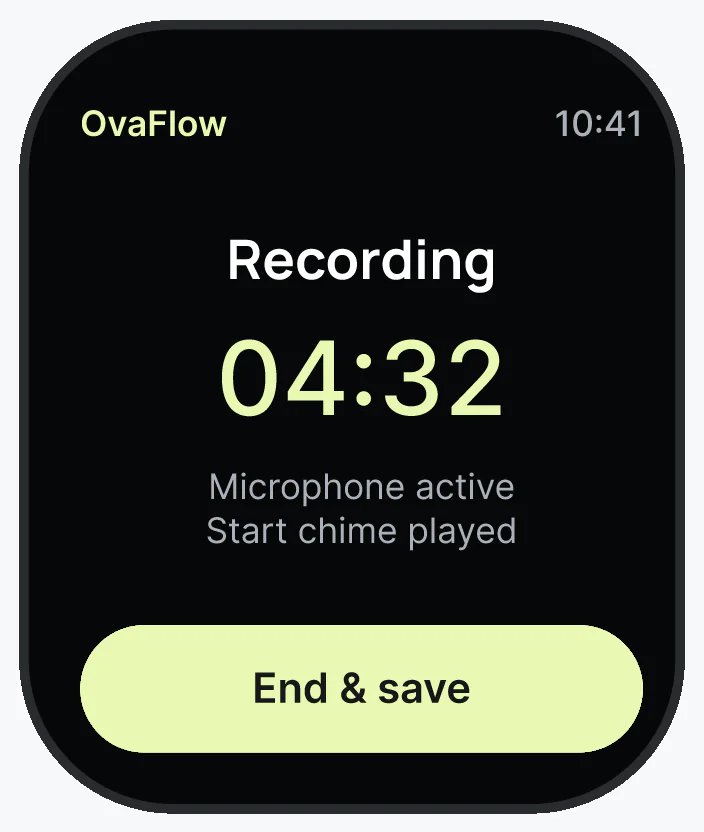
Dr. Mira Lee records a quick room observation on Apple Watch
Voice notes recorded in hallway transitions vanish if Wi-Fi drops or transcribe into an unverified background buffer.
Saves locally on the Watch first, shows storage location plainly, and hands draft to desk
Draft staged · Never auto-committed to chartDr. Mira Lee & Maya Chen return consult; physical exam mid-visit
Ambient microphones started before explicit patient consent or left running during a pelvic exam capture private side talk.
Starts only after recorded consent, pauses cleanly for exam, shows draft beside transcript
Save check · Confirms Save Draft in the EMRPartner workups in separate charts + urgent oncology referral before gonadotoxic therapy
One partner's missing infectious-disease or semen lab stalls cycle readiness unseen; oncology timelines slip between clinics.
Tracks both charts in parallel and holds preservation window until both teams accept
Parallel readiness · Both teams committedEstradiol, progesterone, and follicle measurements reviewed for Elena Rivera
Unsigned note proposals or verbal changes reach nursing tasks before the physician signs, or eRx steps are bypassed.
Keeps 'Awaiting clinician approval' separate; signing v3 cascades to nursing, OR, and lab
Signed source v3 · Downstream tasks flaggedElena Rivera's 20:20 PDT injection report arrives; nursing accepts callback at 20:28 PDT
When a nurse closes the patient callback ticket, the physician's clinical review item accidentally closes with it.
'Clinical review pending' stays open on Dr. Mira Lee's queue until she reviews and decides
Clinician authority · Never closed by callbackWorked clinician example · Dr. Mira Lee & Dr. Priya Shah
See how OvaFlow supports Dr. Mira Lee across a consultation with Maya Chen, a parallel partner/preservation workup with Dr. Priya Shah, and Elena Rivera's 17:10 PDT signed trigger change.
Why this moment matters in an IVF clinic
Physicians make dozens of high-consequence choices daily: whether to convert to freeze-all for OHSS risk [2], whether ovulatory FET patients should follow a natural or programmed protocol [3], whether non-male-factor ICSI is indicated [1], and whether a placed EMR note draft actually saved before the room turns over [5].
In consult, recording cannot start until Maya's consent is logged. When Dr. Mira Lee steps to the exam table, one tap pauses capture cleanly. Afterward, the structured draft appears beside the verbatim transcript. After placement into nAbleIVF, OvaFlow verifies that Save Draft in the EMR actually completed rather than assuming paste equaled save.[5]
Consistent with ASRM 2026 evaluation guidance (evaluating both partners in parallel) and ASCO 2025 fertility preservation guidance before gonadotoxic therapy, OvaFlow shows both partners' diagnostic checklists side by side and requires explicit acceptance from both oncology and REI coordinators on the preservation start window.[1][4]
Prepared protocol adjustments remain labeled 'Awaiting clinician approval' and cannot drive patient instructions. Once Dr. Mira Lee signs Trigger v3 (20:00 PDT on Oct 30, replacing v2 at 20:30 PDT) and completes any dose change in the clinic's own e-prescribing system, OvaFlow retires v2 and flags every linked nursing, OR, and embryology commitment.[2][5]
When Elena reports her 20:20 PDT injection, Alex Kim, RN accepts the evening patient callback at 20:28 PDT. OvaFlow keeps Dr. Mira Lee's 'Clinical review pending' item open on her queue so a nursing phone call never silently resolves a physician's timing judgment.[5]
Unsigned items stay labeled 'Awaiting clinician approval.' Prescribing stays in the clinic's e-prescribing system, and nursing callbacks cannot close 'Clinical review pending.'
OvaFlow never diagnoses, recommends doses, ranks embryos, or writes unsigned text into signed EMR fields.
Every visit note draft, transcript, and schedule update shows where it came from and waits for the physician's signature in the EMR.
Prototype walkthroughs
Recorded from the interactive design prototype with fictional patient data. Open one to play it here with chapters and captions.
Confirm the patient and consent before the mic turns on, pause for the exam, and hand the draft to the desk even while the desk is offline.
Between ultrasound rooms, a wrist note saves on the Watch first, says plainly where it is, and hides the patient's name when the wrist drops.
A note isn't done until it's saved, a cycle doesn't start with prior authorization unresolved, dose changes go to eIVF's own e-prescribing, and a PGT label mismatch stops the review.
Common questions & sources
How OvaFlow handles edge cases, clinical authority, and source-system boundaries for this role.
OvaFlow uses named-field placement that does not rely on blind cursor focus, and then runs a Save Check against the EMR. If Save Draft in the EMR did not complete, OvaFlow alerts you immediately while the patient's context is still in front of you rather than assuming the note was saved.[5]
On Apple Watch and mobile, capture saves locally on the device first and displays where the audio is stored. If connectivity drops between ultrasound rooms, nothing is lost; the draft hands off to your desktop workspace once the connection returns.
Staff can stage operational prep, but any unsigned item is explicitly badged 'Awaiting clinician approval' and blocked from being published to the patient or treated as an active clinical order until your signature is recorded in the source system.[5]
Next step
See consent-gated visit capture, EMR save checks, and how one signed amendment cascades across nursing, OR, and lab commitments.