Product preview · Fictional patient data

OvaFlow

Story · Elena Rivera

Elena: from monitoring to a change of plan

Follow Elena Rivera's cycle from Day 8 ultrasound and estradiol monitoring through trigger, egg retrieval, post-retrieval ovarian hyperstimulation syndrome (OHSS) surveillance, and a clinician-led conversion from fresh transfer to freeze-all.

One stimulation cycle7 chapters
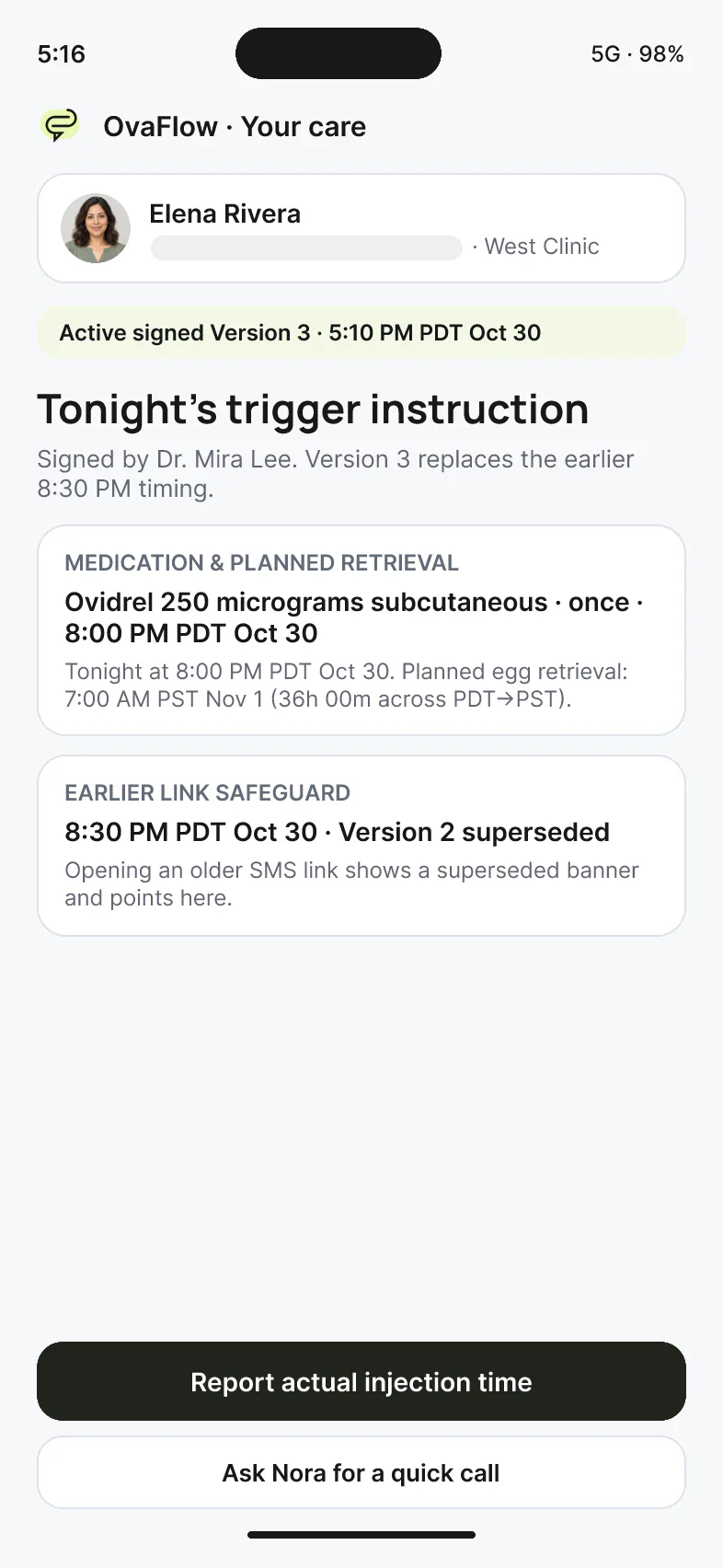
iPhone patient companion (design prototype): tonight's signed trigger instruction, then the safeguard shown when an older reminder link is opened. Fictional patient data.
Elena RiveraPatient going through stimulation, trigger and retrieval
Design prototypeFictional patient data
  1. Elena's phone shows tonight's signed Version 3 trigger instruction: Ovidrel 250 micrograms subcutaneous, once, at 8:00 PM PDT on Oct 30.
  2. Opening the older 8:30 PM text link shows that Version 2 is superseded and points back to the current plan.

People

Who's in this story

View all 4 people in this story
  • Elena RiveraPatient going through stimulation, trigger and retrieval
  • Nora Ruiz, RNIVF nurse coordinator
  • Dr. Mira LeeREI physician
  • Alex Kim, RNEvening on-call nurse

Fictional patient dataEvery patient, family member, clinician and clinic in these stories is fictional. Names, times and screens come from prototype walkthroughs, not from real care.

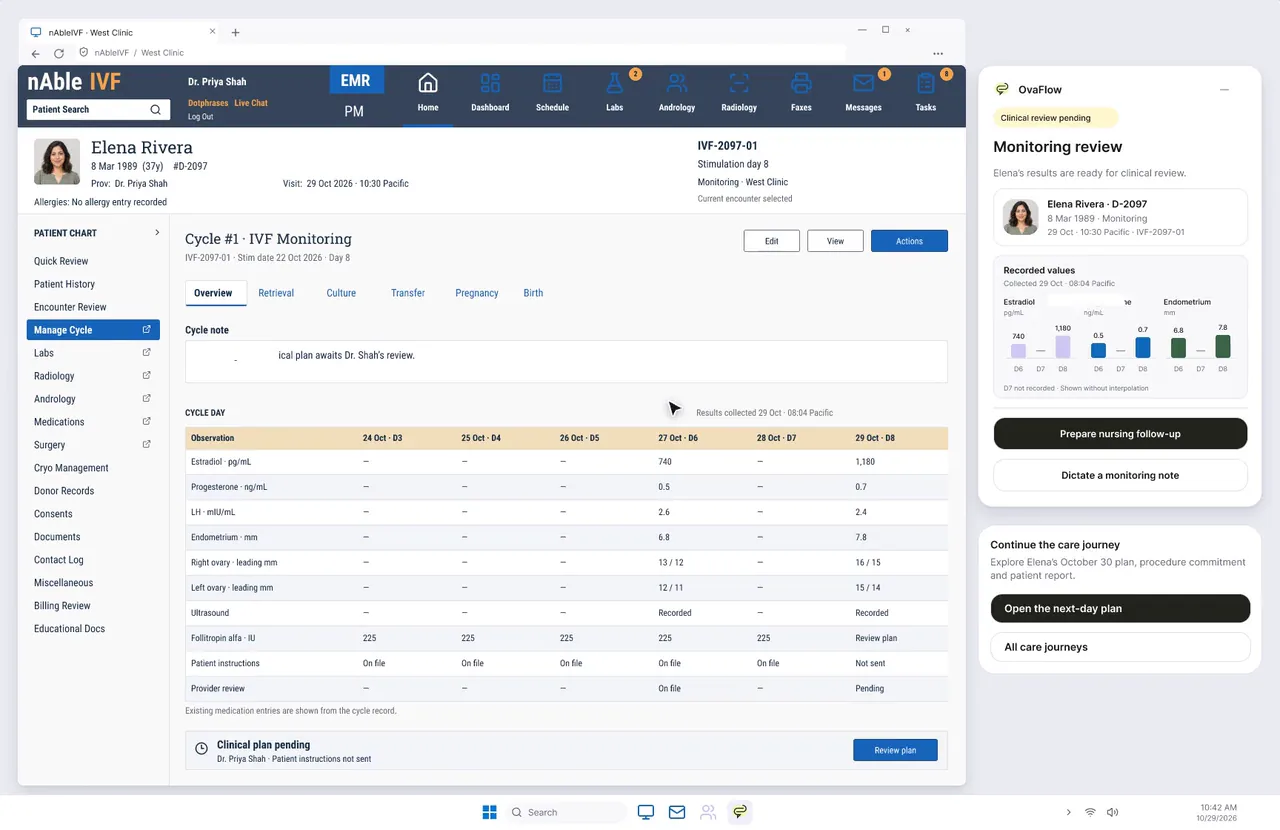
nAbleIVF: allergy check, monitoring note, save check, specimen stop: the moment in each chapter, from the prototype walkthrough. Fictional patient data.
Walkthrough page

Prototype walkthrough · Fictional patient data · Desktop · nAbleIVF · Modeled workflow example

  1. Chapter 01Stimulation & monitoring

    Day 8 monitoring

    Elena's Day 8 monitoring note is captured, reviewed against her follicle ultrasound and estradiol labs, and placed into the clinic's own EMR. It counts as saved only when the EMR flowsheet confirms the saved fields.

    On screen at 0:09Elena Rivera's Day 8 monitoring review opens.

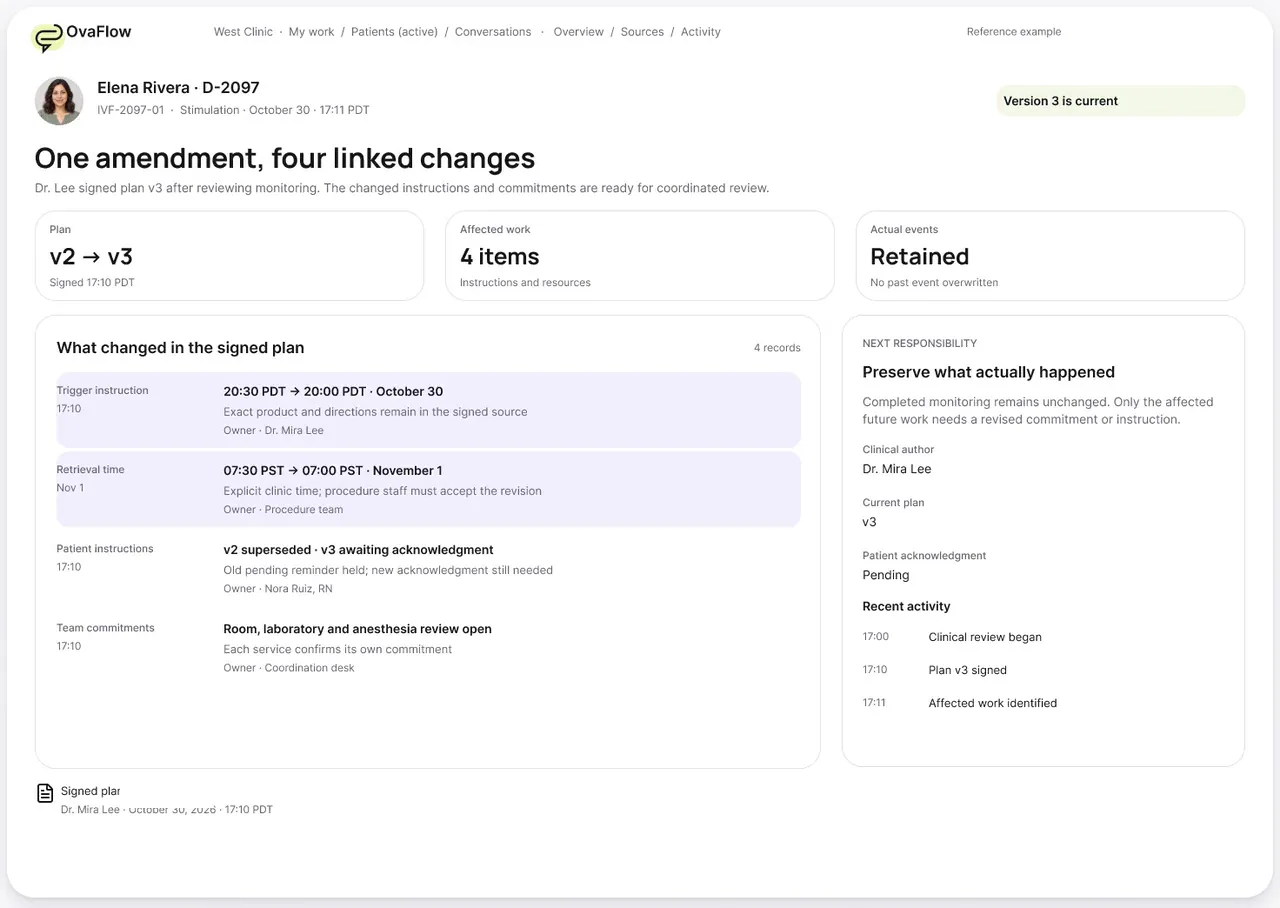
Elena's episode: one change, four commitments, recovery and freeze-all: the moment in each chapter, from the prototype walkthrough. Fictional patient data.
Walkthrough page

Prototype walkthrough · Desktop

  1. Chapter 02Trigger

    One amendment, four commitments

    When Dr. Mira Lee signs the revised trigger time on Oct 30, the amendment updates Elena's patient instructions and tracks explicit re-commitment across the operating room, anesthesia and the embryology lab together.

    On screen at 0:03One signed amendment updates four linked commitments: patient instructions, OR, anesthesia and lab.

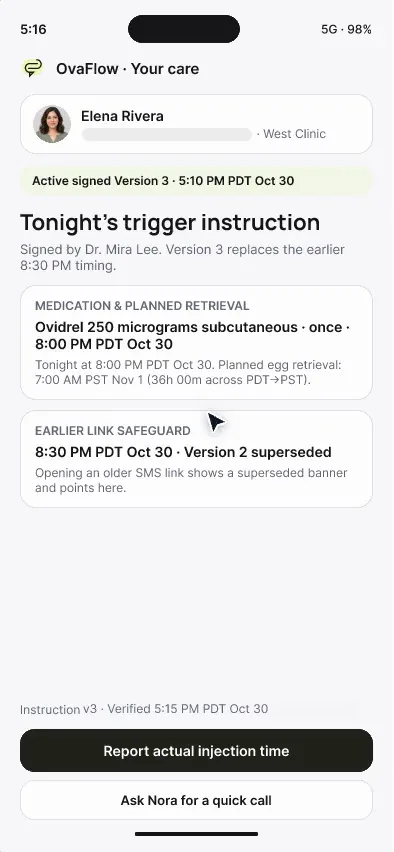
Elena's iPhone: the current instruction, an old link, an honest report: the moment in each chapter, from the prototype walkthrough. Fictional patient data.
Walkthrough page

Prototype walkthrough · iPhone

  1. Chapter 03Trigger

    The current instruction, first

    On her phone, Elena sees version 3 (8:00 PM, Oct 30) before anything else, and tapping an older notification link cannot take her back to the superseded 8:30 PM time.

    On screen at 0:00Elena's current signed trigger instruction, version 3, opens on her iPhone.

Elena's episode: one change, four commitments, recovery and freeze-all: the moment in each chapter, from the prototype walkthrough. Fictional patient data.
Walkthrough page

Prototype walkthrough · Desktop

  1. Chapter 0420:22 PDTTrigger

    An honest report

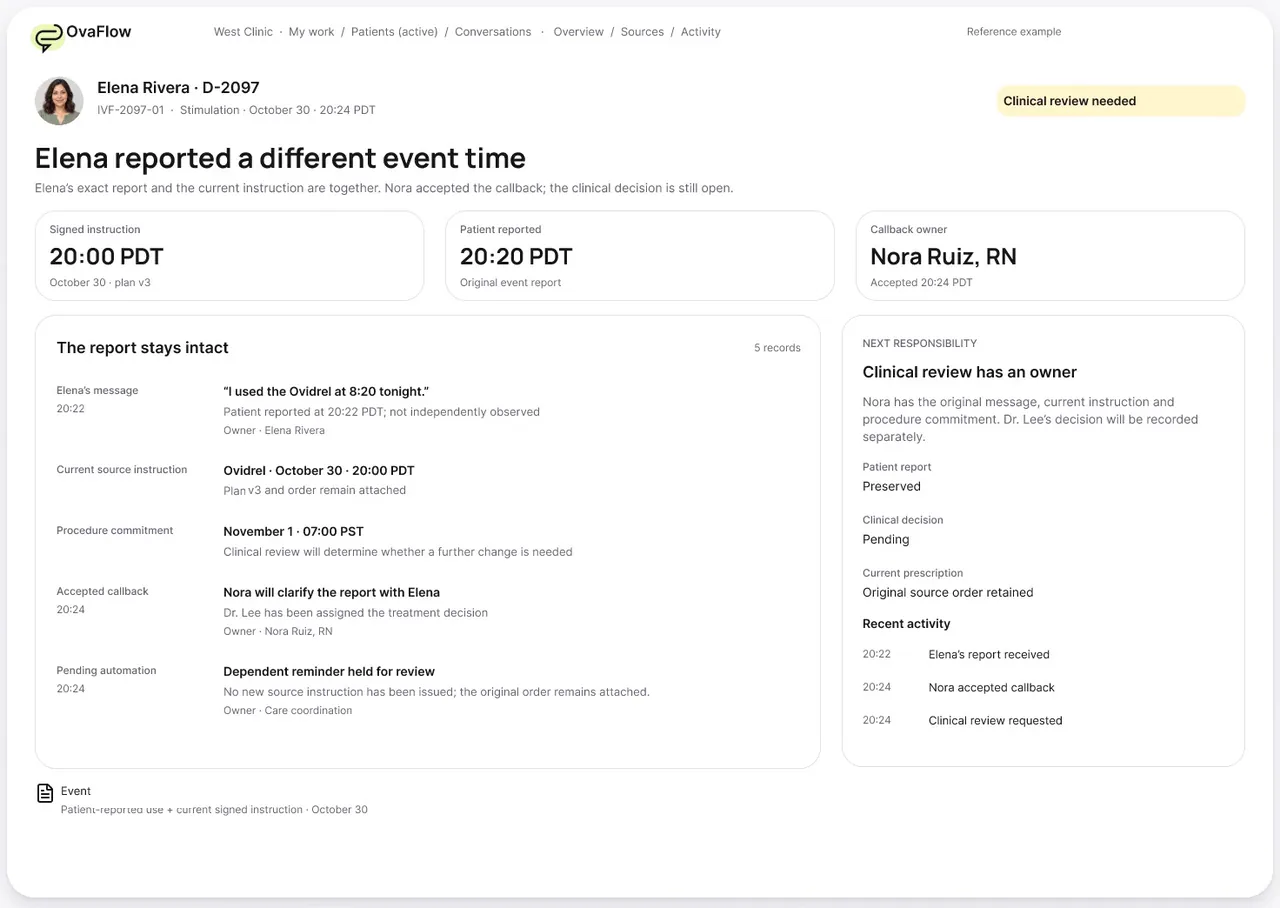
    At 20:22 PDT Elena reports she injected at 20:20 PDT, 20 minutes after the signed 20:00 PDT instruction. It is recorded as a patient-reported difference for Dr. Mira Lee to evaluate, never an overwrite of the prescribed record.

    On screen at 0:07Elena's reported 8:20 PM injection (35h 40m) is shown as a difference to review.

  2. Chapter 05Retrieval & recovery

    Retrieval day

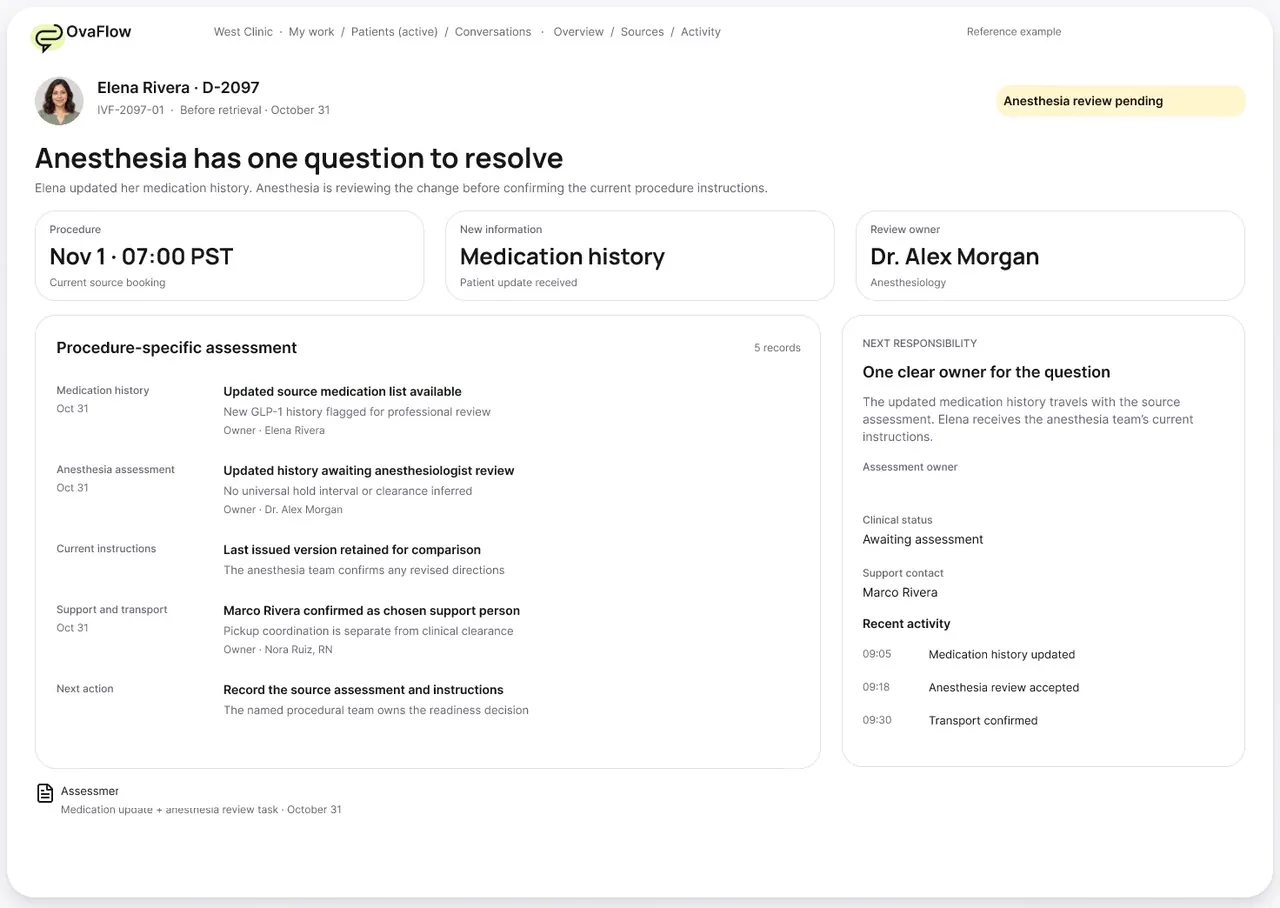
    On Nov 1 (07:00 PST), pre-procedure anesthesia questions are resolved, every procedure role has committed to the slot, and a named nurse owns the Day 1 recovery and fertilization call before Elena is discharged.

    On screen at 0:11A pre-retrieval anesthesia question is resolved.

  3. Chapter 06Retrieval & recovery

    Symptoms after retrieval

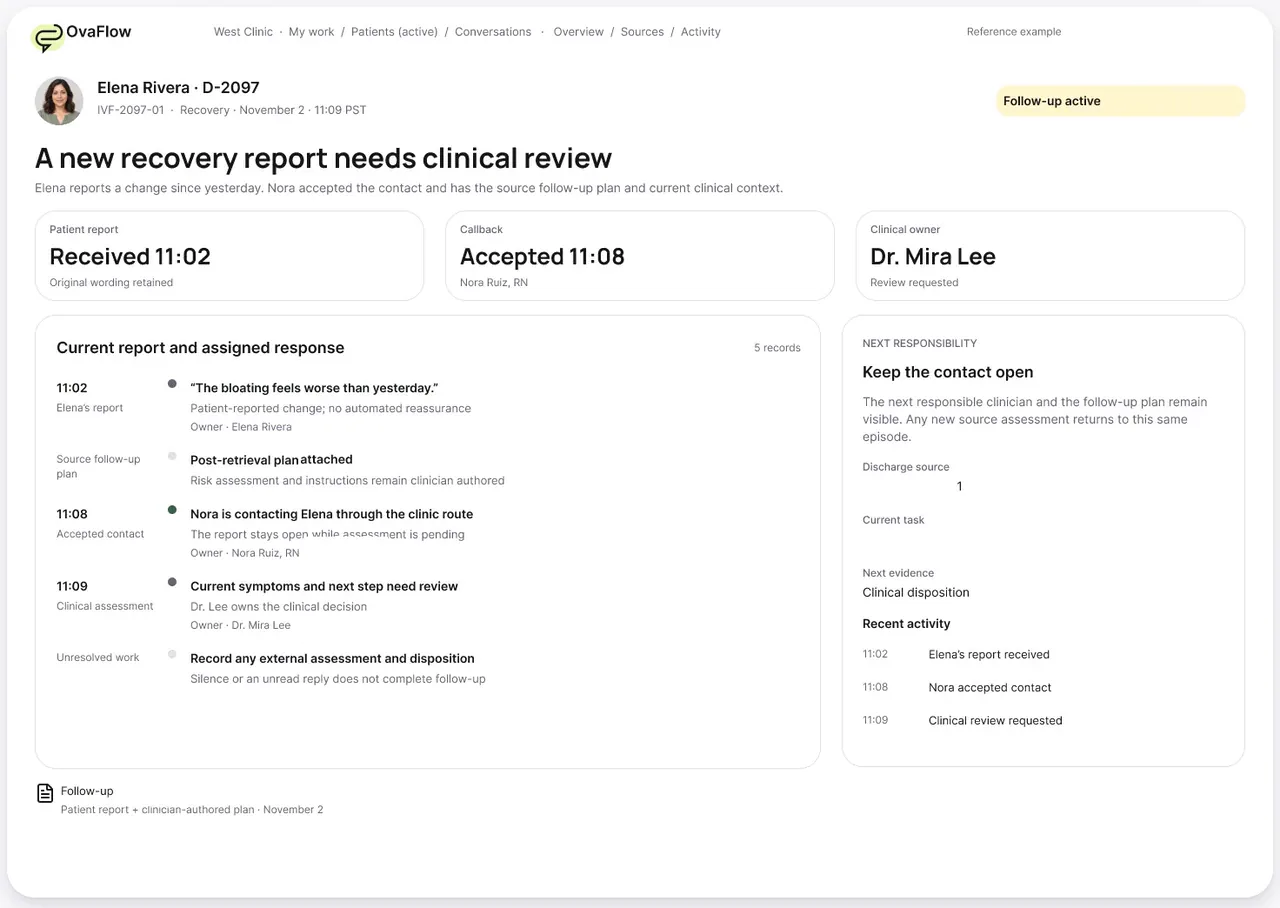
    In the days after retrieval, Elena reports abdominal bloating and rapid weight gain—classic warning signs for ovarian hyperstimulation syndrome (OHSS). Her report routes to the nursing team while keeping the clinic's 24/7 line and 911 visible, and an outside emergency department visit is reconciled back into her active care plan.

    On screen at 0:16After retrieval, Elena reports bloating and weight gain that could signal OHSS. The report goes to the care team for review.

  4. Chapter 07When plans change

    A change of plan

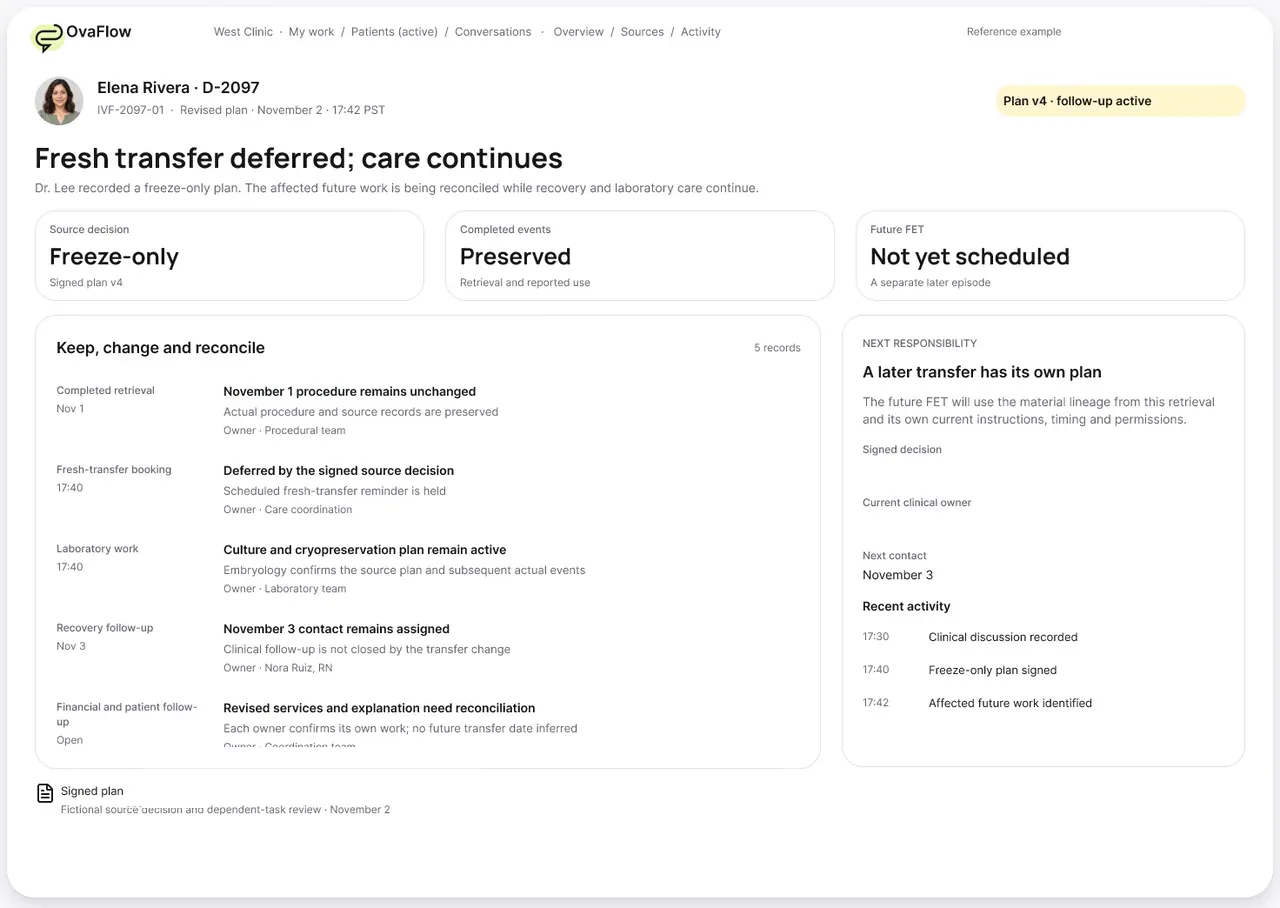
    To protect Elena's recovery, Dr. Mira Lee cancels the planned fresh transfer and converts the cycle to freeze-all. Downstream medication instructions, transfer room holds and embryology vitrification plans update together.

    On screen at 0:20The clinician defers the fresh transfer to freeze-all, and the care plan updates.

For the team

What changed for the team

One episode, many people. The plan stays connected from the first monitoring note to the decision to freeze.

  1. The Day 8 note

    Without it: A note placed in the chart is assumed to be saved.

    In this walkthrough: It counts as saved only when the EMR shows it.

  2. The amendment

    Without it: A changed trigger time reaches some teams and not others.

    In this walkthrough: One signed amendment flags Elena's instructions, the OR, anesthesia and the lab together.

  3. Her report

    Without it: A different injection time is corrected away.

    In this walkthrough: It is kept as a difference for her clinician to review.

  4. After retrieval

    Without it: An outside emergency visit never makes it back to the clinic.

    In this walkthrough: Her symptom report goes to the care team, and the outside visit comes back into her plan.

  5. Freeze-all

    Without it: A change of plan leaves old bookings and instructions behind.

    In this walkthrough: Her clinician decides, and future instructions, bookings and lab work update with the decision.

Every decision in this story is made by a clinician, a nurse or the lab. OvaFlow keeps the work, its owner and its source in view.

Full-cycle timeline

From Day 8 monitoring to post-retrieval recovery and freeze-all

Elena Rivera's episode shows how one stimulation cycle connects ultrasound flowsheet checks, 4-team procedure scheduling, post-op symptom surveillance for ovarian hyperstimulation syndrome (OHSS), and a plan change to freeze-all.

6 handoff checkpoints

Handoff sequence across patient, clinical team, and EMR & lab

  1. 01Day 8EMR & lab check

    Monitoring note EMR save check

    Follicle ultrasound and estradiol note counts as saved only when verified in the EMR flowsheet.

    What holds: EMR save verified

  2. 02Oct 30 · 17:10Clinical team

    One amendment, four teams

    Signed v3 trigger updates patient instructions, OR, anesthesia and embryology together.

    What holds: All 4 teams re-confirm

  3. 03Oct 30 · 20:22Patient & family

    Honest 8:20 PM report kept

    20-minute difference from signed 20:00 PDT is held for Dr. Mira Lee's clinical review.

    What holds: Report kept as said

  4. 04Nov 1 · 07:00 PSTClinical team

    Retrieval & named discharge nurse

    Pre-op anesthesia questions closed; Day 1 recovery call assigned to a named nurse.

    What holds: Named nurse for Day 1

  5. 05Post-op Days 2–4Patient & family

    OHSS symptoms & outside ED visit

    Bloating and weight gain route to nursing with 24/7 & 911 numbers; ED visit reconciled.

    What holds: Routed to nurse + 911

  6. 06Day 5 decisionClinical team

    Clinician converts to freeze-all

    Dr. Lee defers fresh transfer; vitrification plan, OR holds and instructions update together.

    What holds: Lab & calendar updated

Six connected milestones in Elena Rivera's cycle across patient experience, clinic coordination, and EMR/lab synchronization.
Clinical context & EMR scope boundaries

Why this sequence matters

Clinical and operational context

In the clinic: Patients with robust ovarian response face an elevated risk of ovarian hyperstimulation syndrome (OHSS) after trigger and retrieval. If bloating, rapid weight gain or an outside emergency department evaluation occurs during recovery, proceeding with a fresh Day 5 transfer can worsen late-onset OHSS if pregnancy hormone rises.

Across handoffs: When a patient visits an outside emergency room after egg retrieval, that visit often stays invisible to the fertility clinic's transfer schedule. Reconciling the outside visit into the episode and updating the embryology lab and procedure calendar together when the clinician converts to freeze-all prevents outdated fresh-transfer instructions from firing.

Where OvaFlow fits

What OvaFlow coordinates vs. what stays with the clinic

OvaFlow coordinates

  • EMR save verification on Day 8 monitoring notes
  • Four-role commitment across OR, anesthesia, physician and embryology when trigger changes
  • Routing post-retrieval symptom reports to nursing with 24/7 clinic and 911 contacts
  • Reconciling outside emergency visits and updating lab and calendar plans on freeze-all conversion

Clinicians, EMR & lab own

  • Medical evaluation of Elena's post-retrieval bloating, fluid balance and outside ED findings
  • Dr. Mira Lee's clinical decision to defer fresh transfer and convert to a freeze-all cycle
  • Blastocyst vitrification and cryostorage logging in the embryology laboratory

Questions about this walkthrough

Common questions from patients and clinic teams

View all 3 story questions & answers
Why does converting to freeze-all help when a patient develops OHSS symptoms after retrieval?

As ASRM's OHSS prevention guideline details, early OHSS is driven by exogenous trigger hormones, while severe late OHSS is sustained by endogenous pregnancy hormone (hCG) from an implanted embryo. Freezing all suitable blastocysts and deferring transfer to a later frozen embryo transfer (FET) cycle allows the ovaries to recover safely.

Sources: [8] ASRM Practice Committee (2024) · [5] ESHRE Guideline Group (2026)

Does OvaFlow evaluate or score Elena's post-retrieval symptoms?

No. OvaFlow never triages or scores symptoms. Whenever Elena logs post-retrieval bloating or discomfort, the interface displays West Clinic's 24/7 contact line and 911 for emergencies and routes her report directly to a named nurse.

Sources: [8] ASRM Practice Committee (2024) · [18] ONC SAFER Guides (2025)

What updates when Dr. Mira Lee changes Elena's plan from fresh transfer to freeze-all?

Converting to freeze-all is not just a note in the chart—it cancels the provisional Day 5 transfer room booking, updates the embryology bench plan from fresh transfer catheter prep to vitrification of all eligible blastocysts, and replaces fresh luteal transfer instructions on Elena's phone.

Sources: [6] SART Patient Guide (2026) · [9] ASRM Practice Committee (2022)

Clinical & operational guidelines referenced in this story (4 sources)
  1. [8]
    ASRM Practice Committee (2024) — Prevention of moderate and severe ovarian hyperstimulation syndrome (OHSS): a guidelineRisk factors, alternative trigger strategies, post-retrieval symptom surveillance and elective freeze-all conversion.
  2. [5]
    ESHRE Guideline Group (2026) — Guideline on Ovarian Stimulation for IVF/ICSI (v2.3 update)Individualized gonadotropin stimulation, ultrasound and estradiol monitoring cadence, trigger criteria and luteal phase support.
  3. [6]
    SART Patient Guide (2026) — ART Step-by-Step Guide: Oocyte Retrieval and Embryo Transfer8–12 day stimulation window, 35–36 hour trigger-to-retrieval interval, 15–30 minute sedated retrieval, Day 5–6 blastocyst culture and progesterone support.
  4. [9]
    ASRM Practice Committee (2022) — Comprehensive guidance for human embryology, andrology, and endocrinology laboratories: management and operationsContinuous specimen witnessing, chain of custody, culture-media lot traceability, warming authorization and cryostorage records.

See it with your team

Walk this story through with your team

We'll replay the walkthroughs behind each chapter and look at where the same moments happen in your clinic.