Product preview · Fictional patient data

OvaFlow

Story · Avery & Sam

Avery & Sam: two people, two charts, the right consent

Avery and Sam are intended parents building their family across two transfer attempts. Each person has their own clinical chart, biological or gestational role, and privacy boundary. When a consent form is filed under the wrong chart, it is relocated with a visible audit trail, and medical/legal clearance stays bound to one transfer attempt at a time.

Across two transfer attempts3 chapters
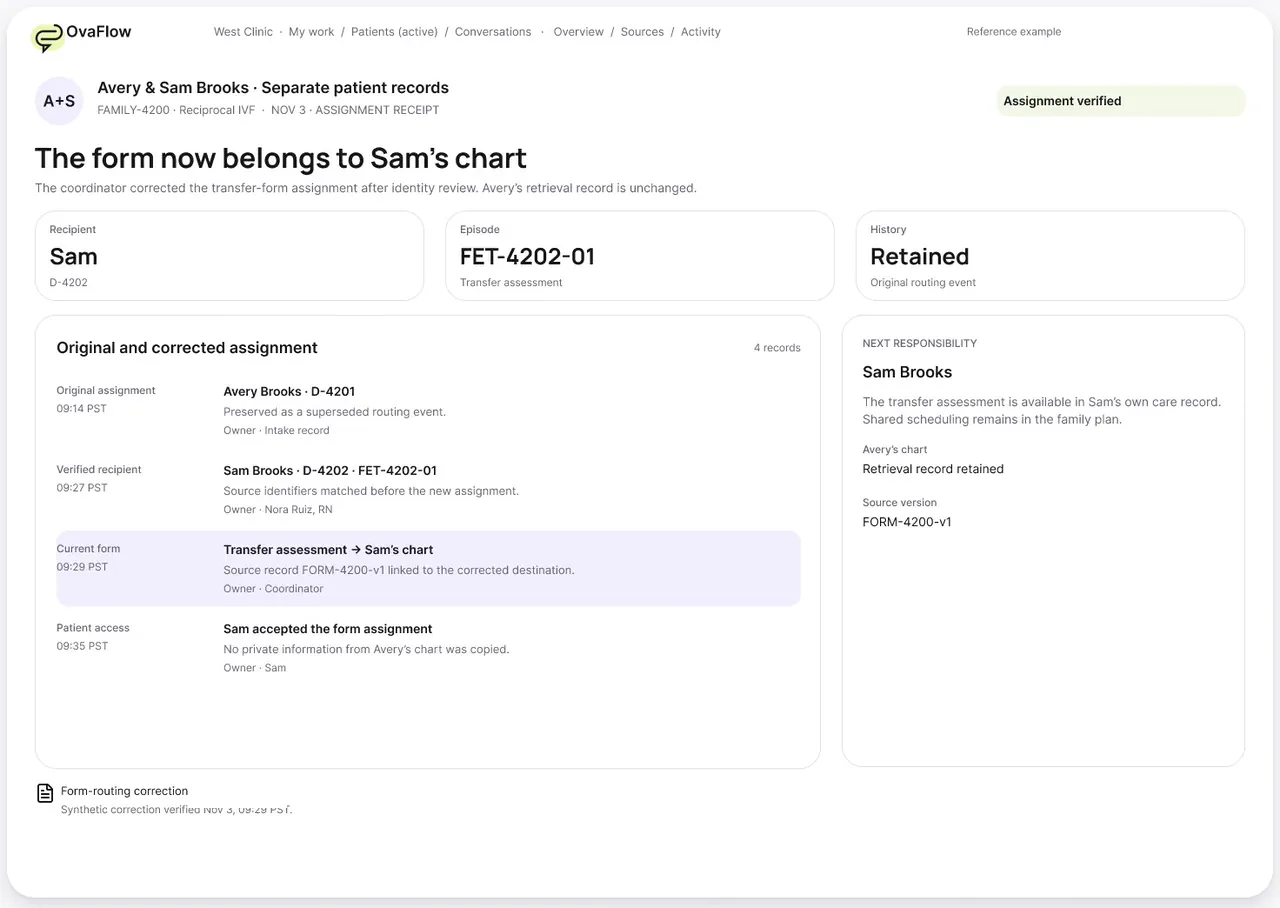
The transfer form now belongs to Sam's chart. Still from a prototype walkthrough. Fictional patient data.
Avery & SamIntended parents, each with their own chart
The transfer form now belongs to Sam's chart.Prototype walkthrough · Fictional patient data
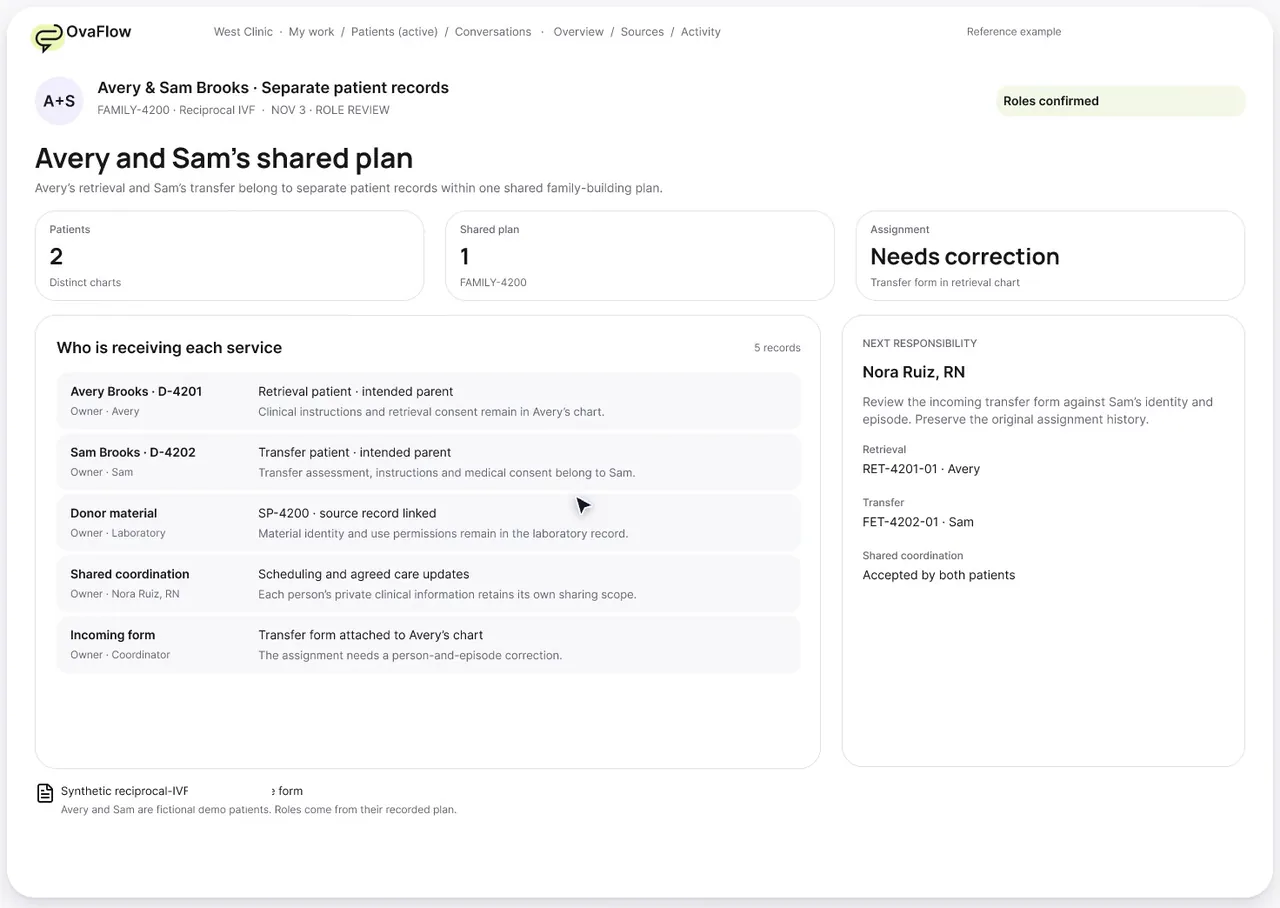
  1. Avery and Sam's shared plan, with separate patient records.

People

Who's in this story

View all 1 people in this story
  • Avery & SamIntended parents, each with their own chart

Fictional patient dataEvery patient, family member, clinician and clinic in these stories is fictional. Names, times and screens come from prototype walkthroughs, not from real care.

Care coordination: procedure team, cost changes, consent and access: the moment in each chapter, from the prototype walkthrough. Fictional patient data.
Walkthrough page

Prototype walkthrough · Fictional patient data · Desktop

  1. Chapter 01Referral & intake

    Two people, two charts

    At intake, Avery and Sam's biological, gestational and legal roles are recorded separately, each on their own medical chart. Sharing a family plan never merges their private clinical records or portal permissions.

    On screen at 0:12Avery and Sam's roles are shown, each with their own chart.

  2. Chapter 02Workup & readiness

    Consent on the right chart

    During workup, a signed consent document is accidentally scanned under Avery's chart instead of Sam's. Readiness holds until the document is moved to Sam's chart with a visible record of who corrected the filing and why.

    On screen at 0:14A misfiled consent form is moved to Sam's chart, and the move is recorded.

  3. Chapter 03Transfer

    Clearance for this attempt only

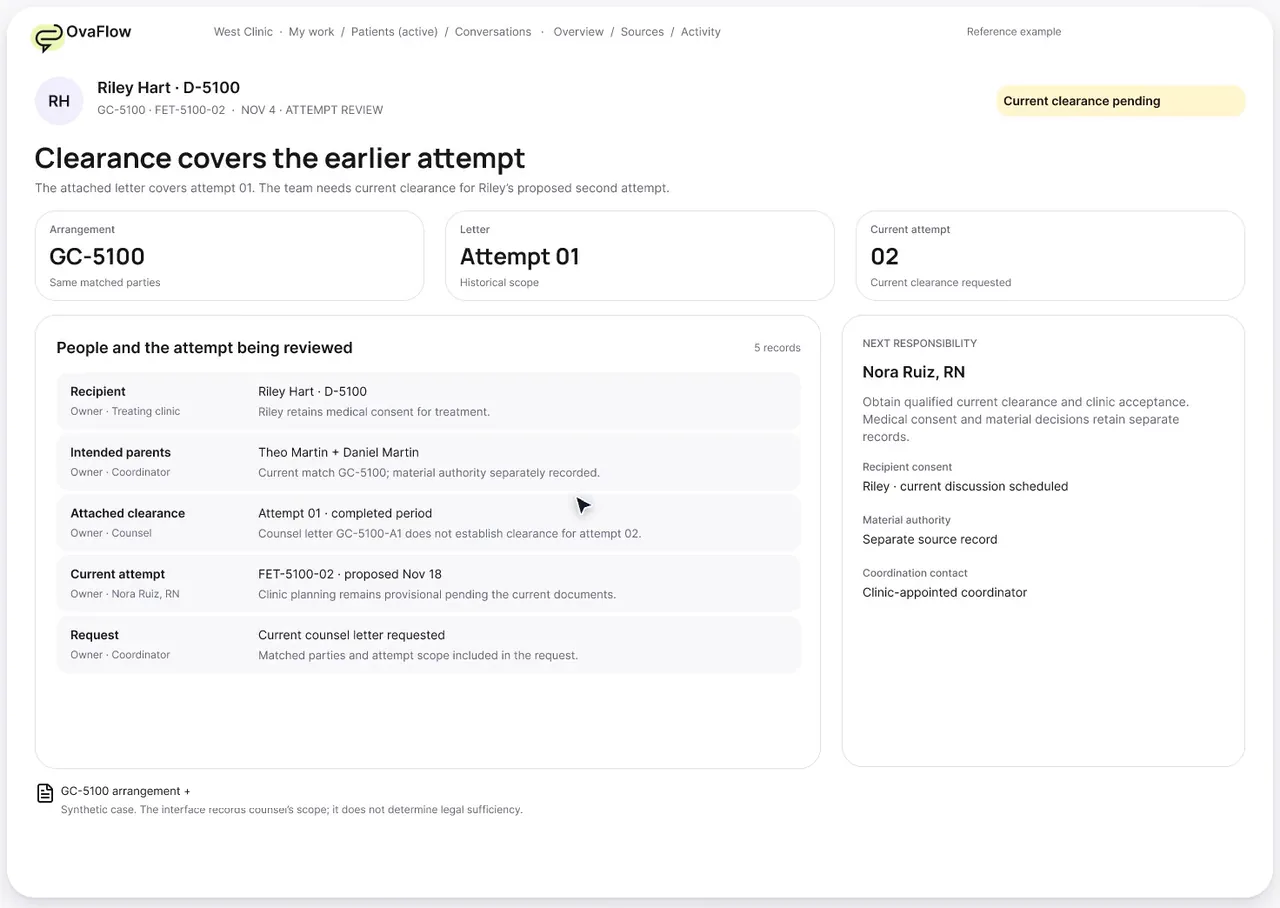
    Medical and legal clearance recorded for the first embryo transfer attempt cannot roll over silently to a second attempt. When the first attempt does not succeed, the second attempt requires its own fresh attempt-scoped clearance before warming.

    On screen at 0:16Clearance from the first attempt can't be reused for the second attempt's transfer cycle.The recording shows this rule for another fictional patient, Riley Hart. The same rule applies to Avery and Sam's second attempt.

For the team

What changed for the team

Two people, two charts, two attempts. Each permission belongs to one person and one attempt.

  1. Two charts

    Without it: Being family is treated as access to the other person's record.

    In this walkthrough: Avery and Sam each have their own role, chart and permissions.

  2. The consent form

    Without it: A form filed under the wrong person stays there.

    In this walkthrough: It moves to Sam's chart, and the move is visible.

  3. The second attempt

    Without it: Clearance from the first attempt is reused.

    In this walkthrough: The second attempt gets its own clearance.

Every decision in this story is made by a clinician, a nurse or the lab. OvaFlow keeps the work, its owner and its source in view.

Two charts & per-attempt clearance

Two intended parents, two charts, and clearance for one attempt at a time

Avery and Sam's story shows how multi-party family building keeps each person's medical chart and privacy separate while coordinating shared consents and ensuring that clearance for Attempt #1 never rolls over silently to Attempt #2.

4 handoff checkpoints

Handoff sequence across patient, clinical team, and EMR & lab

  1. 01Stage 01 · IntakePatient & family

    Separate roles, separate charts

    Avery and Sam each have their own medical chart, biological/gestational role and portal permissions.

    What holds: Separate medical charts

  2. 02Stage 02 · WorkupEMR & lab check

    Misfiled consent moved to Sam's chart

    A transfer consent scanned under Avery's chart is held and moved to Sam's chart with a visible record.

    What holds: Moved to the right chart

  3. 03Stage 07 · Attempt #1Clinical team

    Attempt #1 clearance verified

    Medical and legal clearance is bound specifically to Transfer Attempt #1.

    What holds: Bound to Attempt #1

  4. 04Stage 07 · Attempt #2Clinical team

    Fresh clearance required for Attempt #2

    When moving to a second transfer attempt, Attempt #1 clearance cannot be reused; a new clearance is required.

    What holds: Fresh clearance for #2

Four multi-party checkpoints across Avery & Sam's episode: role-separated charts, visible consent re-filing, and per-attempt transfer clearance.
Clinical context & EMR scope boundaries

Why this sequence matters

Clinical and operational context

In the clinic: In reciprocal IVF, donor-assisted reproduction and gestational-carrier arrangements, two or more adults participate in a single family-building plan while having completely distinct biological roles, medical histories, infectious-disease testing windows and legal consents.

Across handoffs: Many legacy clinic workflows attach a second participant as a text field inside the primary patient's chart or file all scanned PDFs into one folder. Keeping separate charts linked by role—and scoping medical/legal clearance to a single transfer attempt—prevents privacy leaks, misfiled consents and unauthorized repeat transfers.

Where OvaFlow fits

What OvaFlow coordinates vs. what stays with the clinic

OvaFlow coordinates

  • Role-specific linking of Avery's and Sam's separate medical charts without merging private records
  • Chart-matching check and visible relocation audit trail when a consent form is filed under the wrong person
  • Attempt-scoped medical and legal clearance that blocks silent reuse on a subsequent transfer attempt

Clinicians, EMR & lab own

  • Clinical evaluation, infectious-disease screening and procedure counseling for each participant
  • Review of independent legal representation letters and parentage agreements per ASRM guidelines
  • Physician sign-off on each frozen embryo transfer (FET) attempt

Questions about this walkthrough

Common questions from patients and clinic teams

View all 3 story questions & answers
Why do Avery and Sam need separate medical charts if they are building one family together?

Each person undergoing diagnostic testing, egg retrieval, sperm collection or embryo transfer is an individual patient with their own medical history, allergies, lab results, billing and privacy rights. Linking their charts through a shared episode lets the care team see how their readiness items fit together without exposing one person's private clinical notes inside the other person's chart.

Sources: [2] ASRM Practice Committee (2026) · [1] ASRM Practice Committee (2026)

What happens when a scanned consent form lands in the wrong person's chart?

In multi-party care, it is easy for a scanned consent or lab PDF to be uploaded under the other participant's chart. Rather than deleting and re-uploading silently—or letting the wrong chart satisfy the checklist—OvaFlow blocks readiness until the document is reassigned to the right person's chart with a visible record of the move.

Sources: [2] ASRM Practice Committee (2026) · [18] ONC SAFER Guides (2025)

Why must medical and legal clearance be verified anew for a second transfer attempt?

As ASRM's gestational-carrier and third-party reproduction guidance notes, legal clearance letters, psychological counseling and infectious-disease panels are often valid for a specific transfer attempt or time window. Scoping clearance to one attempt ensures that if Attempt #1 does not succeed, Attempt #2 confirms current legal and clinical authorization before embryo warming.

Sources: [12] ASRM Practice Committee (2022)

Clinical & operational guidelines referenced in this story (4 sources)
  1. [2]
    ASRM Practice Committee (2026) — Fertility care and family building for LGBTQ+ individuals: a committee opinionDonor-assisted and reciprocal IVF pathways with distinct gamete-contributing, gestational and legal roles.
  2. [12]
    ASRM Practice Committee (2022) — Recommendations for practices using gestational carriers: a committee opinionIndependent legal clearance, separate medical charts and attempt-specific clearance before embryo transfer.
  3. [1]
    ASRM Practice Committee (2026) — Fertility evaluation of infertile women: a committee opinionTailored, parallel evaluation of each participant rather than a single generic infertility intake.
  4. [18]
    ONC SAFER Guides (2025) — Test Results Reporting and Follow-Up & Contingency PlanningClosed-loop tracking of expected diagnostic results from order to clinician review and downtime reconciliation.

See it with your team

Walk this story through with your team

We'll replay the walkthroughs behind each chapter and look at where the same moments happen in your clinic.