Product preview · Fictional patient data

OvaFlow

Story · Jordan Patel

Jordan: every sample matched to the right embryo

Follow Jordan Patel's preimplantation genetic testing (PGT) and embryology records across six moments: a wrong-chart stop during afternoon nursing, a specimen label mismatch, an outside reference-lab accession hold, an amended genetics report requiring physician sign-off, two-biopsy embryo lineage, and verified cryostorage location.

Embryology and genetic testing6 chapters
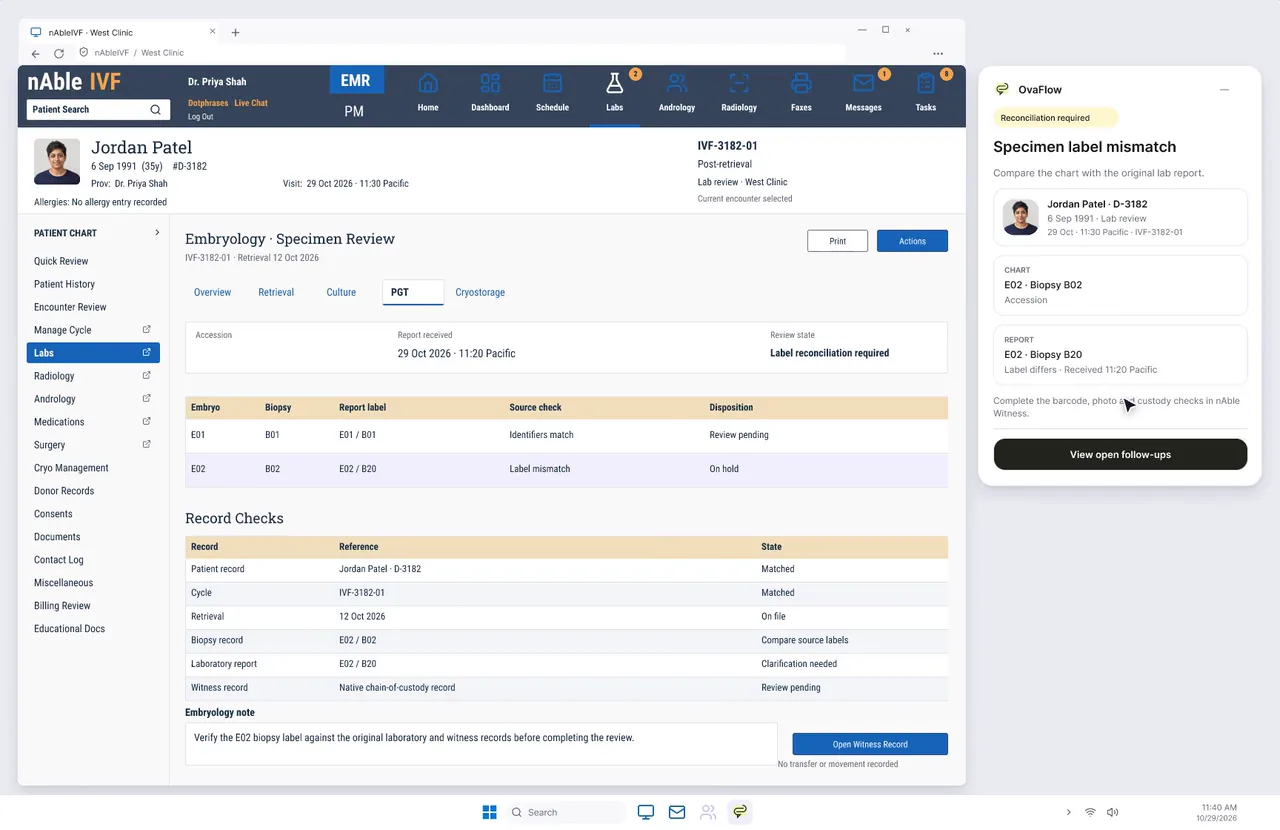
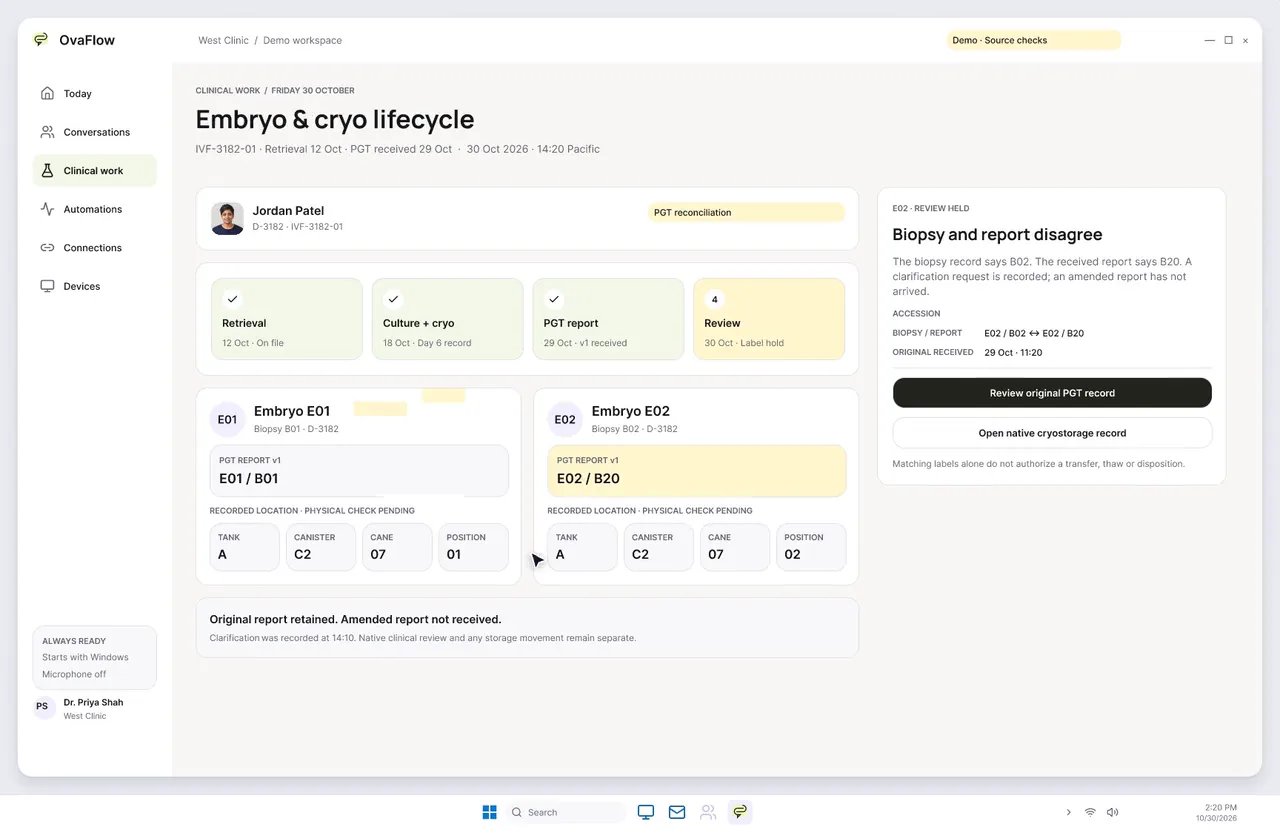
A specimen label for Jordan Patel doesn't match the original report, so review stops. Still from a prototype walkthrough. Fictional patient data.
Jordan PatelPatient whose genetic testing needs careful matching
A specimen label for Jordan Patel doesn't match the original report, so review stops.Prototype walkthrough · Fictional patient data
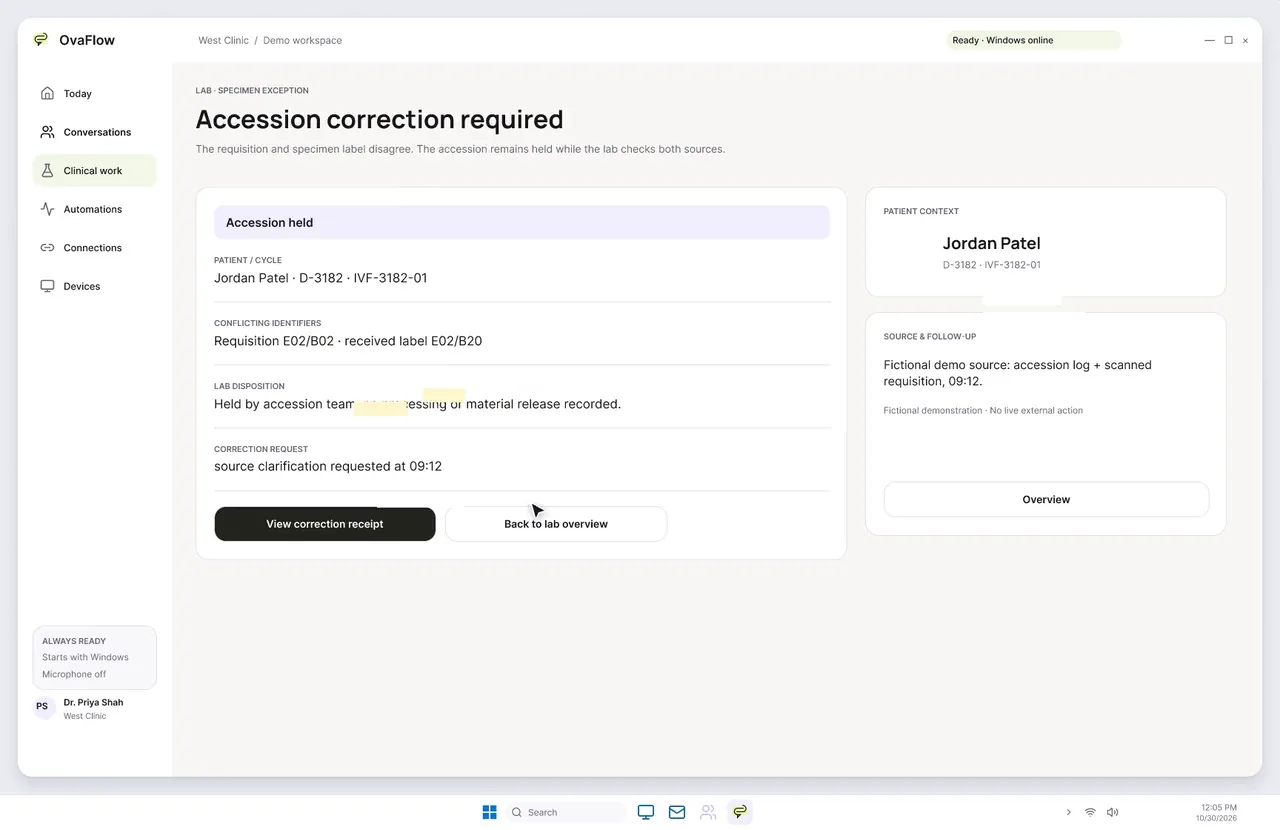
  1. An outside lab accession hold for Jordan Patel needs correction.
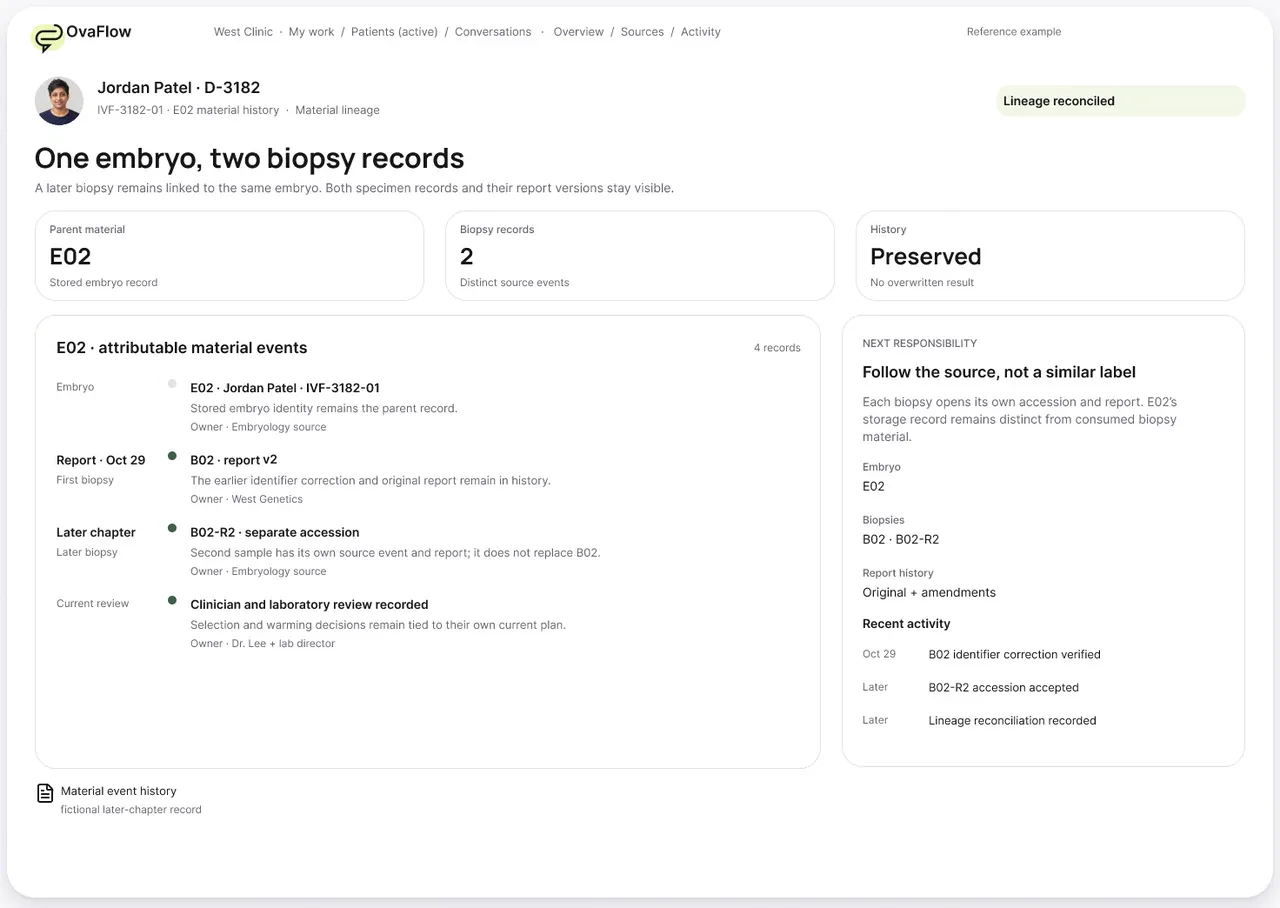
  2. Two biopsy records on one embryo keep their own lineage.

People

Who's in this story

View all 1 people in this story
  • Jordan PatelPatient whose genetic testing needs careful matching

Fictional patient dataEvery patient, family member, clinician and clinic in these stories is fictional. Names, times and screens come from prototype walkthroughs, not from real care.

Daily care: a changed trigger, the wrong chart and an unknown outcome: the moment in each chapter, from the prototype walkthrough. Fictional patient data.
Walkthrough page

Prototype walkthrough · Fictional patient data · Desktop

  1. Chapter 01Trigger

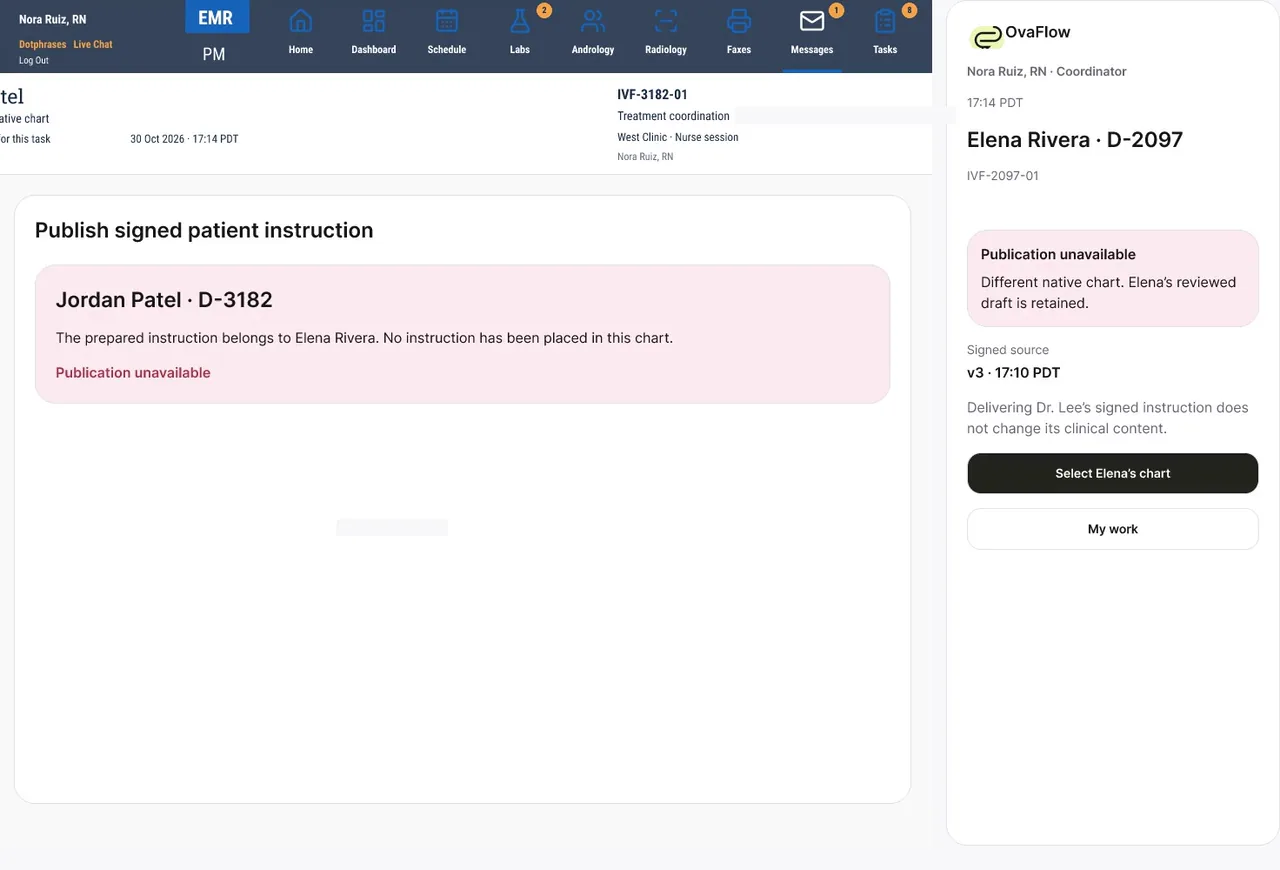
    The chart that was open by mistake

    In the daily-care story, Jordan's chart was the one open on Nora Ruiz's desktop when Elena's revised trigger instruction was ready. Placement stopped immediately, so nothing from Elena's cycle ever touched Jordan's record.

    On screen at 0:19The open chart switches to Jordan Patel. The instruction belongs to Elena, so placement stops.

nAbleIVF: allergy check, monitoring note, save check, specimen stop: the moment in each chapter, from the prototype walkthrough. Fictional patient data.
Walkthrough page

Prototype walkthrough · Desktop · nAbleIVF · Modeled workflow example

  1. Chapter 02Embryology & PGT

    A label that doesn't match

    When an incoming specimen label for Jordan does not match the source accession record, clinical review stops and holds the item until the discrepancy is resolved with the lab.

    On screen at 0:07A specimen label for Jordan Patel doesn't match the original report, so review stops.

Lab & specialty pharmacy: accession hold, amended PGT, cryo signal: the moment in each chapter, from the prototype walkthrough. Fictional patient data.
Walkthrough page

Prototype walkthrough · Desktop

  1. Chapter 03Embryology & PGT

    An accession hold, corrected

    An outside genetics reference lab places an accession hold on Jordan's biopsy packet. The clinic resolves the requisition discrepancy and tracks the hold until the reference lab confirms receipt of the correction.

    On screen at 0:01An outside lab accession hold for Jordan Patel needs correction.

  2. Chapter 04Embryology & PGT

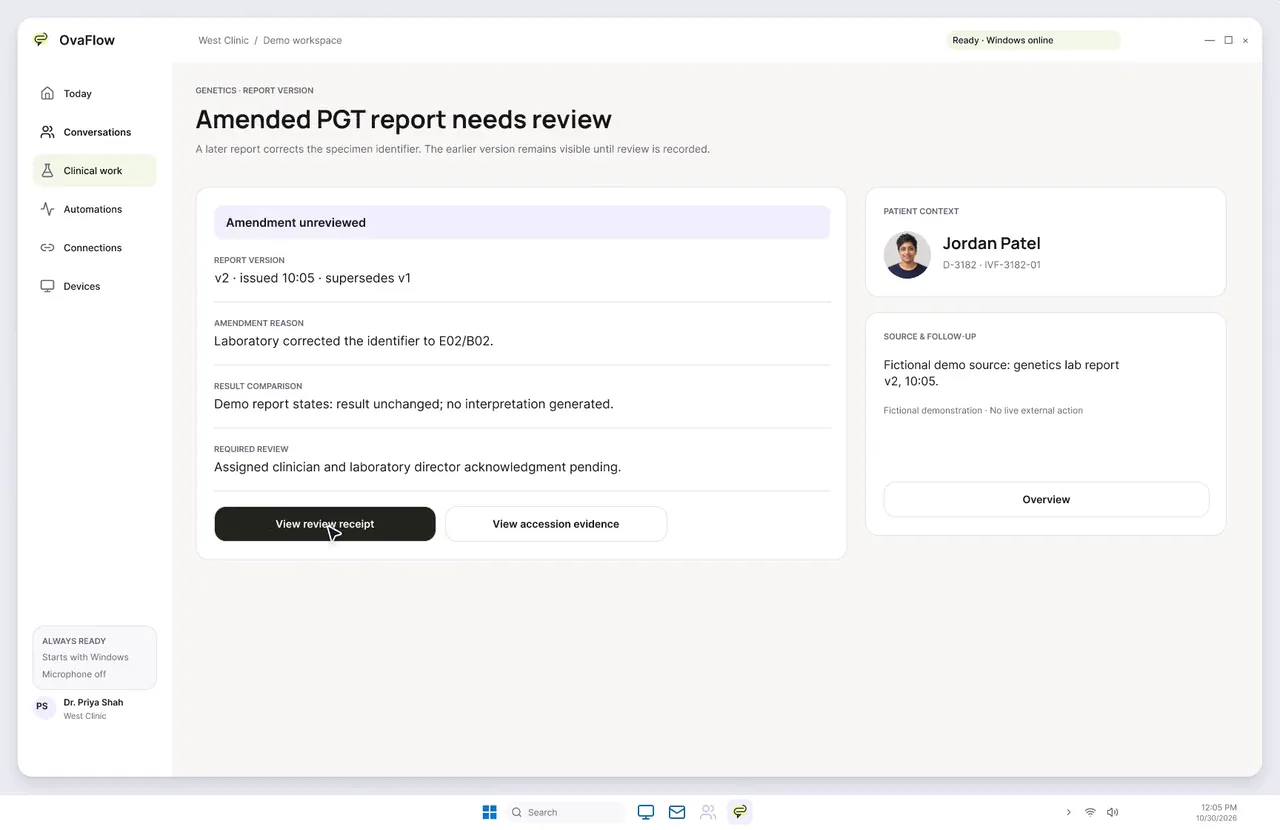
    An amended PGT report

    When the reference genetics lab issues an amended PGT report, transfer planning pauses until a physician's documented review of the version difference is recorded against the specific embryo.

    On screen at 0:05An amended PGT report needs a documented clinician review.

Embryology: PGT-M readiness, a media recall and warming authorization: the moment in each chapter, from the prototype walkthrough. Fictional patient data.
Walkthrough page

Prototype walkthrough · Desktop

  1. Chapter 05Embryology & PGT

    Two biopsies, one embryo

    When a single blastocyst undergoes a second trophectoderm biopsy after an inconclusive first result, both biopsy records stay linked to one parent embryo lineage so results are never double-counted or crossed.

    On screen at 0:07Two biopsy records on one embryo keep their own lineage.

Lab & pharmacy core: witnessing, prior auth, delivery and readiness: the moment in each chapter, from the prototype walkthrough. Fictional patient data.
Walkthrough page

Prototype walkthrough · Desktop

  1. Chapter 06Cryo & long‑term

    The embryo record and its storage location

    Before any frozen transfer or long-term storage decision, Jordan's embryo PGT status, witnessing check and tank/canister/cane storage coordinates are reconciled against the lab's own record.

    On screen at 0:16Jordan Patel's embryo PGT and storage location check opens.

For the team

What changed for the team

In genetic testing, a small mismatch matters. Review stops until it is resolved, and the people who decide still decide.

  1. The open chart

    Without it: Another patient's instruction can be placed in Jordan's record.

    In this walkthrough: Placement stopped, and nothing of Elena's reached Jordan's chart.

  2. The label

    Without it: A label that doesn't match its report slips through review.

    In this walkthrough: Review stops until the mismatch is resolved.

  3. The amended report

    Without it: An amended PGT report is missed before transfer planning.

    In this walkthrough: A physician's documented review is recorded before planning continues.

  4. Two biopsies

    Without it: Results from two biopsies of one embryo can cross.

    In this walkthrough: Each biopsy keeps its own lineage.

Every decision in this story is made by a clinician, a nurse or the lab. OvaFlow keeps the work, its owner and its source in view.

Sample & embryo custody

Six custody checks from open-chart protection to cryostorage

Jordan Patel's story follows preimplantation genetic testing (PGT) across the clinic and embryology bench: blocking a wrong-chart publish, stopping on a specimen label mismatch, resolving an outside genetics lab accession hold, reviewing an amended PGT report, tracking two biopsies on one embryo, and verifying tank coordinates.

6 handoff checkpoints

Handoff sequence across patient, clinical team, and EMR & lab

  1. 01Trigger cameoEMR & lab check

    Open chart protected

    Elena's trigger publish is blocked when Jordan's chart is open on Nora Ruiz's desktop.

    What holds: Other chart protected

  2. 02Lab intakeEMR & lab check

    Specimen label mismatch stop

    A specimen label that differs from the source requisition halts review immediately.

    What holds: Stopped on label mismatch

  3. 03Reference labClinical team

    Accession hold resolved

    Outside genetics lab hold is corrected and tracked until the reference lab confirms receipt.

    What holds: Lab receipt confirmed

  4. 04Report v2Clinical team

    Amended PGT report sign-off

    Updated genetics report pauses transfer planning until documented physician review.

    What holds: Physician review required

  5. 05Re-biopsyEMR & lab check

    Two biopsies, one embryo

    First and second trophectoderm biopsy tubes stay linked to a single blastocyst ID.

    What holds: Linked to one embryo

  6. 06Cryo tankEMR & lab check

    Storage coordinate reconciled

    Embryo PGT result, witnessing check and tank/canister/cane location match before transfer.

    What holds: Tank & PGT matched

Custody timeline for Jordan Patel's embryo and genetic testing records across EMR chart protection, reference-lab intake, biopsy lineage and cryostorage.
Clinical context & EMR scope boundaries

Why this sequence matters

Clinical and operational context

In the clinic: In preimplantation genetic testing (PGT), clinical decisions about which blastocyst to warm and transfer depend completely on chain-of-custody accuracy between the embryology dish, the trophectoderm biopsy tube, the outside reference genetics report, and the liquid-nitrogen storage cane.

Across handoffs: Genetic testing records frequently change over several weeks: an outside reference lab may place an accession hold for a missing form, a blastocyst with an inconclusive first result may be warmed and biopsied a second time, or a genetics lab may issue an amended report. Tracking version history and parent-embryo lineage prevents transferring on outdated or crossed data.

Where OvaFlow fits

What OvaFlow coordinates vs. what stays with the clinic

OvaFlow coordinates

  • Wrong-chart stop protecting Jordan's open chart from another patient's instruction
  • Workflow stops on specimen label mismatches and outside reference-lab accession holds
  • Mandatory physician review gate when an amended PGT report arrives from the genetics lab
  • Parent-embryo lineage across multiple biopsies and reconciliation with cryostorage coordinates

Clinicians, EMR & lab own

  • Trophectoderm biopsy, embryo vitrification, and physical barcode/RFID witnessing in the lab
  • Reference genetics laboratory sequencing, bioinformatics and variant classification
  • Physician interpretation of amended PGT reports and patient counseling on embryo selection

Questions about this walkthrough

Common questions from patients and clinic teams

View all 3 story questions & answers
Why can an amended PGT report arrive after the initial genetic results were already shared?

Reference genetics laboratories occasionally issue an amended report if quality-control re-analysis updates a mosaicism call, resolves a formerly inconclusive sample after re-biopsy, or updates variant classification in single-gene testing (PGT-M). OvaFlow flags any amended report and holds transfer planning until a physician documents review of what changed.

Sources: [4] ASRM Practice Committee (2023) · [7] HFEA Patient Guide (2026)

How does tracking 'two biopsies, one embryo' prevent errors in embryo inventory?

When one blastocyst is biopsied twice (for example, Day 5 biopsy #1 inconclusive, re-biopsy #2 euploid), a flat spreadsheet of biopsy tubes can make it look like the patient has two separate embryos or leave the old 'inconclusive' label attached. Linking both biopsy tubes as child records of one unique embryo ID keeps the inventory count and final genetic call unambiguous.

Sources: [4] ASRM Practice Committee (2023) · [9] ASRM Practice Committee (2022)

How does OvaFlow interact with the embryology lab's electronic witnessing system?

Embryology laboratories use dedicated hardware (optical barcode or RFID readers at the laminar-flow hood) to witness physical dish-to-dish moves. OvaFlow works beside that system by surfacing requisition label mismatches, reference-lab accession holds, report version diffs and tank coordinate checks across the clinical and lab teams.

Sources: [9] ASRM Practice Committee (2022) · [18] ONC SAFER Guides (2025)

Clinical & operational guidelines referenced in this story (4 sources)
  1. [4]
    ASRM Practice Committee (2023) — Indications and management of preimplantation genetic testing for monogenic conditions (PGT-M)Custom single-gene test design, family DNA samples, reference-lab acceptance before stimulation, and non-portability of amplified biopsy DNA across labs.
  2. [9]
    ASRM Practice Committee (2022) — Comprehensive guidance for human embryology, andrology, and endocrinology laboratories: management and operationsContinuous specimen witnessing, chain of custody, culture-media lot traceability, warming authorization and cryostorage records.
  3. [7]
    HFEA Patient Guide (2026) — In vitro fertilisation (IVF) and Pre-implantation Genetic Testing (PGT-M / PGT-SR)Plain-language overview of IVF stages, embryo grading, single embryo transfer and genetic testing options.
  4. [18]
    ONC SAFER Guides (2025) — Test Results Reporting and Follow-Up & Contingency PlanningClosed-loop tracking of expected diagnostic results from order to clinician review and downtime reconciliation.

See it with your team

Walk this story through with your team

We'll replay the walkthroughs behind each chapter and look at where the same moments happen in your clinic.