Product preview · Fictional patient data

OvaFlow

Branch · Can open at almost any stage

When plans change

Real IVF care branches frequently: a stimulation cycle may be canceled for low or excessive ovarian response, a planned fresh transfer may convert to freeze-all for ovarian hyperstimulation syndrome (OHSS) prevention or genetic testing wait times, an embryo transfer may not result in pregnancy, an early pregnancy may end in loss, or a person may choose a pause to recover emotionally, physically or financially. Each transition requires reconciling downstream orders and bookings, silencing routine reminders, offering confidential support, and keeping the door open for a return on the patient's own timing.

5 prototype walkthroughs
Maya's iPhone: a chosen pause and a private support call. Prototype walkthrough preview with fictional patient data.
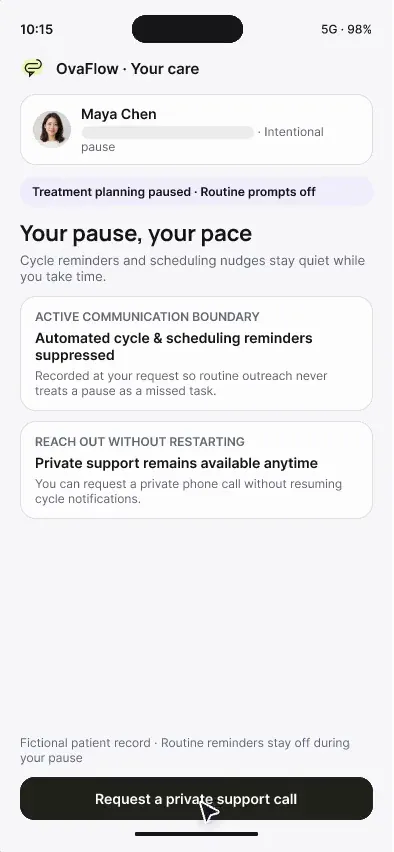
  1. Maya's treatment pause screen opens on her iPhone: “Your pause, your pace”.
  2. She asks for a private call with a clinician. Lock Screen previews stay off and her pause stays in place.
  3. She's back on her pause overview, with the private call request pending.
Maya's pause: routine reminders stop, and private support stays one tap away.Prototype walkthroughFictional patient dataOpen the walkthrough

A pause

Routine prompts go quiet. Support stays.

When Maya pauses treatment, cycle reminders and scheduling nudges stop, and a pause is never treated as a missed task. Private support stays one tap away.

  • Cycle remindersQuiet during the pause
  • Scheduling nudgesQuiet during the pause
  • Lock Screen previewsOff
  • Private support callAvailable anytime, without restarting reminders

From Maya's pause walkthrough on iPhone. Fictional patient data.

Both sides

One stage, seen from both sides

For the clinic team

What the team coordinates

OvaFlow tracks cancellation, conversion to freeze-all, unsuccessful cycles, loss, a chosen pause and a patient-led return, and stops prompts that no longer fit.

  • Plan changes that reconcile future medication instructions, procedure bookings and lab orders together
  • Routine reminders and celebratory prompts suppressed immediately after a loss or a chosen pause
  • A named clinician and nursing owner for follow-up review and bereavement or counseling support
  • Confidential support requests that keep the pause state and Lock Screen privacy intact
  • A patient-led return that resumes from planning, frozen transfer or long-term storage choices on their own timing
Operational checks at this stage (3)
  • Reconcile all future medication instructions, procedure-room bookings, lab thaw requests and authorizations whenever a cycle cancels or converts to freeze-all.
  • Silence routine reminders and celebratory messages immediately upon recording a loss, unsuccessful transfer or chosen pause, and assign a named follow-up owner.
  • Allow confidential support callbacks with Lock Screen privacy while keeping the episode in a paused state until the patient initiates a return.

For you and your family

What you experience

If treatment pauses, stops or doesn't work, your care team changes the plan with you, at your pace.

Questions you may ask here (3)
  • “If my cycle is canceled or we experience a pregnancy loss, will the app stop sending daily injection or pregnancy reminders right away?”
  • “If I choose to take a break for a few months, can I still ask for a private call with my doctor or counselor without restarting automated messages?”
  • “When I feel ready to come back, where does my care pick up?”
Words you may hear (3)
Freeze-all
A clinician's decision to freeze all embryos instead of doing a fresh transfer in the same cycle.
Treatment pause
A break in treatment that the patient chooses. Reminders stop, and returning happens on the patient's timing.
Pregnancy loss
The end of a pregnancy before birth. Care afterward is clinician-led, and routine reminders should stop.

Questions about your own treatment go to your care team. OvaFlow never gives medical advice. In an emergency, call 911.

Read the plain-language guide to IVF

See it

Walkthroughs from this stage

Recorded from an interactive design prototype. Every patient, clinician and clinic is fictional, and EMR screens are modeled reconstructions.

Prototype walkthrough · Fictional patient data

Handoffs and safeguards

Where work slips, and what holds instead

These are the moments the design is built around. Each safeguard stops or holds work; the decision stays with the clinician or the lab.

Where it slips today

  1. Automated medication or pregnancy-week reminders keep arriving on a patient's phone after a cycle cancellation or loss.
  2. Requesting a confidential nursing or counseling callback during a treatment pause accidentally flips the episode back to active and restarts routine prompts.
  3. A canceled or converted cycle leaves operating-room holds, lab thaw orders and prior authorizations dangling across systems.
  4. A patient returning after several months has to repeat their story from scratch because the reason for pause and remaining cryo inventory were never linked.

What holds in OvaFlow

  • Right next stepRespectful prompt pauseAfter a loss or a chosen pause, routine and celebratory reminders stop.
  • Right ownerClinical questions go to a personDose and symptom questions are routed to a nurse, never answered by an automated reply.
  • Right ownerSent isn't acceptedA referral or transfer of care counts only when the receiving team accepts it.
All safeguards

Step-by-step timing & questions

How When plans change unfolds day by day

Plans change when stimulation is canceled, a fresh transfer converts to freeze-all, a transfer does not result in pregnancy, an early pregnancy ends in loss, or a patient chooses a pause—requiring coordinated cleanup of future orders, quieted reminders, private support and an open return path.

Can open from any active stage · Return at patient's pace

How a change of plan unwinds active orders and protects a patient-paced return

  1. 01When plans change

    Cycle stops, freezes all, or loss

    Patient & family

    Your clinician talks with you directly when a cycle needs to stop, convert to freeze-all, or when a test or scan brings hard news.

    What holdsFuture orders & bookings cleaned up
    Clinic, EMR & lab

    Physician records the plan change; OvaFlow identifies all downstream medication instructions, OR holds and lab orders to reconcile.

  2. 02Right away

    Routine reminders go quiet

    Patient & family

    Routine medication alarms, appointment nudges and pregnancy-week messages stop immediately so your phone stays quiet.

    What holdsRoutine & pregnancy prompts stopped
    Clinic, EMR & lab

    Automated cadence prompts are suppressed across the episode while a named nurse or physician owns personal follow-up.

  3. 03During a pause

    Private support without restarting

    Patient & family

    You can request a private counseling or nursing call with Lock Screen privacy, and asking for support never restarts treatment reminders.

    What holdsSupport call keeps the pause in place
    Clinic, EMR & lab

    Confidential callback routes only to the accepted clinician/nurse without flipping the episode status from Paused to Active.

  4. 04On your timing

    Returning where you choose

    Patient & family

    Weeks or months later, when you decide you are ready, you let the clinic know—without having to repeat your history from scratch.

    What holdsPrior notes & embryos ready on return
    Clinic, EMR & lab

    Episode resumes into Workup, Frozen Transfer or Cryo choices with prior cycle notes, accommodations and stored embryos linked.

Opening this branch from any stage reconciles downstream bookings and medications, silences routine reminders, keeps confidential support separate from reactivation, and preserves context for when the patient chooses to return.
Worked example: Maya Chen's chosen pause & confidential call, and Elena Rivera's freeze-all conversion
Worked example · West ClinicFictional patient data

Maya Chen's chosen pause & confidential call, and Elena Rivera's freeze-all conversion

What the patient sees

After an unsuccessful attempt, Maya Chen chooses to pause. Routine reminders stop. When she requests a confidential callback on her phone, no sensitive details appear on her Lock Screen and her pause remains intact until she chooses to return months later.

What the clinic team sees

In Elena Rivera's cycle, Dr. Mira Lee's conversion to freeze-all updates downstream transfer holds and lab instructions together. In Maya's episode, Dr. Lee accepts the private callback while the episode stays paused.

Why it holds: A change of plan is treated as a first-class clinical workflow rather than an exception that leaves ghost orders and painful automated nudges behind.

Where OvaFlow fits

How OvaFlow works beside the clinic's own EMR and lab

Coordination companion

What OvaFlow coordinates

  • Coordinated cleanup of downstream medication instructions, procedure holds and lab orders when a cycle cancels or converts
  • Immediate suppression of routine and celebratory notifications during a pause or after a loss, with Lock Screen privacy on support requests
  • Preservation of prior cycle context, accommodations and linked cryostorage inventory for a patient-initiated return
System of record

What stays with clinicians & the EMR

  • Clinical judgment on canceling stimulation, converting to freeze-all, or evaluating recurrent implantation failure and pregnancy loss
  • Direct bereavement counseling, psychological support referrals, and medical debrief consultations
  • Planning the next stimulation protocol, frozen transfer regimen or long-term disposition when the patient returns
OvaFlow never prescribes medications, never triages symptoms, and never replaces the clinic's own EMR or electronic witnessing hardware.

Common questions at this stage

Questions from patients, families and clinic teams

View all 4 stage questions & answers
What are the most common reasons an IVF cycle changes plan mid-stream?

Cycles commonly branch for several clinical reasons: ovarian stimulation may be canceled before trigger if follicle recruitment is much lower or higher than expected; a planned fresh transfer may convert to freeze-all to reduce ovarian hyperstimulation syndrome (OHSS) risk, wait for preimplantation genetic testing (PGT) results, or address elevated progesterone or fluid in the uterine cavity; or a patient may choose to pause after an unsuccessful transfer or early pregnancy loss.

Sources: [5] ESHRE Guideline Group (2026) · [8] ASRM Practice Committee (2024) · [17] ASRM & ESHRE (2015–2026)

Why do patients sometimes still receive automated pregnancy or medication reminders after a loss?

In many fragmented clinic stacks, patient messaging campaigns run in a separate portal or CRM tool from the clinical flowsheet where a negative beta-hCG, miscarriage or cycle cancellation is documented. OvaFlow ties notification rules directly to the episode state so recording a loss or pause immediately silences routine and celebratory prompts.

Sources: [13] NICE Guideline 126 (2026) · [17] ASRM & ESHRE (2015–2026)

How does OvaFlow handle a request for emotional or clinical support while a patient is on a break?

ESHRE psychosocial care guidelines emphasize that patients need accessible emotional and clinical support before, during and after treatment—especially following an unsuccessful cycle or loss. In OvaFlow, requesting a confidential callback routes privately to the care team and keeps Lock Screen notifications generic, without flipping the episode back to active treatment.

Sources: [17] ASRM & ESHRE (2015–2026) · [13] NICE Guideline 126 (2026)

What happens when a patient decides to return after a pause?

A return is always initiated on the patient's timing. Depending on whether frozen embryos are already in storage or a new retrieval is planned, the episode re-enters at Workup & Readiness, Transfer, or Cryo & Long-Term choices—with prior cycle notes, accommodations and embryo inventory already linked.

Sources: [17] ASRM & ESHRE (2015–2026) · [16] ASRM Ethics & Practice Committees (2020–2021)

Clinical & operational sources for When plans change (5 primary guidelines)
  1. [17]
    ASRM & ESHRE (2015–2026) — ESHRE Routine Psychosocial Care in Infertility & ASRM Recurrent Implantation Failure (2026)Structured post-cycle review, suppression of automated treatment prompts during a pause or loss, and patient-paced return.
  2. [13]
    NICE Guideline 126 (2026) — Ectopic pregnancy and miscarriage: diagnosis and initial management (updated June 2026)Active surveillance for pregnancy of unknown location (PUL) until definitive diagnosis, symptom escalation and compassionate loss follow-up.
  3. [8]
    ASRM Practice Committee (2024) — Prevention of moderate and severe ovarian hyperstimulation syndrome (OHSS): a guidelineRisk factors, alternative trigger strategies, post-retrieval symptom surveillance and elective freeze-all conversion.
  4. [5]
    ESHRE Guideline Group (2026) — Guideline on Ovarian Stimulation for IVF/ICSI (v2.3 update)Individualized gonadotropin stimulation, ultrasound and estradiol monitoring cadence, trigger criteria and luteal phase support.
  5. [16]
    ASRM Ethics & Practice Committees (2020–2021) — Disposition of unclaimed embryos (2021) & Cryostorage of reproductive tissues in the IVF laboratory (2020)Storage fee payment as active contact, multi-channel outreach before any unclaimed status, and holds on conflicting disposition instructions.

See it with your team

Talk through how a change of plan is handled.

We'll go through the prototype walkthroughs for this stage and the questions your team would ask first.