Product preview · Fictional patient data

OvaFlow

Stage 2 of 9

Workup & readiness

Before stimulation begins, ovarian reserve and uterine evaluation, semen analysis or donor vial verification, infectious-disease screening, custom single-gene genetic testing preparation (PGT-M), procedure consents, and specialty pharmacy prior authorizations all have to come together. Because these items cross multiple people and outside labs on different calendars, each prerequisite needs its own owner and status before Day 1.

6 prototype walkthroughs
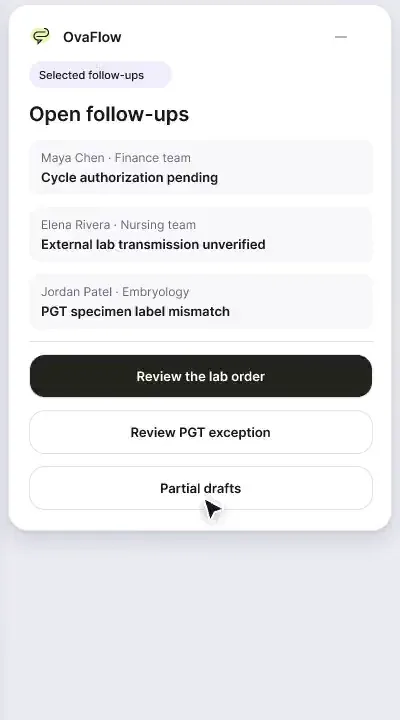
eIVF: note save, financial blocker, e-prescribing handoff, PGT stop. Prototype walkthrough preview with fictional patient data.
  1. The destination for the consultation note is confirmed before anything is placed.
  2. The reviewed draft is placed in the eIVF note editor.
  3. Staff press Save in eIVF. The task stays open until the saved draft is checked.
  4. The saved draft is confirmed in the eIVF record itself.
  5. Maya Chen's cycle readiness checklist opens.
  6. An unresolved financial authorization blocks cycle start and is shown before anything begins.
  7. Back to the clinical and financial readiness overview.
  8. A monitoring review includes a dictated medication change.
  9. The details of the dose change are clarified before anything is prescribed.
  10. The change is handed to the clinic's own eIVF e-prescribing workflow. OvaFlow does not prescribe.
  11. Back to the monitoring overview.
  12. The eIVF follow-up queue opens.
  13. An order handed to an outside reference lab is tracked.
  14. Back to the follow-ups.
  15. A PGT biopsy label doesn't match its source, so review stops.
Follow-ups beside the chart: an order sent to an outside reference lab stays tracked until it comes back.eIVF · Modeled workflow exampleFictional patient dataOpen the walkthrough

Both sides

One stage, seen from both sides

For the clinic team

What the team coordinates

OvaFlow tracks each person's workup, the sperm-source prerequisite, PGT-M preparation, consent, benefits and allergy reconciliation, with clinical and financial readiness shown side by side.

  • Parallel workups for each person involved, linked across separate charts without merging private records
  • Sperm-source prerequisite (fresh collection, frozen backup or verified donor vial on site) flagged before stimulation
  • PGT-M family samples and reference-lab acceptance tracked early
  • Clinical readiness and financial authorization shown side by side before baseline start
  • Patient-reported allergy reconciliation against the clinic's own EMR chart
Operational checks at this stage (3)
  • Verify that every participant's infectious-disease panel, blood type and role-specific consent are filed on the right chart.
  • Confirm sperm-source readiness (fresh collection plan, frozen backup vial, or verified donor shipment in tank) prior to gonadotropin start.
  • Check that custom PGT-M probe/haplotype design is accepted by the reference genetics lab and that specialty pharmacy prior authorization matches the prescribed regimen.

For you and your family

What you experience

Tests, consents, coverage and medications are lined up before a cycle begins.

Questions you may ask here (3)
  • “How do I know whether we are waiting on my lab results, the genetics lab, or insurance prior authorization?”
  • “Why does single-gene genetic testing (PGT-M) need preparation weeks before I even start hormone injections?”
  • “What if I noted a medication or latex allergy on my intake form—how do I know the prescribing doctor sees it?”
Words you may hear (4)
Workup
The tests and assessments done before treatment begins. When two people are involved, each has their own.
PGT-M
Genetic testing for a specific inherited condition. It often needs family samples and lab preparation before the cycle starts.
Prior authorization
Approval from an insurer before a medication or procedure is covered.
Readiness gate
Clinical and financial readiness shown side by side before a cycle starts, without either one standing in for the other.

Questions about your own treatment go to your care team. OvaFlow never gives medical advice. In an emergency, call 911.

Read the plain-language guide to IVF

The readiness gate

Every readiness item has an owner

Readiness is several separate items, each owned by someone. The gate shows what is still open. Starting the cycle stays the clinician's decision.

Cycle readinessClinical and financial, side by sideEach item stays open until its owner closes it.
  • WorkupNurse coordinatorAcceptedEach person's tests in place
  • Sperm sourceAndrologyAcceptedConfirmed before stimulation
  • ConsentCoordinatorAcceptedOn the right person's chart
  • PGT-M preparationGenetics labPendingStarted early, still open
  • Prior authorizationFinancePendingWaiting on the payer

2 items open. The start decision stays with the clinician.

Illustration of the readiness gate. Roles are examples.

Handoffs and safeguards

Where work slips, and what holds instead

These are the moments the design is built around. Each safeguard stops or holds work; the decision stays with the clinician or the lab.

Where it slips today

  1. One person's infectious-disease panel or semen analysis sits in a separate chart and holds up the whole plan on Day 1.
  2. A patient-reported antibiotic or latex allergy stays buried in intake notes instead of reaching the EMR allergy list.
  3. A stimulation cycle starts while a specialty pharmacy prior authorization or cold-chain shipment is still unresolved.
  4. Custom PGT-M single-gene test development or family cheek-swab collection starts too late to be accepted by the genetics lab before retrieval.

What holds in OvaFlow

  • Right next stepClinical and financial readiness, side by sideAn unresolved authorization or clearance is visible before a cycle starts, without either one standing in for the other.
  • Right patientConsent on the right chartA consent form filed under the wrong person is moved to the right chart, with a visible trail.
  • Right ownerPrescribing stays in the EMRDose changes are handed to the clinic's own e-prescribing workflow. OvaFlow never prescribes.
All safeguards

See it

Walkthroughs from this stage

Recorded from an interactive design prototype. Every patient, clinician and clinic is fictional, and EMR screens are modeled reconstructions.

Prototype walkthrough · Fictional patient data

Step-by-step timing & questions

How Workup & readiness unfolds day by day

Workup brings together diagnostic testing, infectious-disease screening, sperm-source verification, custom genetic test preparation, signed consents, allergy reconciliation and specialty pharmacy authorization before cycle Day 1.

2–6 weeks typical · 4–12 weeks with custom PGT-M

Parallel readiness tracks that must converge before Day 1

  1. 01Weeks 1–2

    Ovarian, uterine & infectious labs

    Patient & family

    Cycle-day bloodwork (AMH, hormones, infectious screening) and a saline sonogram or hysterosalpingogram check uterine anatomy.

    What holdsLabs & allergies reconciled in EMR
    Clinic, EMR & lab

    Nursing tracks each ordered test as expected until results return and reconciles patient-reported allergies with the EMR.

  2. 02Weeks 1–3

    Sperm source & andrology

    Patient & family

    Semen analysis is completed, a frozen backup sample is banked if needed, or donor vials are selected and shipped.

    What holdsSperm source verified before stim
    Clinic, EMR & lab

    Andrology verifies that an eligible sperm source or received donor vial is physically on site before stimulation starts.

  3. 03Weeks 2–8

    PGT-M reference lab prep

    Patient & family

    For a known single-gene condition (PGT-M), you and participating family members submit DNA cheek swabs to the genetics lab.

    What holdsGenetics lab test-ready confirmation
    Clinic, EMR & lab

    Coordinator tracks variant confirmation, family samples and reference-lab test acceptance before cycle Day 1.

  4. 04Before Day 1

    Consents, coverage & meds

    Patient & family

    Each person signs their own procedure consents, reviews benefits, and checks that refrigerated medications arrived.

    What holdsEvery readiness item confirmed
    Clinic, EMR & lab

    Readiness gate shows clinical consents, prior authorization (PA) and pharmacy delivery side by side before baseline.

Clinical labs, partner or donor prerequisites, genetics lab test build, and financial/pharmacy clearance run in parallel; the readiness gate holds cycle start until every track is verified.
Worked example: Sam's misfiled consent and a held cycle start until PGT-M & allergy checks clear
Worked example · West ClinicFictional patient data

Sam's misfiled consent and a held cycle start until PGT-M & allergy checks clear

What the patient sees

During Avery & Sam's workup, a signed consent form is accidentally uploaded under Avery's chart. The readiness view shows Sam's consent still pending until the document is moved to Sam's chart with a visible audit note.

What the clinic team sees

Before baseline stimulation, the readiness gate flags an unreconciled patient-reported allergy and a pending PGT-M reference-lab acceptance, routing the prescription back to the clinic's own e-prescribing screen.

Why it holds: A cycle never starts on verbal assurance while a sperm source, custom genetics workup, allergy check or prior authorization is still incomplete.

Where OvaFlow fits

How OvaFlow works beside the clinic's own EMR and lab

Coordination companion

What OvaFlow coordinates

  • Side-by-side visibility of clinical workup, sperm-source status, PGT-M lab acceptance and financial prior authorization
  • Chart-level verification that each signed consent is attached to the right person's record
  • Reconciliation prompts when intake allergy notes differ from the EMR allergy list
System of record

What stays with clinicians & the EMR

  • Ordering diagnostic tests, interpreting ovarian reserve or uterine imaging, and signing prescriptions in the clinic's own e-prescribing tool
  • Reference genetics laboratory design and validation of custom PGT-M assays
  • Insurance benefit determination and specialty pharmacy dispensing
OvaFlow never prescribes medications, never triages symptoms, and never replaces the clinic's own EMR or electronic witnessing hardware.

Common questions at this stage

Questions from patients, families and clinic teams

View all 4 stage questions & answers
Why does PGT-M (single-gene testing) have to be set up before ovarian stimulation begins?

As ASRM's PGT-M committee opinion explains, testing embryos for a specific inherited monogenic condition often requires building a custom linkage map using DNA swabs from the prospective parents and sometimes relatives. Because test design and validation take several weeks—and amplified biopsy DNA cannot simply be sent to a different genetics lab mid-cycle—the reference lab's acceptance is tracked as a pre-stimulation gate.

Sources: [4] ASRM Practice Committee (2023) · [7] HFEA Patient Guide (2026)

Why is the sperm source checked before stimulation Day 1 instead of on retrieval morning?

Once daily gonadotropin injections begin, the patient is on a timed path toward egg retrieval. Discovering on trigger or retrieval day that a donor vial has not arrived, a quarantine release is incomplete, or a required surgical/backup sperm sample is missing creates an avoidable crisis. OvaFlow flags the sperm-source prerequisite before stimulation starts.

Sources: [1] ASRM Practice Committee (2026) · [15] 21 CFR Part 1271 & ASRM (2024–2026)

How do clinical readiness and financial prior authorizations interact?

Injectable gonadotropins and GnRH antagonists require specialty pharmacy prior authorization and cold-chain shipping. Showing financial authorization and pharmacy delivery status alongside clinical labs prevents a patient from arriving for a baseline scan without medications in hand.

Sources: [6] SART Patient Guide (2026) · [18] ONC SAFER Guides (2025)

Does OvaFlow send prescriptions to the pharmacy when readiness clears?

Never. OvaFlow checks that allergies are reconciled and shows which prior authorizations are approved, then hands the clinician back to the clinic's own e-prescribing system where safety, interaction and formulary checks run.

Sources: [18] ONC SAFER Guides (2025)

Clinical & operational sources for Workup & readiness (5 primary guidelines)
  1. [1]
    ASRM Practice Committee (2026) — Fertility evaluation of infertile women: a committee opinionTailored, parallel evaluation of each participant rather than a single generic infertility intake.
  2. [4]
    ASRM Practice Committee (2023) — Indications and management of preimplantation genetic testing for monogenic conditions (PGT-M)Custom single-gene test design, family DNA samples, reference-lab acceptance before stimulation, and non-portability of amplified biopsy DNA across labs.
  3. [6]
    SART Patient Guide (2026) — ART Step-by-Step Guide: Oocyte Retrieval and Embryo Transfer8–12 day stimulation window, 35–36 hour trigger-to-retrieval interval, 15–30 minute sedated retrieval, Day 5–6 blastocyst culture and progesterone support.
  4. [15]
    21 CFR Part 1271 & ASRM (2024–2026) — eCFR Title 21 Part 1271 Subpart C (Donor Eligibility) & ASRM Guidance Regarding Gamete and Embryo DonationSeparation of physical transport release from clinical-use eligibility and longitudinal routing of donor medical updates.
  5. [18]
    ONC SAFER Guides (2025) — Test Results Reporting and Follow-Up & Contingency PlanningClosed-loop tracking of expected diagnostic results from order to clinician review and downtime reconciliation.

See it with your team

Bring the checklist that holds up a cycle start.

We'll go through the prototype walkthroughs for this stage and the questions your team would ask first.