Product preview · Fictional patient data

OvaFlow

Stage 1 of 9

Referral & intake

People come to IVF for different reasons: infertility evaluation, a known single-gene condition, donor-assisted or reciprocal IVF family building, or urgent fertility preservation before cancer treatment or other gonadotoxic therapy. The first step is recording which clinical path applies, who is contributing eggs or sperm, who intends to carry a pregnancy, who holds legal parent consent, and whether an oncology therapy date makes the timeline urgent.

3 prototype walkthroughs
Two-person intake, sperm source and urgent preservation. Prototype walkthrough preview with fictional patient data.
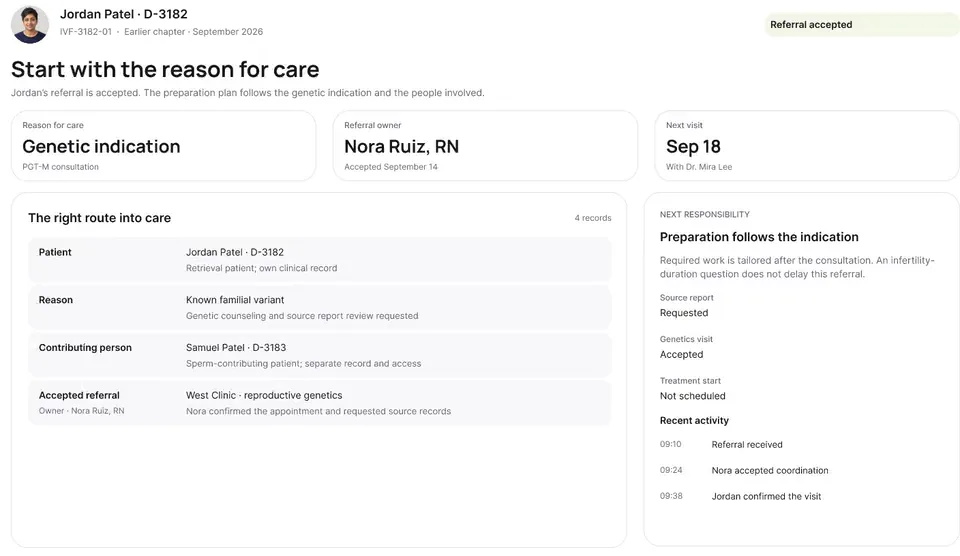
  1. Intake is organized around the patient's reason for care.
  2. Both people's diagnostic workups run in parallel.
  3. The planned sperm source is flagged as a prerequisite before stimulation starts.
  4. Back to the parallel preparation view.
  5. Back at intake, an urgent oncology pathway is opened.
  6. The care team prioritizes a time-critical fertility preservation referral.
  7. A retrieval window before chemotherapy is accepted by both the fertility and oncology teams.
  8. The preservation retrieval completes with named post-op and oncology follow-up.
Intake is organized around the reason for care. Each person's diagnostic workup then runs in parallel.Prototype walkthroughFictional patient dataOpen the walkthrough

At intake

The plan follows the reason for care

Intake opens around why someone is seeking care. Everything that has to happen first becomes its own item, in order.

  1. 01Reason for careIntake is organized around the patient's reason for care.
  2. 02Each person's workupDiagnostic workups for each person involved run in parallel.
  3. 03Sperm sourceThe planned sperm source is flagged as a prerequisite before stimulation starts.
  4. 04Urgent pathwayAn urgent oncology pathway opens from intake, with an owner on both teams.

From the intake walkthrough. Fictional patient data.

Both sides

One stage, seen from both sides

For the clinic team

What the team coordinates

OvaFlow tracks the reason for care, each person's role in the plan, and urgent preservation windows with an owner on both teams.

  • Reason-for-care intake that shapes the workup, consents and counseling track
  • Urgent fertility preservation with a retrieval window both oncology and fertility teams accept
  • Separate biological, gestational and legal roles for each person involved
  • Expected prior records and baseline history tracked from request to physician review
Operational checks at this stage (3)
  • Route oncology and gonadotoxic preservation referrals to an expedited 24–72 hour track with a shared latest safe retrieval date.
  • Record gamete-contributing, gestational and legal parentage roles separately on each participant's own chart.
  • Track requested outside operative reports, semen analyses and genetic carrier panels as expected items until reviewed.

For you and your family

What you experience

Your clinic learns why you are seeking care, who is involved, and what has to happen first.

Questions you may ask here (3)
  • “Why am I being asked infertility history questions when I am here for genetic testing or reciprocal IVF?”
  • “My oncologist wants to start treatment in two weeks—can the fertility clinic coordinate directly so I do not carry messages between doctors?”
  • “If two of us are building a family together, do we each have our own private chart and portal login?”
Words you may hear (4)
Fertility preservation
Freezing eggs, sperm or embryos for later use, sometimes urgently before a treatment such as chemotherapy.
Reciprocal IVF
A path where one person provides the eggs and the other carries the pregnancy.
Intended parents
The people who will be the parents of a child born through treatment, including when a donor or gestational carrier is involved.
Reason for care
Why someone is seeking treatment, for example infertility, a genetic condition, donor or reciprocal treatment, or preserving fertility. It shapes which steps come next.

Questions about your own treatment go to your care team. OvaFlow never gives medical advice. In an emergency, call 911.

Read the plain-language guide to IVF

Handoffs and safeguards

Where work slips, and what holds instead

These are the moments the design is built around. Each safeguard stops or holds work; the decision stays with the clinician or the lab.

Where it slips today

  1. A standard infertility questionnaire becomes the gate for someone who needs urgent fertility preservation or single-gene testing.
  2. An oncology referral waits in a general fax inbox while the chemotherapy start date approaches without a shared latest safe retrieval date.
  3. Each person's biological and legal role in the plan is assumed from a relationship label rather than recorded on their own chart.
  4. Outside surgical, pathology or prior cycle records arrive as unindexed PDFs that nobody reconciles before the first consult.

What holds in OvaFlow

  • Right ownerWhole-team commitmentA procedure slot counts only when every required team member has committed to it.
  • Right patientConsent on the right chartA consent form filed under the wrong person is moved to the right chart, with a visible trail.
All safeguards

See it

Walkthroughs from this stage

Recorded from an interactive design prototype. Every patient, clinician and clinic is fictional, and EMR screens are modeled reconstructions.

Prototype walkthrough · Fictional patient data

Step-by-step timing & questions

How Referral & intake unfolds day by day

Intake sets the clinical track before any test is ordered: diagnostic infertility workup, single-gene preimplantation genetic testing (PGT-M), reciprocal or donor-assisted family building, or rapid fertility preservation before cancer therapy.

24–72h urgent oncology · 1–3 wks routine

From first referral to a role-specific care plan

  1. 01Day 0

    Why you are coming in

    Patient & family

    You share why you are coming in: trying to conceive, genetic carrier status, LGBTQ+ family building, or upcoming medical treatment.

    What holdsPathway recorded before forms go out
    Clinic, EMR & lab

    Intake coordinator selects the pathway template so questionnaires and lab panels match the actual clinical reason.

  2. 0224–72 hrs

    Urgent window check

    Patient & family

    If chemotherapy, radiation or surgery is scheduled, you share your oncology team's target start date.

    What holdsBoth teams accept the retrieval window
    Clinic, EMR & lab

    REI physician and referring oncologist agree on the latest safe retrieval date; both teams have a named owner.

  3. 03Week 1

    Separate roles & charts

    Patient & family

    Each person involved confirms their role: egg source, sperm source, person carrying the pregnancy, or intended parent.

    What holdsSeparate charts linked by role
    Clinic, EMR & lab

    Separate medical charts are linked to the episode without merging private records or assuming permissions.

  4. 04Consult day

    Consult & physician review

    Patient & family

    You meet your fertility specialist; if audio capture is used, you can pause it at any time for personal moments.

    What holdsClinician review & EMR save confirmed
    Clinic, EMR & lab

    Clinician reviews and edits the structured consult draft and confirms it saved in the clinic's own EMR.

Four intake checkpoints align the reason for care, each person's chart role, outside medical records, and—when cancer therapy is planned—a shared latest safe retrieval date.
Worked example: Avery & Sam's role separation and Maya's consented consult
Worked example · West ClinicFictional patient data

Avery & Sam's role separation and Maya's consented consult

What the patient sees

Avery & Sam arrive as intended parents for reciprocal IVF. Each sees only their own chart and signs role-specific forms without exposing private medical history to the other person's login.

What the clinic team sees

In Maya Chen's initial consult with Dr. Priya Shah, microphone capture pauses immediately during a personal disclosure, and the draft summary requires Dr. Shah's edit and EMR save confirmation.

Why it holds: Intake never forces every family through a single couple-infertility template, and ambient notes never land in the chart without physician sign-off.

Where OvaFlow fits

How OvaFlow works beside the clinic's own EMR and lab

Coordination companion

What OvaFlow coordinates

  • Reason-for-care pathway selection (infertility, PGT-M, reciprocal/donor, or urgent medical preservation)
  • Shared oncology–fertility retrieval window with a named owner on both teams
  • Role-based linking of separate participant charts and interpreter or sensory accommodations
System of record

What stays with clinicians & the EMR

  • Medical diagnosis, counseling on treatment options, and selection of stimulation protocol
  • Oncologist clearance and timing of chemotherapy, radiation or surgery
  • Legal parentage agreements and official chart creation inside the clinic's own EMR
OvaFlow never prescribes medications, never triages symptoms, and never replaces the clinic's own EMR or electronic witnessing hardware.

Common questions at this stage

Questions from patients, families and clinic teams

View all 4 stage questions & answers
How fast does an urgent fertility preservation referral move compared with a routine consult?

When a patient faces chemotherapy, pelvic radiation or gonadotoxic surgery, ASCO and NICE guidelines recommend immediate referral so stimulation and egg or embryo freezing can start within days using random-start protocols. OvaFlow flags the oncology start date and keeps a named owner on both the oncology and fertility teams until the retrieval window is accepted.

Sources: [3] ASCO & NICE (2025–2026) · [5] ESHRE Guideline Group (2026)

How does intake handle reciprocal IVF or donor-assisted family building?

Following ASRM guidance for LGBTQ+ family building, intake records who provides oocytes, who provides sperm, who carries the pregnancy, and who holds legal parentage as distinct roles. Each participant receives the clinical workup and consents that match their biological and gestational role rather than a generic infertility form.

Sources: [2] ASRM Practice Committee (2026) · [1] ASRM Practice Committee (2026)

Can one spouse or intended parent automatically read the other person's full medical chart?

No. Sharing a family-building episode links the coordination checklist across charts so the care team sees the whole plan, while each adult's medical history, confidential callbacks and portal access remain separate unless explicitly authorized.

Sources: [2] ASRM Practice Committee (2026) · [12] ASRM Practice Committee (2022)

What happens if I want the consultation recording paused during a sensitive topic?

Consent for consultation capture is explicit and revocable at any moment. Pausing the microphone stops audio capture immediately, and nothing from a captured consult becomes part of the medical record until the physician reviews, edits and saves it in the clinic's own EMR.

Sources: [18] ONC SAFER Guides (2025)

Clinical & operational sources for Referral & intake (4 primary guidelines)
  1. [1]
    ASRM Practice Committee (2026) — Fertility evaluation of infertile women: a committee opinionTailored, parallel evaluation of each participant rather than a single generic infertility intake.
  2. [2]
    ASRM Practice Committee (2026) — Fertility care and family building for LGBTQ+ individuals: a committee opinionDonor-assisted and reciprocal IVF pathways with distinct gamete-contributing, gestational and legal roles.
  3. [3]
    ASCO & NICE (2025–2026) — Fertility Preservation in People With Cancer (ASCO Guideline Update) & NICE Guideline 257Time-critical oncology referrals and coordinated retrieval windows before gonadotoxic therapy.
  4. [18]
    ONC SAFER Guides (2025) — Test Results Reporting and Follow-Up & Contingency PlanningClosed-loop tracking of expected diagnostic results from order to clinician review and downtime reconciliation.

See it with your team

Start where the referral comes in.

We'll go through the prototype walkthroughs for this stage and the questions your team would ask first.