nAbleIVF: allergy check, monitoring note, save check, specimen stop
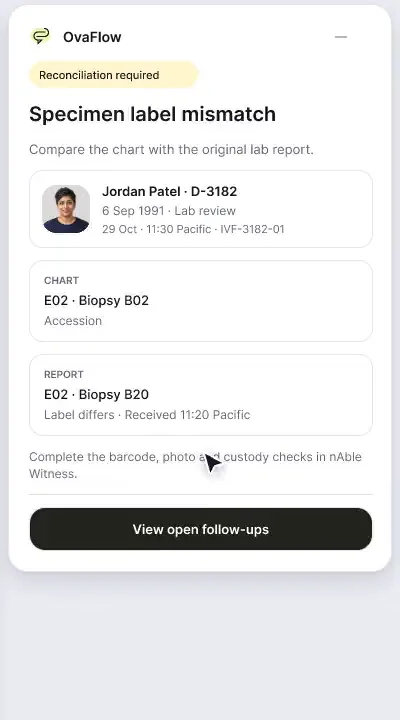
A patient-reported penicillin rash is surfaced against the chart, a monitoring note is confirmed saved rather than assumed, and a specimen label mismatch stops review.
Product preview · Fictional patient data
Walkthrough 21 of 29 · Desktop
A missing family sample, a culture-media recall and an embryo that doesn't survive warming, each traced to the exact embryo, case and decision.
Embryology: PGT-M readiness, a media recall and warming authorization, muted recording of the design prototype. Fictional patient data.
Chapter 1 of 7: PGT-M: the missing family sample
Recorded from an interactive design prototype. Every patient, clinician and clinic is fictional, EMR screens are modeled reconstructions, and nothing shown is a live connection to any clinic or vendor system.
Clinical & operational context
Three lab situations, each traced precisely. A missing family sample holds up PGT-M preparation; a culture-media lot notice opens an investigation with a named reviewer for every affected case; and warming is authorized for one exact embryo. If that embryo doesn't survive, warming another needs a new authorization.
Inside the embryology laboratory, coordination failures carry irreversible consequences: starting stimulation for a monogenic preimplantation genetic testing (PGT-M) cycle before the reference lab has received the family linkage swab and finished probe validation; losing track of biopsy lineage when an embryo undergoes a second trophectoderm biopsy; failing to identify which embryos touched a recalled culture-media lot; or warming an embryo on transfer morning when a day-of clinical deferral was just called from the ultrasound room.
This 7-chapter embryology walkthrough traces those high-consequence laboratory checkpoints: holding PGT-M cycle start when a required family linkage sample is missing, preserving parent-to-biopsy lineage across a re-biopsy event, handling a cohort with zero usable blastocysts with immediate clinician-to-patient call coordination, tracing every dish and embryo exposed to a recalled culture-media lot, verifying the exact single authorized embryo before warming, halting warming when a day-of clinical deferral occurs, and coordinating the immediate backup/clinician protocol if an embryo does not survive warming.
OvaFlow safeguard
Holds start until family linkage sample & probe clear
Embryology lab
Tracks re-biopsy lineage and culture-media lot exposure
OvaFlow safeguard
Verifies exact authorized embryo ID and active consent
Embryology lab
Halts on day-of deferral or escalates non-survival immediately
How OvaFlow connects laboratory readiness, reagent lot recall tracing, and transfer-morning warming gates to the clinical team.
Guardrail: No embryo warming proceeds without matching consent, clinician authorization, and cleared day-of clinical readiness.
What to watch for
Three lab situations, each traced precisely. A missing family sample holds up PGT-M preparation; a culture-media lot notice opens an investigation with a named reviewer for every affected case; and warming is authorized for one exact embryo. If that embryo doesn't survive, warming another needs a new authorization.
Follow the exact timestamps, UI status changes, and coordination safeguards as the recording plays.
What to watch for: Before stimulation begins for a PGT-M case, OvaFlow flags a missing family linkage sample so the cycle is not started prematurely.
Boundary rule: PGT-M probe setup is verified before gonadotropins start, preventing an un-testable biopsy cohort.
On-screen narration: A missing family sample is holding up the PGT-M probe build. The genetics lab confirms assay readiness for the agreed case. Switching reference labs requires a fresh commitment from the new lab. An accepted backup sperm source is confirmed before retrieval day.
What to watch for: When an inconclusive blastocyst undergoes a second biopsy, both biopsy sample IDs stay tied to the same parent embryo record.
Boundary rule: Lineage visibility prevents sample mix-ups across initial and repeat PGT reports.
On-screen narration: Two biopsy records on one embryo keep their own lineage.
What to watch for: If no blastocysts reach biopsy/freeze criteria, an urgent clinician-owned call task opens before any routine portal digest can fire.
Boundary rule: Difficult embryology news is delivered by a clinician first, never by an automated notification.
On-screen narration: No usable blastocysts: the lab result is carried to the clinical plan. Clinical and patient follow-up are aligned with the lab outcome.
What to watch for: Entering a recalled culture-media lot number lists every affected cycle, dish, and stored embryo for laboratory and clinical review.
Boundary rule: Lot exposure tracing links laboratory records to the clinical disclosure workflow.
On-screen narration: A manufacturer notice for a culture-media lot opens an investigation. Three dish-use records need their lot details checked. Bench records are attached to fill in the missing lot entries. A named lab director or clinician reviewer is assigned to every exposed case. The investigation closes with a complete record across every affected case.
What to watch for: On warming morning, the gate checks the exact embryo identifier, single-embryo authorization, and signed episode consent.
Boundary rule: Warming requires exact agreement between the signed transfer order, consent, and cane/goblet location.
On-screen narration: The exact embryo and its warming authorization are confirmed before warming. The completed transfer is reconciled against the lab's own record.
What to watch for: When the clinic calls a day-of medical deferral (for example, fluid in the endometrial cavity), the warming gate locks immediately.
Boundary rule: Real-time clinical deferral signals stop warming before the straw leaves liquid nitrogen.
On-screen narration: The recipient's medical deferral on the day of transfer opens a different path. A refreeze or disposition owner and clinical follow-up are assigned.
What to watch for: If an embryo does not survive warming, the embryologist triggers an immediate clinician handoff before any backup warming occurs.
Boundary rule: Backup embryo warming requires explicit clinician and patient authorization under the signed consent.
On-screen narration: Stepping back to the safeguard for an embryo that doesn't survive warming. Back to the warming authorization. The warmed embryo's non-survival is recorded in the lab's own record. Warming any backup embryo requires a new, explicit authorization.
OvaFlow never makes the clinical call in these recordings. Physicians sign, the person taking a handoff accepts it, and the lab keeps its own holds. The companion tracks, checks and stops; staff decide.
In this walkthrough
Every patient, family member, clinician and clinic in these stories is fictional. Names, times and screens come from prototype walkthroughs, not from real care.
Systems a clinic running this workflow often uses. They do not appear in this recording.
 Electronic witnessing (RI Witness) & PGT genetics
 Electronic witnessing & embryology lab technology
 PGT & reproductive genetics lab
 PGT & embryo genomics lab
Third-party names and logos are trademarks of their respective owners, shown to illustrate systems commonly used in IVF clinics. No affiliation, endorsement or live integration is implied. nAbleIVF, eIVF and Artisan appear as modeled workflow examples.
Where this appears
This recording is part of these pages. Each one explains the step in more depth.
Questions & answers
What clinicians, coordinators, practice leaders, and patients ask when reviewing Walkthrough 21.
Monogenic PGT-M often requires DNA samples from parents or relatives so the reference genetics lab can build and validate the custom test workup. Catching a missing family swab before Day 1 avoids retrieving oocytes before the test is ready.
OvaFlow holds automated portal digests and assigns a high-priority callback to the reproductive endocrinologist so the patient hears from her physician directly.
If the morning ultrasound or nursing check identifies a reason to postpone transfer, flagging the deferral immediately turns the embryology warming gate red before warming begins.
Related
A patient-reported penicillin rash is surfaced against the chart, a monitoring note is confirmed saved rather than assumed, and a specimen label mismatch stops review.
A note isn't done until it's saved, a cycle doesn't start with prior authorization unresolved, dose changes go to eIVF's own e-prescribing, and a PGT label mismatch stops the review.
From duplicate barcodes to cold-chain delivery and the patient's own “received”, every handoff to the clinic's own system has an owner and a confirmation.
Next step
We'll replay this flow against your roles and handoffs, using fictional records. Please don't send patient data.