Elena's episode: one change, four commitments, recovery and freeze-all
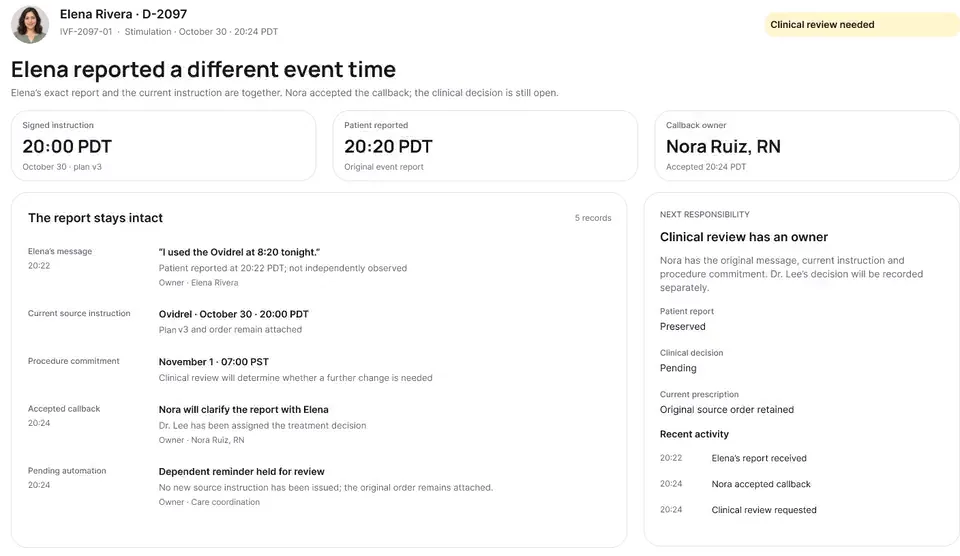
One signed change reaches instructions, the OR, anesthesia and the lab. Later an outside emergency visit for OHSS turns a planned fresh transfer into freeze-all.
Product preview · Fictional patient data
Walkthrough 23 of 29 · Desktop
Every member of the procedure team commits to the slot, a mid-cycle insurance change rebuilds the estimate, consent lands on the right person's chart, and the interpreter is booked for every visit.
Care coordination: procedure team, cost changes, consent and access, muted recording of the design prototype. Fictional patient data.
Chapter 1 of 8: The whole team commits to the slot
Recorded from an interactive design prototype. Every patient, clinician and clinic is fictional, EMR screens are modeled reconstructions, and nothing shown is a live connection to any clinic or vendor system.
Clinical & operational context
Coordination work that sits between clinical care and everything else. A procedure slot counts only when the whole team commits, an insurance change rebuilds the full estimate, and Avery and Sam each keep their own chart and consent. Maya's private requests, interpreter and sensory accommodations, and her chosen pause are each handled with an owner.
Assisted reproduction regularly spans multiple people, third-party agreements, evolving insurance coverage, and individual patient communication or physical accommodations. Common operational breakdowns include booking a retrieval or transfer slot when one required team member (anesthesia, embryologist, or room) has not confirmed; missing that a mid-cycle protocol or insurance change invalidated the patient's prior financial estimate; confusing which lab or consent belongs to which person in a reciprocal IVF or gestational-carrier arrangement; reusing an old cycle's consent for a new attempt; or forcing a patient to repeat her interpreter, sensory, or privacy needs at every room change.
This 8-chapter walkthrough addresses multi-party, financial, and accessibility coordination: requiring every procedure-team role to commit to the slot, escalating an overdue pre-procedure lab in time, flagging mid-cycle insurance or protocol cost drift so financial counseling can update the patient before charges accrue, keeping Avery and Sam on their own distinct charts while coordinating their shared cycle, scoping signed consent strictly to the current attempt, honoring a private contact line for Maya Chen, carrying patient accessibility and interpreter accommodations across every visit, and respecting the patient's pace on every decision.
Procedure team
REI, RN, anesthesia, and embryologist each confirm the slot
Financial counselor
Flags mid-cycle insurance or protocol change affecting estimate
Avery & Sam charts
Verifies each person's clearance on their own chart for this attempt
Accommodation banner
Carries Maya's private line and accessibility preferences forward
Coordinating procedure-team slot commitments, mid-cycle financial changes, separate participant charts (Avery & Sam), and persistent accommodations.
Guardrail: Consents are scoped to the specific attempt only, and mid-cycle insurance or protocol changes trigger a financial re-check.
What to watch for
Coordination work that sits between clinical care and everything else. A procedure slot counts only when the whole team commits, an insurance change rebuilds the full estimate, and Avery and Sam each keep their own chart and consent. Maya's private requests, interpreter and sensory accommodations, and her chosen pause are each handled with an owner.
Follow the exact timestamps, UI status changes, and coordination safeguards as the recording plays.
What to watch for: The procedure slot turns ready only when physician, nurse, anesthesia, embryology bench, and room are all confirmed.
Boundary rule: A tentative calendar hold is never shown as a fully committed procedure team.
On-screen narration: Physician, anesthesia, OR and embryology commitments are checked for the revised slot. Coverage is confirmed across the entire procedure team.
What to watch for: An overdue pre-procedure infectious-disease or anesthesia lab is escalated while there is still time to draw it.
Boundary rule: Missing pre-op labs surface days before retrieval rather than in the pre-op bay.
On-screen narration: An overdue outside lab result is raised before the cutoff. The result arrives, and clinical review owners are confirmed.
What to watch for: When insurance coverage changes mid-cycle or a protocol add-on alters out-of-pocket cost, a financial counseling review opens.
Boundary rule: Cost drift is surfaced to financial counselors early so patients receive updated estimates before procedures.
On-screen narration: A mid-cycle insurance change is detected before the procedure. A complete revised estimate is rebuilt: clinic, pharmacy, lab and storage. Elena's review of the revised estimate is recorded.
What to watch for: In Avery and Sam's two-person cycle, each participant's labs, consents, and roles stay anchored to their own chart.
Boundary rule: Multi-party coordination never blends two individuals' medical records.
On-screen narration: Avery and Sam's roles are shown, each with their own chart. A misfiled consent form is moved to Sam's chart, and the move is recorded.
What to watch for: Signed procedure and warming consents carry an explicit episode/attempt badge and cannot roll over silently to a later cycle.
Boundary rule: Prior-attempt consents never satisfy a new retrieval or transfer attempt automatically.
On-screen narration: Clearance from the first attempt can't be reused for the second attempt's transfer cycle. Clearance is recorded for the second attempt specifically.
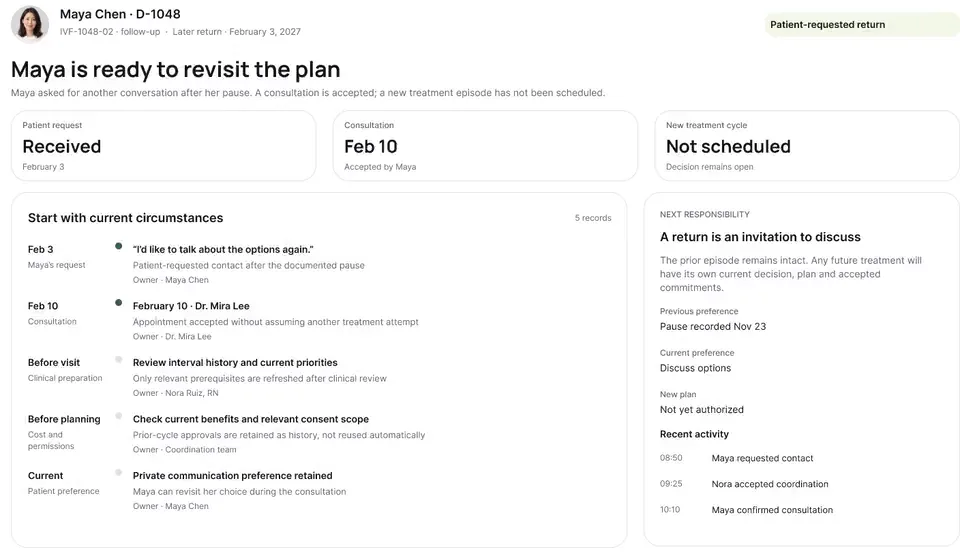
What to watch for: Maya Chen's private callback number and disclosure boundary remain visible on her care card.
Boundary rule: Confidential contact preferences are enforced before staff dial or message.
On-screen narration: Maya Chen's private request for a clinician callback is kept out of a shared thread. Dr. Mira Lee explicitly accepts Maya's private review channel.
What to watch for: Interpreter, sensory, mobility, or trauma-informed exam accommodations follow the patient from intake to ultrasound to procedure.
Boundary rule: Patients never have to re-explain their accommodations at every room doorway.
On-screen narration: Interpreter and sensory accommodations are set up for Maya's visits. The care team accepts Maya's support arrangements.
What to watch for: Pending consent or counseling decisions show no countdown pressure, keeping the decision at the patient's pace.
Boundary rule: Informed consent is tracked for completeness, never rushed by dark-pattern timers.
On-screen narration: A next-step conversation with Maya, without pressure. Maya's chosen pause is recorded, with check-in rules she controls.
OvaFlow never makes the clinical call in these recordings. Physicians sign, the person taking a handoff accepts it, and the lab keeps its own holds. The companion tracks, checks and stops; staff decide.
In this walkthrough
Every patient, family member, clinician and clinic in these stories is fictional. Names, times and screens come from prototype walkthroughs, not from real care.
 Maya ChenPatient
 Elena RiveraPatient
Systems a clinic running this workflow often uses. They do not appear in this recording.
 Outside reference lab
 Outside reference & genetic lab
 Specialty fertility pharmacy
 Fertility benefits manager
 Employer fertility benefits
 Patient education & eConsent
Third-party names and logos are trademarks of their respective owners, shown to illustrate systems commonly used in IVF clinics. No affiliation, endorsement or live integration is implied. nAbleIVF, eIVF and Artisan appear as modeled workflow examples.
Where this appears
This recording is part of these pages. Each one explains the step in more depth.
Questions & answers
What clinicians, coordinators, practice leaders, and patients ask when reviewing Walkthrough 23.
When an employer switches insurance carriers mid-month, a prior authorization expires, or a cycle adds ICSI, PGT, or cryopreservation, the patient's expected out-of-pocket cost can change from her initial estimate. OvaFlow flags that change so the financial counselor can update the patient proactively.
Every consent is tagged to the specific episode and attempt. When a new attempt begins, the readiness gate requires fresh episode-specific consent verification rather than reusing the previous attempt's sign-off.
They appear in the persistent episode header across intake, morning ultrasound, phlebotomy, and procedure rooms so every staff member sees them before entering the room.
Related
One signed change reaches instructions, the OR, anesthesia and the lab. Later an outside emergency visit for OHSS turns a planned fresh transfer into freeze-all.
Provisional dates stay provisional, a positive test isn't the finish line, a loss stops cheerful reminders, and OB graduation counts only when the OB accepts.
Next step
We'll replay this flow against your roles and handoffs, using fictional records. Please don't send patient data.