Product preview · Fictional patient data

OvaFlow

Walkthrough 18 of 29 · Desktop

Two-person intake, sperm source and urgent preservation

Two people's workups run in parallel, the sperm-source prerequisite is flagged early, and an oncology referral gets a retrieval window both teams accept.

Length
0:15
Chapters
4
Shown on
Desktop episode workspace
  • Planned after the pilot
  • Prototype walkthrough · Fictional patient data

Two-person intake, sperm source and urgent preservation, muted recording of the design prototype. Fictional patient data.

Chapter 1 of 4

Chapter 1 of 4: Starting from the reason for care

Recorded from an interactive design prototype. Every patient, clinician and clinic is fictional, EMR screens are modeled reconstructions, and nothing shown is a live connection to any clinic or vendor system.

Clinical & operational context

The situation on screen, why it matters, and where OvaFlow stops.

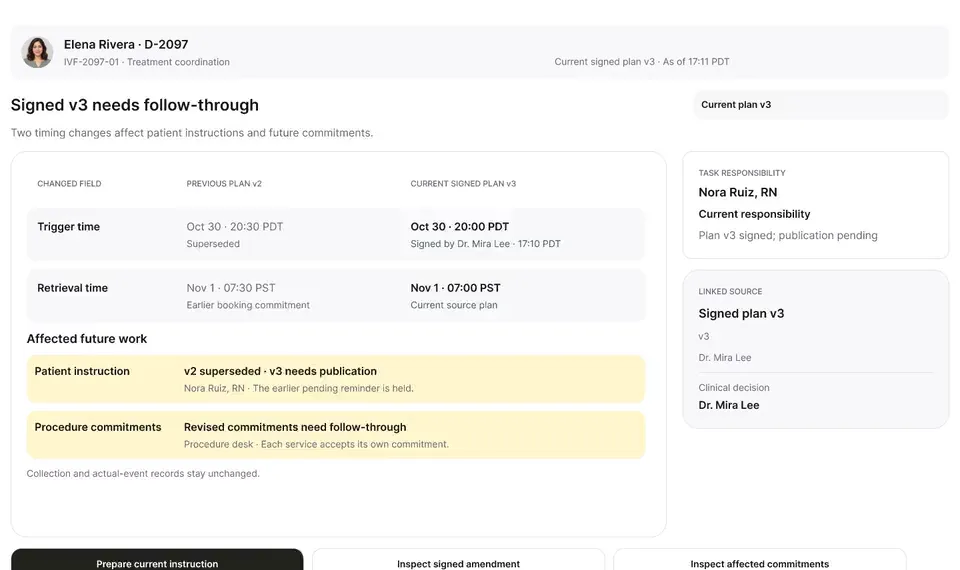
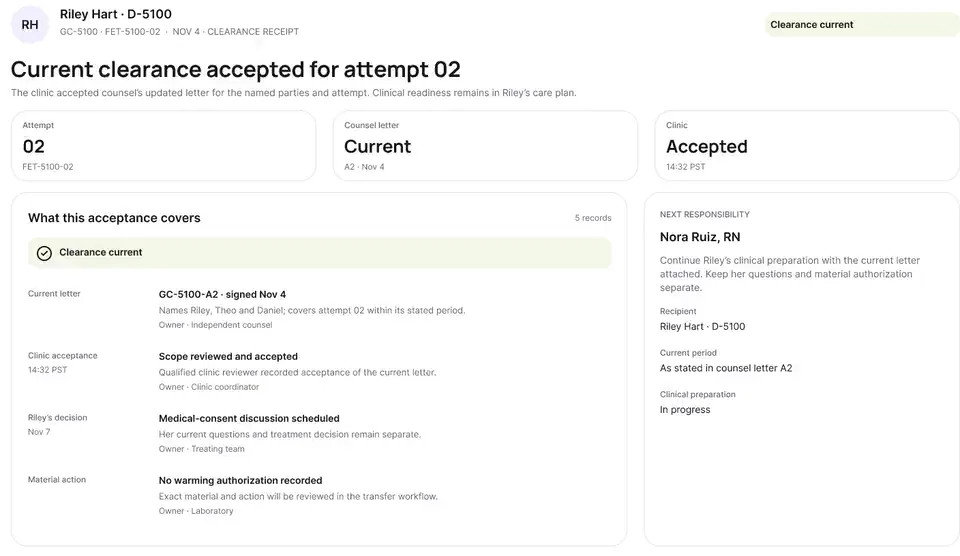
Intake starts from the reason for care. Both people's diagnostic workups move in parallel, and the planned sperm source is flagged as a prerequisite before stimulation. An urgent fertility preservation referral gets a retrieval window before chemotherapy that both the fertility and oncology teams accept.

What clinical situation this depicts

Every fertility journey begins with a clinical reason for care, and different pathways require radically different diagnostic workups and timelines. A couple pursuing reciprocal IVF or routine infertility evaluation can complete baseline ovarian reserve, infectious disease, and uterine cavity studies across several weeks, whereas a newly diagnosed oncology patient referred for fertility preservation before chemotherapy or pelvic radiation has a narrow window measured in days — where any delay between oncology clearance and reproductive endocrinology start can forfeit her chance to bank oocytes or embryos before gonadotoxic treatment begins.

This desktop walkthrough contrasts routine multi-party diagnostic intake with an urgent oncology fertility-preservation referral: starting from the clinical reason for care, tracking two partners' workup checklists side by side so neither person's missing lab holds up the cycle unnoticed, receiving an urgent oncology preservation referral with its chemotherapy start constraint, and locking a coordinated stimulation/retrieval window that both the oncology team and the fertility clinic explicitly accept.

Step-by-step workflow

Reason-for-care intake and urgent oncology fertility preservation window

Step 1Reason for care

Intake coordinator

Sets pathway (routine workup vs. urgent preservation)

Pathway scoped
Step 2Dual workup view

Care team

Tracks both intended parents' diagnostic items side by side

2 charts aligned
Step 3Urgent intake row

Oncology referral

Flags planned oncology treatment start deadline

Urgent window
Step 4Shared window gate

REI + Oncology

Both teams confirm the retrieval target before chemo start

Window accepted

How OvaFlow structures parallel diagnostic workups and coordinates an urgent pre-chemotherapy preservation window across oncology and REI.

Guardrail: Urgent preservation timelines track explicit acceptance from both the referring oncology team and the fertility clinic.

What OvaFlow coordinates in this recording

  • Organizes pre-cycle checklists around the patient's documented reason for care.
  • Displays two-person diagnostic workups side by side while keeping each person's medical record distinct.
  • Tracks urgent oncology fertility-preservation windows with explicit confirmation from both oncology and REI teams.

What stays with clinicians & the clinic's own systems

  • Never selects a stimulation protocol (such as random-start vs. luteal-start) — the REI decides in the EMR.
  • Never merges two partners' medical records into a single chart.
  • Never marks an oncology clearance complete without documented confirmation from the oncology team.

What to watch for

What could go wrong, and what you'll see instead.

Intake starts from the reason for care. Both people's diagnostic workups move in parallel, and the planned sperm source is flagged as a prerequisite before stimulation. An urgent fertility preservation referral gets a retrieval window before chemotherapy that both the fertility and oncology teams accept.

The problems it is designed around

  1. Two-person workups stalling because the sperm-source prerequisite sits in a separate chart.
  2. Urgent preservation referrals delayed before chemotherapy by handoffs nobody owns.

What you'll see in the recording

  1. Intake anchored on the reason for care
  2. Parallel workups and an early sperm-source flag
  3. A preservation window accepted by both teams
Chapter-by-chapter guide

Every chapter in this 0:15 walkthrough (4 chapters)

Follow the exact timestamps, UI status changes, and coordination safeguards as the recording plays.

  1. Chapter 10:00 – 0:02

    Starting from the reason for care

    What to watch for: The episode header anchors every checklist to the patient's specific clinical reason for care.

    Boundary rule: OvaFlow tailors coordination checklists to the pathway selected by the clinician; it never diagnoses infertility.

    On-screen narration: Intake is organized around the patient's reason for care.

Show chapters 2–4 (3 more chapters with timestamps & boundary notes)
  1. Chapter 20:02 – 0:08

    Two workups, side by side

    What to watch for: For two-person episodes, both charts' infectious-disease, genetic, and anatomical workups sit side by side.

    Boundary rule: Each person's results remain in their own chart while readiness is visible together.

    On-screen narration: Both people's diagnostic workups run in parallel. The planned sperm source is flagged as a prerequisite before stimulation starts. Back to the parallel preparation view.

  2. Chapter 30:08 – 0:11

    An urgent preservation referral

    What to watch for: An urgent oncology fertility-preservation referral surfaces the oncologist's target therapy start date.

    Boundary rule: Time-critical preservation referrals are visually separated from routine intake queues.

    On-screen narration: Back at intake, an urgent oncology pathway is opened. The care team prioritizes a time-critical fertility preservation referral.

  3. Chapter 40:11 – 0:15

    A window both teams accept

    What to watch for: The stimulation and retrieval window is marked ready only when both the oncology contact and REI team accept the dates.

    Boundary rule: Neither team assumes the schedule is approved until both sides confirm.

    On-screen narration: A retrieval window before chemotherapy is accepted by both the fertility and oncology teams. The preservation retrieval completes with named post-op and oncology follow-up.

OvaFlow never makes the clinical call in these recordings. Physicians sign, the person taking a handoff accepts it, and the lab keeps its own holds. The companion tracks, checks and stops; staff decide.

In this walkthrough

The people on screen

Every patient, family member, clinician and clinic in these stories is fictional. Names, times and screens come from prototype walkthroughs, not from real care.

  • REI physicianLeads the plan
  • Intake nurse coordinatorRuns intake
  • Oncology liaison nurseCoordinates with oncology
Fictional patient data

Where this appears

Read the page around it.

This recording is part of these pages. Each one explains the step in more depth.

Show all pages where this walkthrough appears

Questions & answers

Common questions about this walkthrough

What clinicians, coordinators, practice leaders, and patients ask when reviewing Walkthrough 18.

How does OvaFlow help prevent delays in oncology fertility preservation referrals?

It puts the patient's planned chemotherapy or radiation start date at the top of the intake row and tracks every required clearance, lab, and schedule slot against that hard deadline until both oncology and REI teams accept the retrieval window.

Why are two partners' workups shown side by side?

In couples and reciprocal IVF cycles, a missing infectious-disease panel or semen/egg-source clearance on the second person's chart is one of the most common causes of a last-minute Day 1 hold.

Show 1 more walkthrough questions
Does OvaFlow recommend which diagnostic tests a patient needs?

No. The reproductive endocrinologist orders the diagnostic workup in the EMR; OvaFlow tracks each ordered item to completion.

Next step

Walk through it with your own team.

We'll replay this flow against your roles and handoffs, using fictional records. Please don't send patient data.