Product preview · Fictional patient data

OvaFlow

Walkthrough 20 of 29 · Desktop

Frozen transfer, early pregnancy, loss and returning after a pause

Provisional dates stay provisional, a positive test isn't the finish line, a loss stops cheerful reminders, and OB graduation counts only when the OB accepts.

Length
0:29
Chapters
8
Shown on
Desktop episode workspace
  • Planned after the pilot
  • Prototype walkthrough · Fictional patient data

Frozen transfer, early pregnancy, loss and returning after a pause, muted recording of the design prototype. Fictional patient data.

Chapter 1 of 8

Chapter 1 of 8: Preparing a frozen embryo transfer

Recorded from an interactive design prototype. Every patient, clinician and clinic is fictional, EMR screens are modeled reconstructions, and nothing shown is a live connection to any clinic or vendor system.

Clinical & operational context

The situation on screen, why it matters, and where OvaFlow stops.

A frozen embryo transfer from preparation to its possible endings. Dates stay provisional until signed, a pregnancy of unknown location keeps an owner, and if a pregnancy is lost, routine prompts stop and a named clinician follows up. When care moves to an obstetric team, it counts only once they accept, and a patient can return from a pause on her own timing.

What clinical situation this depicts

The second half of an IVF journey — frozen embryo transfer (FET), serial beta-hCG testing, early pregnancy ultrasound surveillance, transition ('graduation') to obstetric care, or navigating a biochemical/clinical pregnancy loss and an eventual pause or return — is where communication breakdowns hurt patients most deeply. Clinics routinely struggle with three transitions: a cancelled or deferred transfer where luteal medication reminders keep firing, a pregnancy of unknown location or pregnancy loss where cheerful 'Congratulations on your pregnancy!' automated messages are not halted in time, and an obstetric graduation where the receiving OB office never acknowledges receipt of the transfer summary.

This 8-chapter walkthrough covers the full post-embryology arc: preparing a frozen embryo transfer with endometrial and embryo readiness gates, cleanly handling a deferred transfer, tracking serial beta-hCG rises and early ultrasound follow-up, immediately silencing celebratory nudges and routing compassionate support when a pregnancy is lost, assembling the obstetric graduation packet with a named discharge owner, keeping the fertility clinic responsible until the receiving OB team explicitly accepts, supporting a patient when an attempt does not succeed, and welcoming a paused patient back only on her own timing.

Step-by-step workflow

Post-transfer pathways: beta-hCG surveillance, OB graduation, or compassionate pause

Step 1Transfer prep

OvaFlow safeguard

Aligns lining clearance, embryo authorization, and luteal meds

FET gates checked
Step 2Early pregnancy

Nursing & REI team

Tracks 48-hour serial beta-hCG & ultrasound with named owner

Serial follow-up owned
Step 3OB graduation

Discharge owner

Holds luteal/care ownership until OB confirms transfer packet

OB receipt verified
Step 4Compassionate path

OvaFlow safeguard

Retires pregnancy milestones immediately on loss or pause

Milestones halted

How OvaFlow coordinates frozen transfer readiness, serial beta-hCG follow-up, verified OB graduation handoff, and loss/pause safeguards.

Guardrail: Fertility clinic ownership continues until the OB practice confirms receipt, and any pregnancy loss immediately halts routine milestone nudges.

What OvaFlow coordinates in this recording

  • Tracks serial beta-hCG blood draws and early ultrasounds with a single named nursing owner.
  • Immediately suppresses pregnancy milestone reminders and opens compassionate follow-up when a loss or negative test is recorded.
  • Keeps a named discharge owner responsible for luteal tapers and urgent questions until the receiving OB team confirms receipt.

What stays with clinicians & the clinic's own systems

  • Never interprets beta-hCG doubling curves or diagnoses ectopic pregnancy / miscarriage.
  • Never drops a graduating patient from the fertility clinic's active roster merely because records were faxed.
  • Never sends automated 'Ready to try again?' marketing nudges to a patient after a loss.

What to watch for

What could go wrong, and what you'll see instead.

A frozen embryo transfer from preparation to its possible endings. Dates stay provisional until signed, a pregnancy of unknown location keeps an owner, and if a pregnancy is lost, routine prompts stop and a named clinician follows up. When care moves to an obstetric team, it counts only once they accept, and a patient can return from a pause on her own timing.

The problems it is designed around

  1. Provisional transfer dates treated as signed, or canceled transfers leaving unclear next steps.
  2. A pregnancy of unknown location, or a loss, still triggering congratulatory reminders.
  3. OB referrals assumed complete when sent, before the receiving practice accepts.

What you'll see in the recording

  1. Provisional versus signed transfer dates
  2. Pregnancy of unknown location tracked
  3. Prompts stopped and an owner named after a loss
  4. Referral sent versus OB accepted
  5. A return from a chosen pause
Chapter-by-chapter guide

Every chapter in this 0:29 walkthrough (8 chapters)

Follow the exact timestamps, UI status changes, and coordination safeguards as the recording plays.

  1. Chapter 10:00 – 0:06

    Preparing a frozen embryo transfer

    What to watch for: Frozen embryo transfer readiness checks endometrial clearance, consent, and the specific embryo authorized for warming.

    Boundary rule: Warming and transfer scheduling require signed clinician and embryology gates.

    On-screen narration: A new frozen embryo transfer (FET) preparation episode opens. The transfer date stays provisional until the biological timing is confirmed. The transfer date is locked only against the clinician's signed authorization.

Show chapters 2–8 (7 more chapters with timestamps & boundary notes)
  1. Chapter 20:06 – 0:07

    If the transfer doesn't happen

    What to watch for: If a transfer is deferred before warming, luteal and transfer-day reminders are retired cleanly.

    Boundary rule: Patients never receive 'Arrive with a full bladder tomorrow' texts after a transfer deferral.

    On-screen narration: If there is no transfer, a cancellation plan with owned next steps opens instead.

  2. Chapter 30:07 – 0:11

    A positive test, followed closely

    What to watch for: After a positive beta-hCG, 48-hour repeat bloodwork and viability ultrasound appointments carry a named nurse owner.

    Boundary rule: Serial beta-hCG surveillance never relies on the patient remembering to call back.

    On-screen narration: A positive beta-hCG starts early-pregnancy follow-up. A pregnancy of unknown location is tracked as “Location is not yet established” until a scan.

  3. Chapter 40:11 – 0:17

    If a pregnancy is lost

    What to watch for: If a pregnancy loss occurs, all pregnancy-milestone messages stop immediately and compassionate nursing/counseling follow-up opens.

    Boundary rule: Zero automated pregnancy congratulation or OB-prep messages can fire after a loss is recorded.

    On-screen narration: If a pregnancy is lost, routine pregnancy prompts stop immediately. A named clinician or nurse accepts the follow-up after the loss. The loss follow-up is confirmed as owned.

  4. Chapter 50:17 – 0:22

    Toward OB graduation

    What to watch for: At 8 to 10 weeks, the obstetric graduation summary (embryo dates, luteal support taper, ultrasound findings) is prepared under a named discharge owner.

    Boundary rule: A named fertility nurse remains the discharge owner during the transition window.

    On-screen narration: Back to early-pregnancy follow-up, toward OB graduation. An intrauterine pregnancy and the ongoing luteal support plan are recorded. The OB graduation packet is sent. The fertility clinic stays responsible while it is pending.

  5. Chapter 60:22 – 0:26

    The OB team accepts

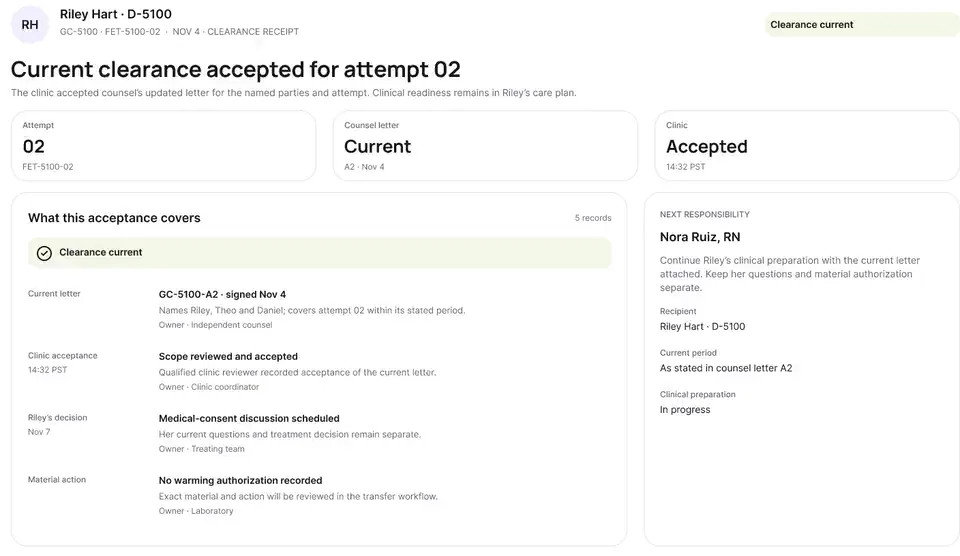
    What to watch for: Graduation completes only when the receiving obstetric practice confirms receipt and the first OB visit is verified.

    Boundary rule: Faxing a graduation packet never ends fertility clinic responsibility on its own.

    On-screen narration: The receiving OB team explicitly accepts the transfer of care. The graduated episode stays linked to the remaining frozen embryos.

  6. Chapter 70:26 – 0:28

    When an attempt doesn't succeed

    What to watch for: When a transfer attempt is negative, follow-up consult and support tasks open without pressuring an immediate next cycle.

    Boundary rule: Clinical review of next steps happens at a human pace.

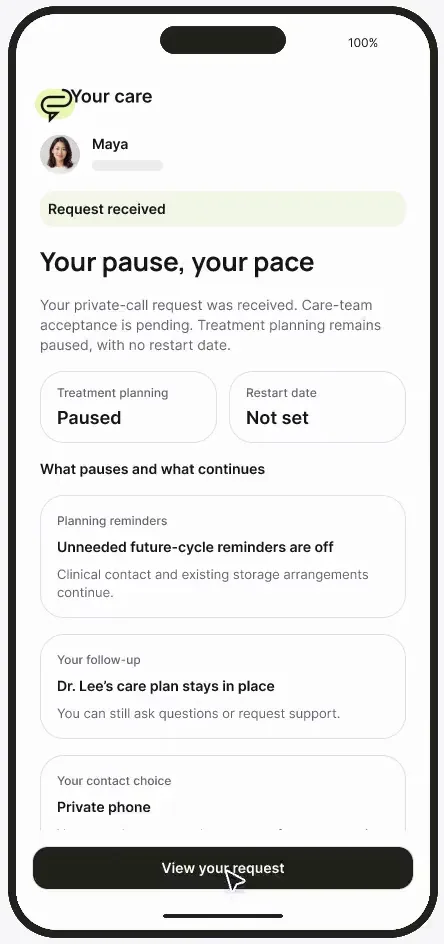
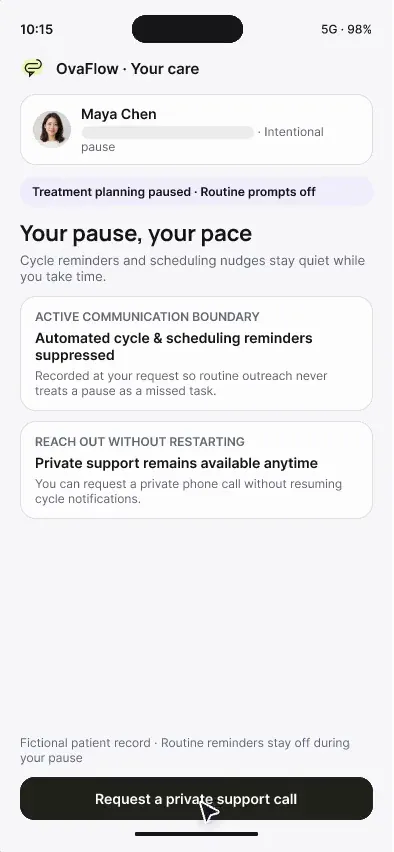
    On-screen narration: An unsuccessful attempt opens a structured debrief and the option to pause.

  7. Chapter 80:28 – 0:29

    Returning, on her timing

    What to watch for: When a paused patient decides to return months later, her prior episode context is ready without re-asking her whole history.

    Boundary rule: Returning from a pause is initiated by the patient and clinician together.

    On-screen narration: Maya returns from her chosen pause, ready to revisit her plan.

OvaFlow never makes the clinical call in these recordings. Physicians sign, the person taking a handoff accepts it, and the lab keeps its own holds. The companion tracks, checks and stops; staff decide.

In this walkthrough

The people on screen

Every patient, family member, clinician and clinic in these stories is fictional. Names, times and screens come from prototype walkthroughs, not from real care.

  • REI physicianSigns the transfer plan
  • Early pregnancy nurseFollows up
  • Receiving OB teamAccepts care
  • Maya ChenPatient
Fictional patient data

Systems often found around this workflow

Show 1 systems around this workflow

Systems a clinic running this workflow often uses. They do not appear in this recording.

  • Hospital, OB & emergency EHR (outside records)

Third-party names and logos are trademarks of their respective owners, shown to illustrate systems commonly used in IVF clinics. No affiliation, endorsement or live integration is implied. nAbleIVF, eIVF and Artisan appear as modeled workflow examples.

Where this appears

Read the page around it.

This recording is part of these pages. Each one explains the step in more depth.

Show all pages where this walkthrough appears

Questions & answers

Common questions about this walkthrough

What clinicians, coordinators, practice leaders, and patients ask when reviewing Walkthrough 20.

Why does OvaFlow keep a 'discharge owner' assigned during OB graduation?

Patients graduating from IVF at 8 to 10 weeks are often still tapering estradiol and progesterone support. Keeping a named fertility nurse as discharge owner until the OB practice confirms receipt prevents a care gap between clinics.

What happens to scheduled portal reminders if a pregnancy loss is documented?

Every upcoming pregnancy milestone, ultrasound prep reminder, and graduation checklist item is immediately retired so the patient is never hurt by an automated message.

Show 1 more walkthrough questions
Does OvaFlow decide when a patient is ready to return after an unsuccessful cycle?

Never. The episode stays in a quiet paused state until the patient and her clinician choose to initiate a new plan.

Next step

Walk through it with your own team.

We'll replay this flow against your roles and handoffs, using fictional records. Please don't send patient data.