Lab & specialty pharmacy: accession hold, amended PGT, cryo signal
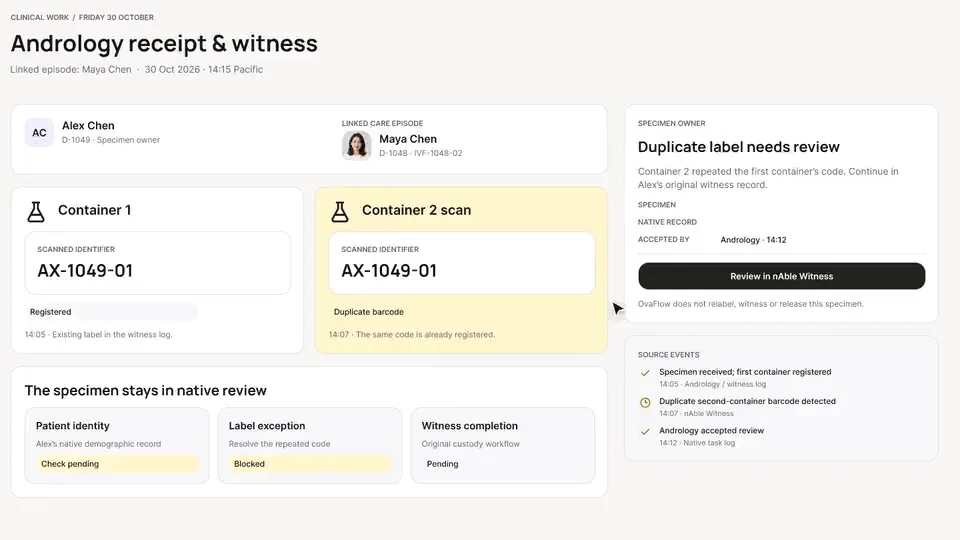
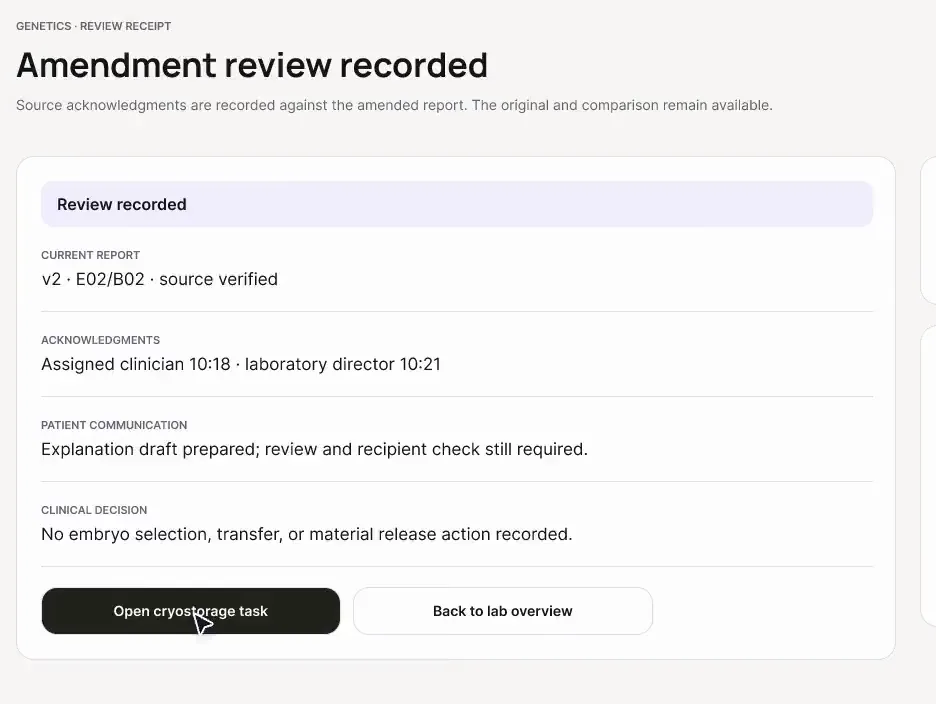
Accession holds, amended PGT reports, cryo tank signals and pharmacy change requests land in one queue, each with a named owner.
Product preview · Fictional patient data
Walkthrough 22 of 29 · Desktop
Shipping clearance isn't clinical clearance, a bounced email isn't abandonment, and a model update waits for the medical director.
Cryo custody, donor updates, outages and model governance, muted recording of the design prototype. Fictional patient data.
Chapter 1 of 9: Shipping isn't clinical clearance
Recorded from an interactive design prototype. Every patient, clinician and clinic is fictional, EMR screens are modeled reconstructions, and nothing shown is a live connection to any clinic or vendor system.
Clinical & operational context
Long-term continuity across storage, facilities and staff. Shipping permission and clinical-use clearance stay separate, a bounced email never counts as abandonment, and conflicting instructions are held. After an outage, paper notes are reconciled; when someone leaves, a named successor accepts their work; and a model update waits for the medical director.
Cryopreserved gametes and embryos can remain in liquid-nitrogen storage across years, clinic power outages, staff departures, donor medical updates, and inter-clinic cryo shipments. During those long intervals, clinics face severe coordination hazards: mistaking a courier delivery receipt for clinical clearance to use donor tissue, discovering that one cane in a four-cane shipment has a label discrepancy, treating a bounced storage-billing email as 'embryo abandonment', acting when divorced or separated intended parents submit conflicting disposition forms, or losing task ownership when a coordinator leaves the practice.
This 9-chapter walkthrough covers long-horizon cryostorage and continuity safeguards: separating physical cryo shipping arrival from clinical/donor eligibility clearance, isolating a single mismatched cane in a multi-cane receipt while holding the discrepancy, preventing a bounced email or returned letter from satisfying abandonment contact rules, locking disposition when intended parents submit conflicting instructions, routing a post-donation donor health update across recipient charts with genetic counseling ownership, tracking tank-to-tank emergency relocation during a cryoroom event, reconciling open work after a network/power outage, reassigning every owned task when a staff member leaves, and anchoring all 29 walkthroughs to one transparent model gate.
Cryo receiving
Logs physical arrival; flags 1 of 4 canes with ID mismatch
OvaFlow safeguard
Blocks action on bounced email or conflicting partner forms
Donor registry link
Routes donor medical update to recipient REI & counselor
OvaFlow companion
Reconciles post-outage state and reassigns departing staff tasks
Separating courier arrival from donor clearance, holding disputed dispositions, and preserving task ownership across outages and staff turnover.
Guardrail: Physical shipment receipt never grants clinical clearance, and any conflicting multi-party instruction freezes disposition immediately.
What to watch for
Long-term continuity across storage, facilities and staff. Shipping permission and clinical-use clearance stay separate, a bounced email never counts as abandonment, and conflicting instructions are held. After an outage, paper notes are reconciled; when someone leaves, a named successor accepts their work; and a model update waits for the medical director.
Follow the exact timestamps, UI status changes, and coordination safeguards as the recording plays.
What to watch for: Receiving a dry shipper into the lab logs physical custody while keeping 'Clinical & donor eligibility clearance' separately blocked.
Boundary rule: Physical arrival in the cryoroom never clears tissue for clinical thawing or transfer.
On-screen narration: Permission to ship cryopreserved material is kept separate from clearance for clinical use. The receiving facility confirms tank space and accepts custody.
What to watch for: When 1 cane out of 4 has an identifier discrepancy, that cane is quarantined with a hard stop.
Boundary rule: Batch shipment approval cannot gloss over a single cane mismatch.
On-screen narration: On arrival, one of four canes doesn't match the manifest. All four items are reconciled, and clinical use stays restricted until the required infectious-disease and eligibility review is complete.
What to watch for: A bounced email or undeliverable notice is flagged as 'Contact failed — not patient refusal or abandonment'.
Boundary rule: Delivery failures never count toward unclaimed-embryo abandonment timelines.
On-screen narration: In long-term storage, one bounced email doesn't mean the embryos are abandoned.
What to watch for: When two intended parents submit conflicting disposition elections, the inventory record locks under 'Conflicting instructions — on hold'.
Boundary rule: No thawing, transfer, or discard can proceed while co-owners disagree.
On-screen narration: Two people submit conflicting instructions, so nothing is carried out. A separate, verified legal resolution and the lab's own record are both required.
What to watch for: A late medical or genetic update reported for a gamete donor fans out to affected recipient episodes with a named counselor/clinician owner.
Boundary rule: Donor health updates are tracked to verified recipient notification.
On-screen narration: A late donor health update reaches linked recipient clinics without exposing unrelated identities. Both receiving clinics acknowledge the update.
What to watch for: During an emergency tank relocation, cane-by-cane movement from the source tank to the backup tank is logged with dual witness attribution.
Boundary rule: Emergency cryo moves preserve exact canister and goblet coordinates.
On-screen narration: A cryo facility emergency opens a relocation matched to available capacity. The receiving labs accept the exact canister capacity. The relocated inventory is reconciled before the emergency is closed.
What to watch for: After a clinic power or network outage, OvaFlow lists every in-flight task and unverified action for structured reconciliation.
Boundary rule: Post-outage recovery never guesses what happened while systems were down.
On-screen narration: Paper records from a clinic system outage are reconciled. The live queue is aligned with the care actually given during downtime.
What to watch for: When a nurse or coordinator departs the clinic, an administrator reassigns all of their open tasks and handoffs before deactivating the profile.
Boundary rule: No open patient follow-up can remain assigned to a deactivated staff account.
On-screen narration: A departing nurse or clinician's open tasks are reassigned. A named successor explicitly accepts every open episode.
What to watch for: The final chapter summarizes how every modeled safeguard links back to explicit clinical and operational rules.
Boundary rule: Every status pill on screen maps to a defined coordination rule.
On-screen narration: Two official clinic protocol documents disagree. A single authoritative reference revision is approved. A model update is held for local clinical governance review. The model release is limited to approved operational scope, not clinical decision support.
OvaFlow never makes the clinical call in these recordings. Physicians sign, the person taking a handoff accepts it, and the lab keeps its own holds. The companion tracks, checks and stops; staff decide.
In this walkthrough
Every patient, family member, clinician and clinic in these stories is fictional. Names, times and screens come from prototype walkthroughs, not from real care.
Systems a clinic running this workflow often uses. They do not appear in this recording.
 Automated cryostorage & monitoring
Third-party names and logos are trademarks of their respective owners, shown to illustrate systems commonly used in IVF clinics. No affiliation, endorsement or live integration is implied. nAbleIVF, eIVF and Artisan appear as modeled workflow examples.
Where this appears
This recording is part of these pages. Each one explains the step in more depth.
Questions & answers
What clinicians, coordinators, practice leaders, and patients ask when reviewing Walkthrough 22.
Because a cryo tank can physically arrive by courier before infectious-disease screening, donor eligibility documentation (21 CFR Part 1271 Subpart C), or quarantine release has been verified by the laboratory and physician.
OvaFlow places an immediate hold on the cryo inventory record ('Conflicting instructions — on hold') so no warming, shipment, or disposition task can advance until legal and clinical resolution is documented.
Deactivating a staff profile requires reassigning every open task, expected lab result, and pending callback to active team members first.
Related
Accession holds, amended PGT reports, cryo tank signals and pharmacy change requests land in one queue, each with a named owner.
From duplicate barcodes to cold-chain delivery and the patient's own “received”, every handoff to the clinic's own system has an owner and a confirmation.
Next step
We'll replay this flow against your roles and handoffs, using fictional records. Please don't send patient data.